
A to Z Album Reviews
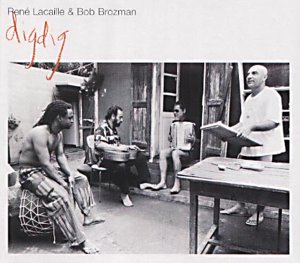
The frighteningly prolific Mr. Brozman, genre-defying guitarist and veteran of countless collaborations with artists as diverse as Mike Auldridge, Ledward Kaapana, David Grisman and Djeli Moussa Diawara (to name but four), here teams up with Réunion Island master accordionist René for a surprisingly varied menu of pieces. Whatever culture Bob decides to explore, you just know the results will be enterprising and enchanting, and this disc proves no exception, but I still think it's one of my favourites after four months of listening. The infectious rhythms of the indigenous Réunion grooves are intriguing - they owe as much to African as to French (predominantly Creole) influences, and swing with a joyfully laid-back spontaneity that you might think deceptive. The island's location, along the trade routes between Asia and Africa, allowed for the development of a rich mix of cultures, which may explain the more than occasional Arab inflections in the music. Bob's slide guitar - that distinctive, typically vibrant blend of Hawaiian and Mississippi Delta - weaves in and out of the shuffling rhythmic textures most delightfully, while René himself brings his spicy, unpretentiously expert accordion and cool, deep and somehow insouciant vocals to the mix, also occasionally picking up the (Bolivian) charango to strum. Some additional percussionists are drafted in on a handful of tracks, enhancing the already enticing crosscurrents of rhythmic possibilities. Reflecting the volcanic nature of the island itself but in a benign way, the music of Digdig erupts with a fiery vigour that's most stimulating.
David Kidman
Jon is one of those contemporary singer-songwriters with a very definite, bold, confident presence - that much is clear from the outset on this, his debut CD. He evidently also has some important friends: musical heroes who've been readily persuaded to contribute to the album sessions. All of which leads to a certain quandary on my part, both as a listener and as a reviewer - for the above attributes should really have led me to react more positively to Jon's work than I actually did, at any rate at first... which is strange, since his music is very much wide-awake, both immediate and easily digestible, and his melodies intelligently crafted. Perhaps the problem lies with Jon's lyrics? Jon concerns himself with life and relationships generally (much in the manner of the contemporary pop lyricist), and yet often seems to lack the deeper sensibility that is born of wider experience and further insights, that deeper sensibility which we tend to have come to expect from a singer-songwriter outside the pop mainstream; they don't appear particularly striking, either in terms of having anything profound to say or in terms of poetic expression. Having said all that, the album still sounds good: bright, forward and full of presence, with Jon's voice placed well in the foreground throughout. His vocal delivery is assured and slightly flamboyant, often reminding me much of Rufus Wainwright and almost equally often of Robert Plant - though without any sense of showing-off or torchy histrionics. Aside from Jon's own prominent guitar (and sometimes piano or mandolin), we hear quite a lot of Adam Brown's piano (and occasional Hammond organ), but the principal interest for folk enthusiasts will be the superbly contoured and highly musical contributions from Kathryn Tickell (Northumbrian pipes) and Tom McConville (fiddle), on three tracks apiece, and Chris Sherburn (concertina) on one other: not lending the songs an especially folky atmosphere, granted, but very pleasing and satisfying nevertheless. The character of these individual musical contributions - indeed, of all the participants involved - has been expertly brought out by engineer Ron Angus. However, there are times when I feel that, even allowing for the impact of Jon's commanding vocal delivery, I find it hard to concentrate on the lyrics due to the genially sumptuous backdrop that's been conjured out of relatively minimal resources. I'm also inclined to think that provision of a lyric sheet would have aided my appreciation of Jon's songwriting craft. But interestingly, I'm finding more to appreciate in Jon's work on each successive hearing - sometimes it's difficult to entirely trust one's own reactions!
David Kidman November 2008
His debut solo album opens with Awakening (intro), which starts like a leviathan rising from his sleep. Laddie builds layer upon layer before unleashing a pulsating, rocking instrumental. He is technically superb as he slashes his guitar. The smouldering Here's A Drink is bluesy but shows that vocally, he is still a bit raw. However, he has all the attributes and stands up to the current best in the genre. Get You Back is a hi-paced blues from an exciting new kid on the block but he slows it down again for I Need Your Love. Float On By has a staccato delivery but shows that he is a real talent. He keeps the solos on this to a good length, something he doesn't always do. Punchy drums and piercing bass from Lee 'Cliffy' Clifford and Rhian Wilkinson respectively. Papa's Got A Brand New Bag is not as frenetic as the James Brown original but he does make it his own – not an easy thing to do with a song like this.
The eponymous title track has funky beats as he puts his soul into it with his wailing guitar a stand out. There is a barrage of notes at times and he may have to take up the new Joe Bonamassa philosophy that sometimes less is more. Miss Supernatural has pounding drums and sustained guitar opening this full on rocker with fuzzed vocal. Two Years is an upbeat swinging blues with stinging guitar whereas Mr Johnson is a complex instrumental that shows his fretboard skills. The latter is perhaps a tad long at 6 minutes but that's only a small criticism. All I Have has a pleading vocal -- a bit mainstream but in the upper echelons. Rock Me Baby is the old BB King song and this live version with Walter Trout is turned into a slow, driving blues with guitars a plenty (10 minutes of them). It's good to hear what he's like live as I intend to seek out his next visit north of the border immediately.
David Blue April 2010
I was captivated big-time by this relatively newly constituted female trio (Hazel Askew, Hannah James and Rowan Rheingans) when I reviewed their exceptional debut CD, Weave And Spin, for these pages almost exactly two years ago. These young ladies have so much going for them - not just in respect of their brilliant vocal expertise (and spine-tingling combination of timbres, individual voices and intuitive harmonies), but also in their unerringly prescient sense of exactly when to accompany, with deliberately spare instrumentation and with exactly the right colours, and in their highly original, and invariably strikingly imaginative, approach to the reinterpretation of sometimes overtly familiar source material.
Mayday is a typically enterprisingly titled collection, in that it draws thematically on three specific meanings of the word: a distress signal, a celebration of springtime and International Workers' Day. Its songs thus chronicle a diversity of human struggles: struggles which may either lament personal tragedies to expose a wider social injustice, or else revel in the triumph of the human spirit - or, quite often (as in the feisty Katy Cruel) combine both aspects in celebrating the power of gender or class, while even the portrayal of the progress of nature itself within folk culture doesn't come without its warnings.
From Rowan's lilting banjo intro I was almost expecting The False Young Man to become October Song, but then in come some luscious vocal harmonies that set the neck hairs prickling, while Hazel's concertina and Hannah's accordion provide so much more than telling counterpoint to the expression of the text. In fact, the vocal harmonies here and on several other places during the course of the album strongly hint of Lady Maisery having taken direct inspiration from The Roches (and then, what do I see but a direct namecheck for that very combo within the digipack's liner notes, albeit in the alternate context of the source for one particular song on the album).
For an ensemble with such pronounced individual and collective vocal talents, it's almost indecent that they're all such capable instrumentalists too, but so it proves in the characterful and unusual settings they employ as backdrops - just listen to the spellbinding harp-and-fiddle arrangement on The Great Selkie, for instance, or the chilling scythe-swinging rhythms and drones which accompany The Crow On The Cradle. And the plaintive fiddle and insistent harp-bass that propel Kate Bush's This Woman's Work, itself an especially inspired choice for the album. Just occasionally, I felt that some of the innovative non-vocal effects (such as The Factory Girl's invocation of the rhythm of machinery via the clatter of foot-percussion and the whine of fiddle), may in time come to prove a touch distracting on repeated hearing, but such gambits certainly make an impact and show the trio to be formidably creative interpreters of their carefully chosen material.
But it's undeniably the Lady Maisery voices that will first and foremost catch the ear. The trio's a cappella unison rendition of the Child ballad from which they take their own name is stark and unemotional and packs its own emotional punch nevertheless, involving the listener completely over its 6½-minute span. At the other temporal extreme, their considered harmony arrangement of Let No Man Steal Your Thyme is every bit as masterly in its very economy of expression, while their intricate weaving of parts on Leon Rosselson's tricky Palaces Of Gold sees them rise to the song's considerable interpretive and technical challenges with distinction. The disc's ten songs are supplemented by a spirited return to the art of diddling (the singing of tunes) which so enchanted listeners on Weave And Spin, and here is brought to bear on the apposite pairing of the morris tune Constant Billy with Andy Letcher's pipe tune The Lie Of The Land.
This is a stunning-sounding (and stunningly mature) album, make no mistake, and a 100% cert contender for the year's top-ten listings.
David Kidman July 2013
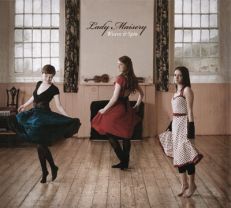
Lady Maisery is a tremendously captivating new female vocal trio that binds together the multifarious talents of Hannah James (ex-Kerfuffle and latterly of James & Sweeney and the Demon Barbers), Hazel Askew (of The Askew Sisters) and Rowan Rhenigans (of Fidola).
Creative and adventurous vocal harmonies are the watchword, and the three voices work (and weave) extraordinarily well together, with a sense of musical intelligence - and intense involvement and enjoyment - that's communicated right to the listener (no dry academic note-spinning here). Amongst other things, Lady Maisery's inspirational debut CD reveals the group as one of the first UK ensembles to celebrate the revival of the tradition of diddling or singing tunes, a practice which has nearly died out in England but is still prevalent in Scandinavia and other parts of Europe; this comes to the fore in their precisely enunciated and rhythmically spirited renditions of such pairings as an Estonian waltz and a Swedish polska (track 2), or a slower Finnish polska and a Playford hornpipe. great fun for both participants and listener.
Elsewhere, we're treated to equally precise and beautifully harmonised treatments of a lively cross-section of folk and roots repertoire that ranges vitally from I Know My Love to Derroll Adams' plaintive Portland Town (the latter sporting a gorgeous fiddle accompaniment from Rowan), via an epic, driven rendition of the Scottish version of the ballad Willie's Lady. The latter prove that these young ladies are not just spellbinding singers, but also expert musicians. For the album's not an exclusively vocal extravaganza, and the spare instrumental arrangements adopted on a good number of the tracks prove both genuinely haunting and exceedingly apt - for instance, Nottamun Town features the exotically eerie sound of the bansitar (played by Rowan), and the group's enchanting take on The Colour Of Amber features Hazel on harp, while Hannah's adaptation of The Gardener is wonderfully mysterious with its atmospheric backdrop. Hannah even gets a spot of clogging in on the utterly delightful, entirely smile-inducing pair of sprightly diddled polkas that comprises the disc's penultimate track. Following which, Lady Maisery's portmanteau version of the hymn Sleep On Beloved is the most ideal closer you could imagine.
It's entirely understandable, then, that in the end the group's attempt to maintain a broad emotional and stylistic range backfires ever so slightly, for not quite everything works - the exception being Mary Ann, on which Lady Maisery bestow a rather too smoothly contoured (arguably even over-selfconscious) barbershop/glee-style treatment that (although beautifully coordinated) loses the earthy charm and gawky passion of the original music-hall number. I've only one other reservation about this release - and that's a purely technical one: on some tracks the close-miking technique used for the recording has produced a degree of over-sibilance that's not entirely comfortable.
But there's no escaping the mesmerising brilliance of this album - it's a sparkling and intriguing debut by any standards, and something impressively different. And yes, a certain contender for this year's best-of list.
David Kidman July 2011
South Africa's most famous vocal group have over the course of half a century become legends of the international stage, captivating audiences worldwide with their vibrant acappella drawn from the indigenous isicathamiya singing tradition, symbolising both freedom and celebration. An important part of their mission is to pass this tradition on to young South Africans, and their proud new recording (their most personal to date) looks to the worlds of innocence and joy that represent their childhoods and homeland.
Here on the first instalment of a projected trilogy of albums the nine-piece group is recording about their lives in South Africa, LBM present songs drawn from the earliest time in their lives, born and raised on the Zulu farms outside of Ladysmith. These are the stories their fathers and other relatives sang and shared, retold for our time: in some cases embellished or ornamented or harmonised but intrinsically taking them straight back to their roots. These songs follow the progress of life on the farm, in all its moods; incorporating pieces portraying wildlife (The Prettiest Bird, Catch The Bird), rejoicing in the qualities of livestock (Praise The Cows And Bulls) or entreating the gods to chase away snakes to ensure safe swimming passage (Ntulube), to items concerning man's interaction with the elements (on one hand Clouds, Move Away and on the other hand a praise song to thunder) and several important message songs (eg Ekhaya, which exhorts teenagers not to leave the bosom of their families too soon). There are also narrative songs, like Wemfana (Bad Donkey) and Wemfazi (the story of two groups of people on different sides of the river).
And in addition to arranging the traditional material and directing the choir, LBM's founder and leader Joseph Shabalala has composed one of the disc's very finest tracks, the tender Thalaza (I Miss My Home, I Miss The Farm), which I couldn't stop playing. While I bet you didn't know that Old Macdonald Had A Farm was a South African favourite – the disc's finale is a genially showstopping Ladysmith makeover of that farmyard cornucopia, full of fun and thankfully not quite falling overboard on the animal impressions (a fate which does, however, mildly spoil The Biting Chicken, the CD's opening track). But even in the less overtly onomatopoeic numbers, the LBM delivery is miraculous to behold, with the distinctive features of the isicathamiya style - like those special percussive clicking elements - present in full splendour, and all excellently recorded. It doesn't need me to say that LBM make a glorious sound, the rich, dark tones of the men's individual and combined voices are a real joy and Songs From A Zulu Farm is a true feelgood listen: a magical celebration indeed, wonderfully exhilarating, and I do hope the remaining two parts of the group's planned trilogy aren't too long in coming our way.
David Kidman February 2011
Although one goes by the title Sunny Side Of The Street, unlike many revivalists he writes all his own tunes though such is his understanding and love of the era that you'd be hard pressed to identify the likes of Head To Toe, Mississippi Blues, banjo showcase Weedwacker Rag, or lazy blues swing Keep Your Hands Off My Gal from vintage specimens if you didn't have the song credits to go by.
A man who likes his traditions, Jack White was so taken with them he produced their Pack It Up single (not on the album, I'm afraid) and while they're never likely to enjoy the sort of breakout success Seasick Steve found by playing to the past, they'll certainly delight devotees of the music they recreate and inspire younger ears to dig back into the same roots to.
Mike Davies May 2011
Pokey LaFarge hails from Kentucky; he spent his younger years out on the open road, where he became steeped in the music of the heroes and misfits of yesteryear – "the long-lost troubadours of country, the kings of swamp-drenched ragtime and the legendary bluesmen of the Cotton Kingdom". His own music, inevitably, is a fresh and quirky kind of hybrid of delta and Appalachia that oozes the idiosyncrasies of Gus Cannon, Dan Hicks, Michael Hurley and the Memphis Jug Band, with occasional excursions into the worlds of Mississippi John Hurt or Loudon Wainwright.
The majority of Pokey's material is self-penned, the above reference points providing the key inspiration and his own dynamic personality providing the sly humour and cheeky mannerisms. Pokey's a kind of one-man-band figure: his dapper frame is belied by a powerful, roaring voice, and this is invariably backed by a scrappy-sounding, distinctly frantic guitar or guitjo line and punctuated with industrial-strength kazoo and harmonica. But Riverboat Soul, his second CD, finds him in the company of his South City Three (Joey Glynn on upright bass, Ryan Koenig on harmonica, washboard and percussion and Adam Hoskins on guitar and slide) with a couple of special guests here and there - Ketch Secor (of Old Crow Medicine Show)'s fiddle work is outstanding.
The most infectious tracks are those where the craziness erupts from Pokey's very frame and cascades around and across the studio: the breakneck ragtime of Claude Jones and Migraines And Heartpains, the carefree call-and-response hoedown of Two-Faced Tom, the high-speed Charleston of You Don't Want Me, and most of all the seriously over-the-top barking-madness of Old Black Dog. But the raw thrust of Won't Make Love At All and the tender pathos of Bag Of Bones are both similarly irresistible in their own way.
Pokey's already made a sizeable impression on audiences at the Edinburgh Festival Fringe and Glasgow's Celtic Connections and impressed Bob Harris - so let's see what CD exposure brings, for unlike some acts purveying this kind of manic good-time music, Pokey's special brand of raggy mayhem actually comes over pretty well on disc.
David Kidman April 2010
After a two-year hiatus, Jimmy LaFave is back and in great form with Cimarron Manifesto.
There are moments when LaFave cuts out the middle man and speaks directly to the heart of the listener. His interpretation of Donovan's Catch The Wind is a moment of absolute beauty, an always elusive song is further intensified by LaFavre's sense of desolation. It's as if LaFave, confronted by a personal wasteland, is giving voice to the hopelessness that lies within his soul.
On Cimarron Manifesto Jimmy LaFave has stripped the flesh from the likes of Lucky Man, all that is left is the core of the song, with LaFave's voice cutting through like a surgeon's scalpel.
Although Jimmy LaFave is a supremely gifted country rock musician, That's The Way It Goes would fill the floor of even the harshest Texas barroom, it is left in the shade by the stark simplicity of Not Dark Yet. When challenged to bare his emotions, however raw, LaFave blossoms, Not Dark Yet is one of those all too rare moments when a song stops you in its tracks.
But LaFave is equally adept at loosening the emotional strings, Walk A Mile In My Shoes is an easy flowing piece of country magic.
With Cimarron Manifesto, Jimmy LaFave has produced an album that, no matter what it is you're looking for in music, you'll find it. He'll break your heart one minute only to lift your spirits the next. It's easy to lose yourself in Cimarron Manifesto, it's a damn sight harder to tear yourself away.
Michael Mee July 2007
David Kidman
Robin's always been keen on whisky (and the fact that he chairs the tasting panel of the prestigious Scottish Malt Whisky Society is surely fortuitous!)… So far he's recorded two themed albums (1997's The Angel's Share and 2004's The Water Of Life), halfway between which he published a book of songs and poems on the subject (The Whisky Muse), which is soon to be followed by a second book (The Whisky River) dealing exclusively with the distilleries of Speyside. One For The Road is album number 3 in Robin's musical "whisky trilogy", then, and its 14 songs place whisky firmly in the context of present-day society while respecting and acknowledging its place in tradition. This new batch of songs tends to clothe Robin's trademark soft-toned, smoothly expressive vocal in settings that seem to embody a more transatlantic feel than hitherto perhaps, many complementing Robin's indigenous Scottish identity with distinct stylistic nods in the direction of country, whether it be rockin' (Bottle Of Gin), Kentucky (Heaven Hill), Americana (Elijah Craig) or mainstream (Everything I Love). And moreover, the transatlantic feel also noticeably extends to the album's approach to instrumentation, which is often quite full-sounding (sax, electric and pedal steel guitars, piano, rhythm section). Just over half of the songs are Robin's own compositions, and these either take the form of bittersweet reflections or else delicious humorous ditties replete with typically puckish wordplay. Among Robin's own songs, I specially enjoyed the historical tale of Uisquebaugh Baul, the tasty Speyside Whisky Song and the reflective Reaching Home (though I felt the latter would have sounded even better backed by guitar rather than keyboard). Standouts among the covers are Robin's particularly sensitive treatments of Karine Polwart's moving The Sun's Coming Over The Hill and Amy Allison's The Whisky Makes You Sweeter (complete with some gorgeous backing vocals), while his choice of Simon Haworth's Rory's Still is a canny one indeed (like me, Robin had first encountered the song through the lovely singing of Rachel Crackett at Mickleby Folk Club), and Tegwen Roberts' mellow yet perceptive Full Moon Whisky forms a fine closer to the album. All song lyrics are available on Robin's website, by the way. Happily, Robin's source of fine whisky-derived songs shows no sign of running dry – and dare I venture to suggest there's "still" (sic) plenty of material out there?!
David Kidman July 2007
Recent winner of the Big Easy Award for Best Female Performer, she's also apparently been a professional mud-wrestler and travelling circus glass-eater, but she's found her true destiny recreating the bluesy-jazz of pre WWII America and earlier.
Working with musicians whose instrumentation includes sousaphone, trombone, cornet and banjo, she clearly knows her musical roots, kicking off the album in lazybones mood with Joe Young and Ira Siras 1930 tune I'm Alone Because I Love You before moving on to Duke Ellington's I Ain't Got Nuthin' But The Blues,, the vaudeville swaying The Curse of An Aching Heart from way back in 1911 (all it needs is a few crackles to sound like a 78), and Jelly Roll Morton's Sweet Substitute before closing up with a good time romp through the traditional Joseph! Joseph! featuring Neti Vaan on gypsy violin.
Lake's been likened to Bessie Smith, so it's no surprise find her tackling a pair of the blues legend's own nuggets, the Smith-penned Backwater Blues and Wesley 'Sox' Wilson's 1933 tune Gimme A Pigfoot with the wonderfully named Winfield 'Tuba Skinny' Newton Burdick IV strumming the banjo.
Not just an interpreter, Lake contributes two of her songs to the collection, the puttering hand percussion snake-charmer rhythmed Slowburn and the frisky jelly roll Do For Myself which, pinned by washboard, serves mostly to showcase the swinging brass section. It goes without saying they fit seamlessly alongside numbers 70 years older.
The sleeve notes describe the disc as 'one of the few that capture the essence of the (sic) today's music scene in New Orleans.' If you can't travel there to confirm it for yourself, I'd just buy a Speakeasy and put this on the jukebox as the next best thing.
Mike Davies May 2011
If ever an album emphatically should not languish unheard even by many of his fans, in the wilfully deliberate obscurity of a limited-edition release.! The initial "escape" of Tales From The Barrel House, Seth's sixth solo record, was to my mind one of the most brainless marketing gambits imaginable; being released exclusively via his website, causing it to crash immediately, was only the start of the frustrating experience that genuine fans had to endure in trying to access the music - let alone us humble writers who were eager to give Seth's new creation the coverage it clearly deserved. But now, at long, long last, and (allegedly) "to meet demand" (self-evidently artificially stimulated, I cynically wonder) from the legions of fans who missed out on the original release that had sold out way before Christmas, the album has been granted a fully-fledged national release, preceded by a short UK tour which may well be mostly over by the time you get to read this (simply because nobody had bothered to inform me of the impending release).
But believe me, I wouldn't even bother to recount all the above unfortunate discographical history if the product itself were not so outstanding; it's almost certainly the finest to come from Seth thus far. Imagine what might have happened if Seth's performing style had developed not pell-mell along the path of overly frenetic youthful thrash that had since and hitherto (albeit unjustly) labelled him as something of an attention-seeking enfant-terrible, but instead along the more individual path that he had been beginning to define by his landmark 2004 solo record Kitty Jay. That album was recorded on a virtual shoestring, in his brother's kitchen, and oozed the genuine spirit of resolute, gritty and confident independence, with Seth's own gripping folk tales reflected in the revealingly primitive settings.
In many ways, Tales From The Barrel House could be regarded as Kitty Jay's natural, and naturally mature, successor: the deeply empathic folk-legend strand of his writing has never sounded more convincing, while the scoring is raw and pared-down and the production is starkly atmospheric (one track was recorded down a disused copper mine, the remainder in the Morwellham Quay barrelhouse that gives the album its title) and is given a special kind of unity by Seth playing all the instruments (fiddle, banjo, viola, mandolin, tenor guitar and an array of unusual percussion implements) and producing the album himself.
Half of the album's songs were penned by Seth with a modicum of help from Dan Goddard (aka DBG), and a further two by Seth alone; the remaining three come from traditional sources arranged by Seth. But it's a strong and wholly consistent set: each individual song is stunningly evocative, with a keen sense of history and a powerful aura of place. Standout songs such as Blacksmith's Prayer, The Watchmaker's Rhyme and The Artisan take the form of telling portrayals of local characters, the craftspeople who once populated the region; and Seth's rough-hewn vocal work is both distinctive and charismatic without overdoing the expressive demands of the material. Echoes of industrial rhythms permeate Hard Road and the chain-gang of Higher Walls, while the lyrics of More Than Money (concerning the breakers, who were piece-work granite miners) are clearly heavily inspired by the folk standard A Miner's Life (Keep your hand upon the hammer, And your eye upon the scale). Salt In Our Veins is a lusty yet realistic trawlerman's reflection, while in contrast The Sender is one of those tender lovers' ballads that Seth conjures so well, its emotional import kept in check and balance by a sensitive reading.
Yes, there have been moments in the past when I've lost a little patience with Seth's delivery, becoming mildly weary of his insistence on loud driving relentlessness, but the abundantly well-considered Tales From The Barrel House redeems everything at a stroke and represents a proud artistic statement that continually satisfies on repeated play.
David Kidman March 2012
With his fifth album, Seth brings his already assertive upfront brand of music ever closer to anthemic festival-cum-stadium-folk, while still managing (just) to observe and respect both his storytelling gift and his roots. But there are times when it's a close-run thing, especially in the earlier stages of the record, where the musical gestures can at times seem slightly hollow; here there's also more than a suspicion at times that the lyrics of this new batch of songs are themselves a touch over-simplistic.
It could be that Seth's trying too hard to branch out from the sphere of regional (some might term it overly parochial) folk-legend into a more contemporary arena by tackling the more obviously universal themes as well as ones dealing directly with his own personal development over the past couple of years. Only two of the disc's twelve songs are cast in the approved Seth Lakeman manner of tales of local west-country characters: Signed And Sealed is the story of a cruel 17th century magistrate who made a pact with the devil, while Preacher's Ghost tells of a Cornish miner who reformed, gave up drink and became a Methodist preacher. These songs are among the disc highlights, and like much of the rest of the new album they benefit from some sensitive signature instrumental work from Benji Kirkpatrick on banjo.
But back to the title-track opener, on which Seth seems deliberately to be "doing a Show Of Hands" in a straight-talking all-out attack on financial mismanagement and politicians etc: even though it's undoubtedly a genuinely felt response on Seth's part, the nagging impression is that we feel we've heard it all before, and the heavy-duty, typically relentless musical setting that is part and parcel of the track emerges a touch unsubtle (albeit light-textured enough to be radio-friendly), even in the skilled hands of Seth and his new producer Tchad Blake (though give it all just a touch more bombast and a thicker drum sound, and it could be Zepp reborn, you might say!).
On first firing this disc up in the player, you could be forgiven for thinking that little has changed in Seth's particular musical universe, and the many moments of in-yer-face-and-feet thrust certainly point unwaveringly in that direction. The catchy rhythm-dominated The Watchman carries on where Poor Man's Heaven left off, and even the gentler affirmation of Tiny World feels a touch constricted in its busy bustling arrangement; even so, the riff-dominated See Them Dance and Hard Working Man are both irresistible in their own way I guess.
But as the disc progresses, Seth eases the tempos down and brings in more light and shade, and the welcome respites in volume and dynamics prove to be more than a device for resting the ears; for instance, the closing track – the sinister The Circle Grows, which takes another (but more satisfying) critical stab at "one man's pain and another's gain" – barely attains mezzo-forte and yet well retains Seth's trademark passion. Spinning Days is an unexpectedly moving, quite gently expressed lament for a fallen soldier, and the pulsating repeated patterns of Changes enhance its haunting melody to mesmerising effect. It's a shame, though, that the tenderly optimistic Stepping Over You is spoilt by a formulaic wide-screen big-gesture predictability in its chorus section. Instrumentally, there's no faulting Seth's tight regular band (Ben Nicholls, Sean Lakeman and Simon Lea), while I note that Seth's own fiddle playing is embracing a new lyricism alongside the bristle-tearing antics we're used to - always a good move.
Overall, Hearts And Minds shows some positive developments in Seth's art, even if it feels a bit like a transitional stage, and it certainly grows in stature on closer acquaintance notwithstanding its consistent quality of fairly immediate listener appeal. Interestingly, the disc is also advertised as being available in a special edition (which includes bonus tracks and the mythical Live At The Minack DVD) - a copy of which, naturally, the record company have as usual neglected to supply us for review (when will they learn that we reviewers need to access the full product in order to do our job properly?).
David Kidman June 2010
Whatever though, the first thing you hear on cranking up the CD is a thudding, battering tribal drumbeat that might lead you to think someone's palmed you an Adam & The Ants or Tenpole Tudor disc in error. But, like all the other elements in the sound picture, this particular approach vector makes sense in the context of the tale Seth's about to tell, that of The Hurlers, which he launches (or should I say hurls into?) without further ado. And when the frantic rhythmic strum of an acoustic guitar enters the fray, it might almost be a lost Led Zepp track - were it not for the catchy chorus! This opening salvo is typical of the wide-screen method of Seth Lakeman: big gestures to tell big tales, exciting and stirring as the rugged and dramatic west-country coastline that inspires him. Both impression-making and impressive, Seth's music is folk on a grand scale, relentless as the sea itself, with an equivalent sense of danger, romance and elemental moodiness, all qualities reflected in the actual stories too. Seth's got a real gift for absorbing into his own songwriting the wellspring of folk heritage, either directly or creatively paraphrased where contemporary concerns provide an overlay for age-old legends (eg Blood Red Sky, Greed And Gold).
Seth's songs tend generally to be primarily rhythm-driven rather than melody-driven, yet there are melodies in there, and the more lyrical of his creations can be surprisingly gentle in their own way. Even the heavy-duty pounding riff of Feather In A Storm doesn't quite wreck the levee, but provides a foil to the sturdy imagery. The overall aggression of the Seth Lakeman sound can be deceptive... For even when the pace itself slackens, as on Greed And Gold and Solomon Browne (which concerns the reporting of the 1981 Penlee lifeboat tragedy), the tension and passion are still there in abundance. Seth's impassioned, often quite plaintive vocal delivery matches the mighty settings, both in directness and economy, and his instrumental skills can't be faulted (for instance, his violin playing isn't all full-on frantic loose-hair tactics, there's plenty of sensitivity in his technique too). Nor for that matter can those of his band-collaborators: brother Sean (tremendous guitar work), Ben Nicholls (some particularly solid bass work I thought) and Andy Tween (whose drumming provides a backbone signature to most of the tracks). And Seth brings in guest musicians for some inventive incidental cameo touches of instrumentation - Jake Walton's droning hurdy gurdy on Blood Red Sky, for instance - and the bouncy jew's harp on the whaling tale Race To Be King adds excitement to the chase.
Also, it's worth noting that although Steve Knightley has co-written three of the disc's standout tracks (including the awesome I'll Haunt You), and I do detect a slight Show Of Hands influence especially in elements such as the strong mando-riffing on the latter-mentioned track and Crimson Dawn, absolutely nothing is allowed to detract from the expression of Seth's own unmistakable and unshakeable musical personality. For this is a mighty album, it makes a mighty impact and I for one don't care whether it frightens some or all of the horses.
David Kidman August 2008
David Kidman
Seth, one of the three talented Lakeman brothers, was until 2001 a key member of young folk supergroup Equation, since when he's been an equally key element among the backing musicians for award-winning singer Cara Dillon. Just a couple of years ago, Seth came into his own with a highly-regarded solo album The Punchbowl, to which Kitty Jay proves an awesome followup. It's a concept album of sorts in that its 11 cuts are all inspired by the legend-filled wilderness of Dartmoor where Seth grew up and to which he's returned to live. Seven of the tracks are Seth's own compositions, the remainder being his own arrangements of traditional material. Probably the first thing you notice about the album is the recording's strong, direct and likeably upfront sound quality, giving a strikingly immediate sense of open space and scale which in its own way correlates with a similar quality in the landscape in which the tales are set. These haunting, often mysterious tales are told with an unbridled energy, a stark passion and an extreme clarity of expression, and the impact is exciting indeed. Seth's own singing is complemented on occasions by that of Kathryn Roberts, and instrumentally Seth's superbly forthright and characterful violin and viola work is given further weight by the rich instrumental contributions of brother Sean (guitar, mandolin - and he produced the album too, by the way!), Ben Nigholls (bass), Iain Goodall (drums), Benji Kirkpatrick (bouzouki) and Harper Simon (12-string guitar); suitably rich and intense when needed, yes, but never clogging the texture. The original songs possess a real sense or urgency that mirrors their instrumental treatment. They mine that creative seam of the folk-influenced and tradition/legend-inspired, and spotlight Seth's (by many hitherto unsuspected) talent for songwriting; in Seth's own words, Kitty Jay is an album "coming from folk but saying something a little new". The title track is typical of Seth's approach, in that its dark, brooding tale has more layers than are first apparent. Ostensibly it recounts the legend of a servant girl who is believed to have got pregnant and hanged herself in a barn; because suicides were never buried in consecrated ground, she was laid to rest at a crossroads near Hounds Tor, where to this day, fresh flowers are mysteriously ever-present on the grave. Various other local legends make for equally vital storytelling in music here, and tellingly depict extremes of emotion and endeavour - from the stirring maritime tales of Henry Clark and The Storm to the deeply felt Farewell My Love (a miniature masterpiece, inexplicably omitted from the liner note listings) through to Blood And Copper which deals with the experiences of men working in the copper mines - and the album's completed by a wonderfully atmospheric slow air (Cape Clear) recorded on location in a church. Interestingly too, the album was recently launched at a gig inside Dartmoor Jail - certainly its music takes no prisoners, for it just can't fail to impress. For me, its one and only disadvantage is that the entire CD's all over in a mere 36 minutes.
David Kidman
Lambchop - Aw c'mon/No you c'mon (City Slang)
Well, who's been a busy lad then. Setting out to write a song a day, Kurt Wagner ended up with sufficiently enough passing the quality control test to make a double album. Well, two albums rather than strictly a double, each featuring 12 songs though with no real stylistic divide between them, though Wagner describes the former as a flowing experience while the latter's more stand alone songs. Well, if he says so.
Back with the full sprawling line up of the halcyon days of Nixon, strings included, it's a welcome reminder of how lush they can be, even at their most miserable, after the stripped back intimate intensity of Is A Woman.
Aw opens on a plush orchestral instrumental, Being Tyler, a nod to the band's principal guitarist, and it's not the only time the vocals take a rest; The Lone Official is a vaguely Occidental n jazz tune while Timothy B Schmidt, named after the Eagles bassist, is a self-effacing little loungey shuffle that may or may not, like the instrumentals elsewhere, be taken from the score he was commissioned to write for a reissue of the 1927 silent Murnau romance, Sunrise.
Schmidt's not the only titular name check either, earlier on Steve McQueen lends his moniker to a dreamy Wagner soulful ballad that curiously calls to mind Dylan's Lay Lady Lay. As you'd imagine, it's business as usual in terms of spooked, whispered tales of losers, wrecked lovers and haunted memories as they rack up the likes of Nothing But A Blur From A Bullet Train, Each Time I Bring It Up It Seems To Bring You Down and, as the blue smoke curls up in wisps, the ironic piano bar crooner Women Help To Create The Kind of Men They Despise. The first disc ends on Action Figure, a nice hint of self-mockery finding Wagner saying he's heard a rumour that he's sad before continuing to sound like someone who's never known a moment's joy in his entire life.
Good news then that NoYou opens in perky summery mood with another instrumental, the title tune from Sunrise, but the mood doesn't last long as, come the next track, Low Ambition, he sounds like he's about to burst into tears, a mood continued into There Is Still Time, a come down open space ballad that suggests there's a Jimmy Webb fan somewhere inside Wagner's heart. And then it all goes up in the air as the mockingly titled Nothing Adventurous Please finds the band positively rocking out in a vaguely Krautrockabilly boogie woogie fest. And if that doesn't knock you, back no sooner have you recovered by listening to the lilting lullaby The Problem than Shang A Dang Dang gets up on its feet and dances around the floor in a bubblegum stylee with Wagner simply mumbling the title in a huh huh sort of way. It's jaunty still for About My Lighter, pretty much Lambchop's equivalent of Punky's Dilemma while the Jan 24 instrumental could be a sample of Michael Nyman having a knees up and The Gusher catches you offguard with a friendly samba that harbours lines about scraping the skin with a razor and damp stains on jeans and a lurking guitar threat riff. It also includes arguably the best cut of the 24 in Under A Dream Of A Lie, a smoky soul jazz ballad that once again reminds you where Curtis Mayfield's spirit has chosen to spend its afterlife. C'mon everybody.
Mike Davies
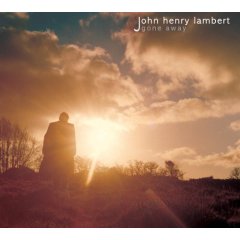
Ever heard of folk rockers Schrodingers Cat or experimental ambient house outfit Shen? No, me neither. Not that it matters, They're part of Lambert's past, whereas the present for this Devon based singer-songwriter is firmly rooted in darkling acoustic folk, as brooding, wild and earthy as the Dartmoor landscapes where it was recorded. Accompanying Lambert's spare guitar and cracked leather and dark loam vocals, wife Isabel provides harmonium and piano, Ian Ritchie the saxophones with Kathleen Willison on violin and backing vocals alongside Natalie Williams. The result may not conjure the recent work of Scott Walker as the blurb suggests, but you'll definitely hear the influences of Roger Waters solo albums and, as Lambert acknowledges, Springsteen's The Ghost of Tom Joad. The sax soaked City Skies suggests he's a fan of Cohen too. In which case Williams and Willison are his Jennifer Warnes. Or, on the harmonium droned Lost Sight of the Way, perhaps the McGarrigles.
Refective themes of loss and change are sketched with an eye for natural imagery (birds, winds, leaves) and the seasons (the music more autumnal or rimmed with frost than the rays of spring and summer) as Lambert talks his way through the numbers.
Actually, with several of them clocking past the six minute mark they tend to be more about the musical accompaniment mood settings than the vocals, more tone poems than songs. As such, while not New Age, they work best when played in tranquillity, the likes of Swallows or The Winter Of 95 offering a sense of spiritual balm; albeit one stained with nicotine and the fumes of roasted barley. I know nothing of Lambert's past, but I'm definitely keeping an eye on his future.
www.goneaway.johnhenrylambert.com
www.myspace.com/johnhenrylambert
Mike Davies April 2008
Another discovery - we learn that Kerosene hit the Number One country record spot in the US in late March, but it's taken a while for the record to filter through to me, and it was finally released here in the UK only last month. Miranda's another blond babe with ripped jeans, Willie Nelson T-shirt and a Gibson geetar, pictured sittin' at the wheel of a truck - looking even younger than her years no doubt but with a hell of a voice that belies that youth. A larynx that she wraps round a debut album that persuasively mixes honky-tonk, jangly country-pop, feisty country rock and Sheryl Crow-inspired ballads, all but one of which she wrote herself. The wealth of experience conveyed in her lyrics is impressive, if occasionally a tad glibly expressed (she can't always entirely avoid speaking in clichés), but Miranda's obviously an ace songwriter in the making who just needs to live life a bit more herself. Ending the album on a song of thoughtful reflection (Love Your Memory) was a brave move too, but it works. As a singer, Miranda's Texan roots are self-evident, and there are times when her forthright phrasing and boldly seductive timbre remind me strongly of Dolly Parton (especially on cuts like Mama I'm Alright), but she's also been favourably compared to Gretchen Wilson and Natalie Maines. Whatever, her voice is strong and attractively spunky yet capable of soaring tenderness too (as on Bring Me Down, Greyhound Bound For Nowhere and the anthemic There's A Wall), even if it tends to lack the last ounce of ballsy grit that would make her a great singer. It helps of course, though, that Miranda's backed by a solid crew (Richard Bennett, Glenn Worf, Randy Scruggs, Joey Huffman, Jay Joyce, Chad Cromwell, Hank Singer et al.) and co-producers Frank Liddell and Mike Wrucke clearly have their finger on the commercial pulse (although a few unnecessary bits of vocal treatment and effects are allowed to get in the way on occasion). Even so, this album will do very nicely for now, and not only to showcase Miranda's vocal skills. There's no escaping that it's a pretty dazzling debut that augurs well for the future.
David Kidman
Twenty-two-year-old Stephanie, raised in Indiana and a recent graduate of Nashville's famous Belmont University, hereby releases a debut album that shows her to be already a singer-songwriter of considerable maturity. Lonely To Alone, characterised by its prevailing heartfelt, expressive country-folk writing, is by anyone's standards a lovely collection of beautiful and sensitively-crafted (all but one original) songs: a collection whose only failing might be judged its overall uniformity as regards pace (gentle mid-tempo) and mood (wistful, often achingly sad and ruefully reflective). Stephanie's blessed with a voice that is perfectly suited to conveying the special emotional climate of her songs, betraying shades and inflections that recall Patty Griffin or even Alison Krauss (though not as sweet-toned). Her writing is intensely personal but not exclusive, and her confidential yet open-hearted delivery is telling and easily draws the listener into her world. There are some gorgeous songs here that I wouldn't be surprised to hear covered by other Americana-country singers pretty swiftly: If I Could, and most of all Tonight and the sublime title number. The instrumental settings truly complement, rather than directly reflect, the songs' internal melancholy and delicately balanced emotional landscape, with soft fingerpicked acoustic guitar, bass and gently shaken or stirred percussion – and occasional sympathetic touches of cello, mandolin, bouzouki, balalaika, sitar, accordion or oboe, with a string quartet on the title track - courtesy of (among others) Tom D'Angelo, Rudy Miller, Joe Spivey, Dongdong Zhang and Phillip Wolfe. My earlier comment about the album's uniformity being regarded a possible fault shouldn't really weigh too heavily in the balance against the sheer quality of the individual songs, for this is a finely-judged and deeply-felt set that in the final analysis really does ring true.
www.myspace.com/stephanielambring
David Kidman July 2009
The first to both be self-produced and bear the name of his touring band (bassist Jennifer Condos, guitarist Eric Heywood, pedal steel player Greg Leisz, keyboardist Patrick Warren and drummer Jay Bellerose), the fourth album from the raspy voiced singer-songwriter rather false-foots you with its opening track.
Repo Man is a thick blues groove with LaMontage growling out the lyric (which includes him talking about spanking his bad girl) while the band lay down Famous Flames style funky fat riffs and rhythms. But that gives way to the achingly wearied New York City's Killing Me, a dusty country flavoured lament that conjures thoughts of Ted Hawkins.
And it's the country side of the blues that informs pretty much the rest of the album; from the Morrison seasonings of the Southern soul title track and a Tim Hardinish chugging coming of age themed Beg Steal Or Borrow through the break-up pairing of the plaintive acoustic Are We Really Through? and the more late night samba jazz mood of This Love Is Over.
Ever reluctant to talk about his inspirations and influences he may be, but there's no disguising the echoes of early Neil Young to the banjo-jogging autobiographical Old Before Your Time, although the melody line is something Don Williams might have penned.
He reaps Young's Harvest too on For The Summer where Heywood delivers resonant Crazy Horse guitar work and LaMontage wails into the harmonica. As indeed he does on six minute Like Rock and Roll & Radio, a wistfully clever number that compares a broken love to the relationship between rock and roll and contemporary radio.
However, having lulled you into grainy reveries, the album reverts back to its initial blues impetus for the closing Devil's In The Jukebox, a r&b foot stomping leg slapper that sounds like it might have been written for a street corner one-man band with its blowing harp, strummed guitar, clanking drum and tambourine and a lyric of repeated line verses.
I'm not sure it's his best album to date, but it's certainly his most fluidly accessible.
www.raylamontage.com
www.myspace.com/raylamontagne
Mike Davies September 2010
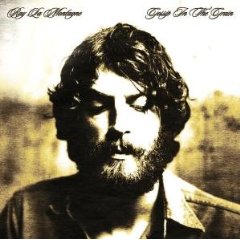
After being forced into the glare of the spotlight when the reissued Trouble turned him into a star, and then taking an introspective step back with Till the Sun Turns Black, the reclusive, bearded singer-songwriter (who, from the cover, is starting to look a lot like Andrew Gold) apparently felt it was time to "open up a little bit more" for this third album. Which, basically, means drafting in strings, pianos, pedal steel and a lot more Stax and Motown brass to add extra flavours to his husky sweet vocals. He should open up more often, because this contains some of his best work yet.
Reminding me a little of I've Been Loving You Too Long, the opening You Are the Best Thing lays out the mood, fat Memphis r&b horns setting the scene before Lamontagne weighs in sounding like an amalgam of Van, Sam and Otis. Let It Be Me (no, not the classic) picks up the baton for a slow country-soul waltz with Ray's honey-smoke tones showing Mr Blunt how it's done before strings and producer Ethan Johns' finger-picked ukulele introduce Sarah, a touching regret-stained reverie of reckless relationship-damaging youth that's both named for and about wife. That it's followed by the brooding desert loneliness sound of I Still Care For You, says all that needs saying.
Elsewhere, the album's an interesting confection of themes, images and styles. Winter Birds is a moving simple voice and guitar number built upon nature images as he sings of the 'widow now that owns that angry plough' and 'the fallow field that will heal no more' while, by contrast, Hey Me, Hey Mama is a mid-tempo Dixieland jugband chugger and Henry Nearly Killed Me (It's a Shame) a stomping train rhythm slice of handclapping, harp-wailing bluesy folk. And what to make of Meg White, a tongue-in-cheek love letter to the White Stripes drummer that opens with Morricone whistle before launching into White-style kit pounding!
But, if you think playful goes against the Lamontagne, ahem, grain, and prefer him to be twisted in pain, remorse and regret, you'll be happy to hear the final two numbers, the steel-stained A Falling Through (with harmonies from Leona Naess) and the spare title track with its mournful wind blowing through the chimes, lonely flute, strummed guitar and fable-framed images of sparrow, jackstraw and crow, see things out in suitably troubled mind.
www.raylamontagne.com
www.myspace.com/raylamontagne
Mike Davies November 2008
After being forced into the glare of the spotlight when the reissued Trouble turned him into a star, and then taking an introspective step back with Till the Sun Turns Black, the reclusive, bearded singer-songwriter (who, from the cover, is starting to look a lot like Andrew Gold) apparently felt it was time to "open up a little bit more" for this third album. Which, basically, means drafting in strings, pianos, pedal steel and a lot more Stax and Motown brass to add extra flavours to his husky sweet vocals. He should open up more often, because this contains some of his best work yet.
Reminding me a little of I've Been Loving You Too Long, the opening You Are the Best Thing lays out the mood, fat Memphis r&b horns setting the scene before Lamontagne weighs in sounding like an amalgam of Van, Sam and Otis. Let It Be Me (no, not the classic) picks up the baton for a slow country-soul waltz with Ray's honey-smoke tones showing Mr Blunt how it's done before strings and producer Ethan Johns' finger-picked ukulele introduce Sarah, a touching regret-stained reverie of reckless relationship-damaging youth that's both named for and about wife. That it's followed by the brooding desert loneliness sound of I Still Care For You, says all that needs saying.
Elsewhere, the album's an interesting confection of themes, images and styles. Winter Birds is a moving simple voice and guitar number built upon nature images as he sings of the 'widow now that owns that angry plough' and 'the fallow field that will heal no more' while, by contrast, Hey Me, Hey Mama is a mid-tempo Dixieland jugband chugger and Henry Nearly Killed Me (It's a Shame) a stomping train rhythm slice of handclapping, harp-wailing bluesy folk. And what to make of Meg White, a tongue-in-cheek love letter to the White Stripes drummer that opens with Morricone whistle before launching into White-style kit pounding!
But, if you think playful goes against the Lamontagne, ahem, grain, and prefer him to be twisted in pain, remorse and regret, you'll be happy to hear the final two numbers, the steel-stained A Falling Through (with harmonies from Leona Naess) and the spare title track with its mournful wind blowing through the chimes, lonely flute, strummed guitar and fable-framed images of sparrow, jackstraw and crow, see things out in suitably troubled mind.
www.raylamontagne.com
www.myspace.com/raylamontagne
Mike Davies November 2008
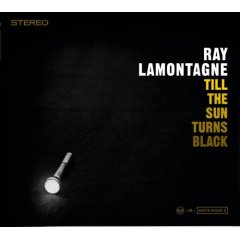
2006 proved quite a turning point for the reclusive, heavily bearded New Hampshire singer-songwriter. After languishing in UK stores for over a year, with a re-release via a new label suddenly his debut album Trouble became one of the essential acquisitions, turning him a belated overnight sensation.
Unfortunately, while not wishing to look gift horses in the mouth, it did mean that the release of his follow-up, already out in America, had to be delayed. However, it's finally surfaced and should comfortably prove that he's here for the long run.
It's not, though, Trouble Mark II. A somewhat lyrically darker affair, there's also a emphasis heavier on the bluesier, more Memphis soul end of his R&B influences to both Three More Days and the jazzy You Can Bring Me Flowers.
Then again the string arrangements, husky mood and warm muted brass that variously colour the hushed Empty, Can I Stay, Gone Away From Me with its plinketty ukulele and the title track conjure nothing less than the foggy sunshine and coaldust hung streets of the colliery towns of Northern England.
At times, it's almost as if Martin Stephenson was inhabiting the spirit of Ted Hawkins with Mark Knopfler's guitar (the instrumental Truly, Madly, Deeply reminiscent of his work on Local Hero), but with Lamontage's formerly grizzled voice now a soft, almost silken buttery wonder brushing over the heartaching lyrics.
He's called the album a song cycle about the nature of human relationships and communication, opening with Be Here Now's lengthy six minute gently rolling, at times almost musically ambient meditation on how easily we become distracted and fail to engage with others. The final track, the slow swaying, brass hued (and not a little Lennon-like) Within You, is, he offers, a lament for the lack of myth and wonder in contemporary American society. Elsewhere Empty considers elected emotional alienation while the wearied Lou Reed flecked lullaby Barfly finds the singer drowning in pointlessness and a desperate need for human contact.
Now if all that sounds a bit heavy and pretentious, be reassured that the songs and melodies are anything but. Rather they are lovely, burnished affairs, the spare acoustic Lesson Learned with its Spanish guitar and dark veined moods evocative of the great Don McLean or Harry Chapin while the fragile aching strings enfolded Can I Stay where he sings 'I've fallen sad inside and I need a place to hide' could be a close relative of Snow Patrol's Chasing Cars. On this evidence, Lamontagne's solar flares are set to burn bright for a long while yet.
www.raylamontagne.com
www.myspace.com/raylamontagne
Mike Davies January 2007
Ray Lamontagne - Trouble (Echo)
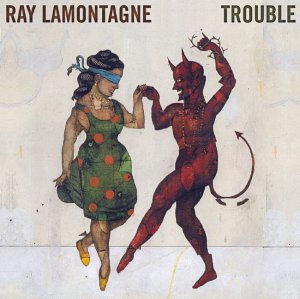
While the sandpapery voiced New Hampshire born singer-songwriter may have spent a rootless childhood moving from pillar to post, or indeed chicken coop, he obviously managed to keep his record collection with him, the influences seeping into his blood like mother's milk. They surface now on his debut album, Trouble (Echo), where you can easily trace the work of Van Morrison (Trouble), Dylan (Hannah), Ted Hawkins (Hold You In My Arms), Otis Redding (Shelter), Stephen Stills (How Come, Forever My Friend), Loudon Wainwright (Burn), and Neil Young (Narrow Escape) veining his blue eyes soul n roots songs of love's healing, heartache and human concern.
Arranged for acoustic guitar with the staple added ingredients of piano, handclaps, percussion, cello and any number of violin players, its intimate, dustily world weary Americana blessed with a lived in voice that could make rocks weep. If you're want quick comparisons, then David Gray and Damien Rice would probably be convenient reference points, but even they would be hard pressed to approach the trembling emotion and stark beauty at the heart of Narrow Escape, the bruised and shaken love of Jolene or the aching lullaby that is All The Wild Horses. To paraphrase Elvis, if you're looking for the right place, then Trouble is where you should come.
Mike Davies
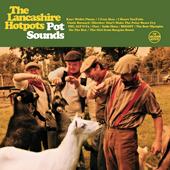
The folky-jokey cloth-cap brigade is with us again! Memorably described as purveyors of "meaty retro comedy, served up between layers of thickly sliced irony", the St. Helens-based Hotpots are evidently well established on th' west side of th' Pennines; their accents clearly originate from across that mountainous divide, but their entirely unpretentious style of humour is not specifically conditional on The Lancashire Experience, being pretty much universal and transfers reet enough. Their repertoire consists entirely of self-penned grumpily-pukka observations on the fads and foibles that make life in today's world so unbearable. Pot Sounds, their second recorded artefact, brings into our homes 13 wittily conceived (although sometimes blindingly obvious!) offerings, each being set to an existing, well-worn (mostly folk or pop) tune and/or based on a well-known song.
The four lads have a keen ear for a parody, as the canny cover art demonstrates, and (this is a welcome development for this type of material) rarely are the jokes allowed to overstay their welcome, for Beach-Boys-style brevity is the watchword here (of course, it may be also that some of the basic ideas don't warrant extension beyond a couple of verses' worth of punchlines). Some of the ideas have been done before, and just as well, but the lads know it and unashamedly trade on comradely punter familiarity. Perhaps the most productive pieces are those extolling the joys of shopping (BOGOFF, I Fear IKEA), leisure activities (On The Box), home-computing (ESC, ALT & F4), and life in general (Keys, Wallet, Phone), whereas The Girl From Bargain Booze enjoys her new lease of life here in the disc's concluding big-ballad. Some pieces feel a touch underexplored or even underexploited, while on the other hand, Indie Disco does go on a bit too long, as does Uncle Bernard (the only track to sound conspicuously over-produced).
The band are obviously a hoot live, but it's good that the CD incarnation retains enough of their chummy charm without going overboard on production gimmicks, while at the same time there's no over-flashy instrumental work to distract from the words or concepts. Inevitably, some of the routines will wear a bit thin on repetition, but the band's inventiveness – like their list of potential targets – is at times seemingly inexhaustible and there are plenty of choice one-liners. The Hotpots give us nothing cutting-edge, nothing arty, nothing rude or offensive: just good honest japery – and good luck to 'em!
www.myspace.com/thelancashirehotpots
David Kidman August 2009
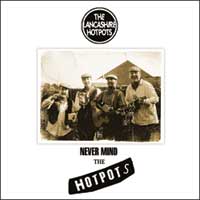
As you might guess from the name and the fact there's members called Dickie Ticker and Willie Eckerslike (on drums, melodica, HTML & Java debugging), this is a bit of a comedy circuit novelty act. Not normally the sort of thing I'd review for this site, but every now and then it's hard to resist something that produces such a big grin. Forget being serious for a moment and have a giggle.
Between the tongue in cheek Lancashire misogyny I Met A Girl On MySpace and the stereotype send ups Chippy Tea and Bitter Lager Cider Ale Stout, they clearly have their pop culture and tech radar well tuned.
There's songs about Firewalls, EBay, Sat Nav, PC World, PSPs, t'Internet, Blue Tooth and (to a tune akin to Matchstick Cats and Dogs) the advantages of Dolby 5.1 while the infuriatingly catchy He's Turned Emo with its singalong choru snamechecks Jimmy Eat World, Bullet For My Valentine and Fall Out Boy.
Given Radio 2 play and a few bevvies, it could easily give them a hit, as too could A Lancashire DJ which, reworks the tune of Belle of Belfast City with a chorus hook of 'I'm a DJ and I'll make you dance with a little bit of techno, a little bit of trance..two turntables and a microphone I'll play some house for your auntie Joan'. There's a few dead spots when you might want to top up the glasses, but they're certainly a lot more cred than the Wurzles. Go on, dip yer bread in.
www.myspace.com/thelancashirehotpots
Mike Davies, Sept 2007
For those not yet in the know, Landermason comprises Northumberland-based Fiona Lander and Paul Mason, who have been making music together for around ten years now and gradually gaining an increasing, well-deserved reputation for their supremely classy, polished, professionally executed, inventively scored and distinctive music that smoothly, and yet entirely satisfyingly, straddles the difficult boundary twixt folk and jazz, with occasional nods to world flavours. All of which they manage without ever descending into self-conscious pretension - and that's even more of a difficult trick to pull off.
So far they've released four studio albums, the latest two of which (2007's The Reason and 2009's Tree Of Souls) have particularly succeeded in reaching the parts that traditionally-inspired folk and less traditionally-inspired crossover have alike failed to reach. The more extended interval between Tree Of Souls and this has been well utilised, allowing for even more generous experimentation with instrumental textures than we've a right to expect from the two protagonists and their many-times-proven, enviably high degree of expertise and accomplishment. Much of Landermason's special appeal, of course, stems from the duo's unusual (for folk) brand of instrumental virtuosity - Fiona being brilliant on piano and an impressive array of saxes, clarinet, whistles and recorders, and Paul stunningly proficient on anything guitarry, not to mention their great vocal talents too…The new disc's canny sequence transports us from a quite literally unique take on the traditional Geordie Song Book number The Shoemakker, with some especially scintillating scoring, through a suitably energising (and energised) Bellingham Stomp (the first of four well contrasted instrumental tracks) and the epic narrative The Bywell Baby (based on the dramatic story of Mary Leighton who miraculously survived the great Tyne Valley storm and flood of 1771). Although there are some equally fine moments later on the CD, I did note that from midway through, following the sumptuous sketch of Kielder Water, the mood lightens generally, with the emphasis definitely more on fun and toe-tapping - not necessarily a bad thing, for Fiona and Paul are such dab hands at the fleet-of-foot! The musical genres tend also to be more polarised here, with the jazzier tracks determinedly keeping to that groove for however long it takes (in the case of Baby Can I Watch You Sleeping, that's seven delectable minutes of swing, Dixie and gypsy ebullience!). And both the uke-happy Hey! Mr Weatherman and the title song's jaunty funk have delicious charms that will be loathe to desert you.
OK, so inevitably there's also the odd artistic decision that I might disagree with (some over-prominent, possibly misplaced atmospheric effects, a smidgen of over-knowing expression here or there), but in the main Landermason once again prove their imagination, their tastefulness and their natural ability to hook their audiences in and keep them enchanted and involved throughout their performance, here in the studio just as live in concert.
David Kidman June 2013
This Northumberland-based duo made quite an impact on me with their classy 2007 CD The Reason, and here's the followup, which builds on the accomplishment of that disc with a further sparkling set of mostly original compositions. Perhaps the sparkle glitters a shade too bright on occasion however, as on the opening (title) song, a gentle voyage of the imagination for which the catalyst was a tree espied by Paul and Fiona by the roadside on a homeward journey one winter. This might almost be the theme song for a fantasy movie, with its memorable (if a touch sugary) melody, appealingly full arrangement and close-miked vocal. Its very sweetness tends to overshadow the ensuing tracks, I find, and the gambit of placing this most commercial track first may prove a disadvantage.
The remainder of the album, like its predecessor, also keeps to the more accessible side of the jazz-folk divide, although it feels less folk-oriented than The Reason and while it maintains that disc's refreshing-breathed approach there isn't quite the same sense of stretching-out and relaxing through the moods and the invention-cum-improvisation element feels more consciously reined-in than before. The musical settings are more ambitious this time round, with fuller textures that make even greater use of instrumental part-writing (the duo swop instruments around in the studio even more than they already so impressively do onstage!): the assorted guitar and piano lines are blessed with imaginative counterpoint from saxophones, clarinet, whistles and percussion (and then boosted at just a few key moments with contributions from guest musicians on spoons, concertina and flute).
The new disc contains some particularly strong songs: especially fine, I thought, the reflections on the industrial past (the bluesy would-be-worksong Working Man and the bleak portrait of a now-deserted industrial landscape Shipbuilding) and the contrasted pair of "sad and lonely" love-songs (the desperate, frustrated Broken and the wistful, pleading Stay With Me). The album's one item drawn from a traditional source is an exceeding playful, jazzy retelling of the local legend of The Lambton Worm; although it's riddled with exotic touches and knowing nuances, its basic cleverness overstays its welcome a little on repeated play. As does the (very evidently autobiographical) gigging artist's would-be-marketing-ploy Living On A Shoestring, although its slight self-consciousness is redeemed somewhat by the genial optimism of the preceding Scrap Book and the simple encore-type farewell-song One For The Road. Following which, the generously extended Sunday makes a welcomingly lazy closer. Casting aside an occasional over-simplistic quality in some of its lyric content, my main reservation with this disc is a technical one: a general over-closeness of vocal presence (I'm not sure how else to describe it) which at times gets in the way of the duo's keen musicality and the ever-thoughtful, consistently high quality of their performances. In all other respects, though, the artistry of this disc shines.
David Kidman October 2009
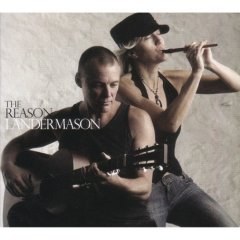
Mm, I really like this one - and against all expectations too. Landermason is a Northumberland-based duo comprising Fiona Lander and Paul Mason, who deftly inhabit the musical territory where according to their press handout "folk provides the theme and jazz determines the style". That's at once rather true and slightly misleading as it turns out, for it's likely that a pure jazz lover would find the music too folky and a folkie would find it too jazzy. Having said that, this is a really refreshing (if often quite soft-focus) record, the duo's third. It presents eleven original compositions by the duo (nine songs and two sprightly instrumentals) which make a virtue of melody but also of variety, the moods and colours ever changing through the heavenly length of the album (over 70 minutes including the lovely leave-the-disc-playing bonus track - In From The Desert? - that really doesn't deserve to be overlooked). There's also a setting of the famous cradle lullaby (here puzzlingly titled Sweep's Song), and even better, a linked sequence of swingingly imaginative arrangements of two traditional songs from the north-east (When The Boat Comes In and Dance To Your Daddy) on which the duo are joined by Peter Tickell on fiddle, Alice Roser on concertina and a veritable chorus of guest singers. Not that Fiona and Paul need extra singers elsewhere, for they're both blessed with truly excellent voices, attractive and clear when solo and abundantly harmonious when singing together. And their instrumental skills are legion too, with Paul's deft and supremely accomplished (and classically-influenced) nylon-strung guitar work the ideal foil for Fiona's finely judged whistles, saxes and piano contributions. Aside from the aforementioned guest musicians, the only augmentation they allow is when young sibling fiddlers Sarah and David Jones get to play on XYZ (the track that's named after the band they both used to be in - David's now with Last Orders of course!). The jazzy idiom comes into its own on The Mirror and Words Unsaid, while Please Yourself and Hero are possibly closest to contemporary folk - but it's the conjoining of the two strands (especially on Somalia, I Know There's A Reason and All Roads) that arguably provides the album's most beguiling moments. Having said that, and appealing though the album's early tracks are without doubt, Landermason really come into their own in the disc's second half, with the sequence from Please Yourself through All Roads to Somalia proving extremely satisfying. Landermason's music brings us one of those combinations of musical styles and influences that's often been tried but less often convinces; it's a tribute to their thoughtfulness, their craft and their intense degree of musicianship that it works so very well. A delightfully classy proficiency is the order of the day with Landermason, sure, but it's shot through both with an abundance of haunting, tuneful beauty and an emotional responsiveness that's not to be dismissed.
David Kidman August 2007
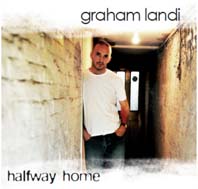
His voice can be a little sharp at times when he hits the higher notes, but otherwise the Kent singer-songwriter's debut is an attractive coming together of influences that include Petty, The Eagles, and Crowded House. As you might expect there's a fair amount of ringing acoustic guitar and catchy melodies on songs that balance the melancholic with the upbeat.
His poppy side is well represented by the jaunty opening Yes Days And Yesterdays with its countrified piano backing, rolling chords and singalong chorus while the poignantly tender Little Onion Head is one of those mid-tempo mid-Western flavoured piano ballads that simply grows on you. On the more mellow side of things, the strummed acoustic Corduroy Pillow has a hint of Martyn Joseph while I Can't is pure Beatles balladeering.
On an album dominated by songs of loss, Mother, a moving piano ballad that remembers following an ambulance through bonfire night streets and flashes back to childhood reminiscences, is a particular standout, reprised in edited radio version form after almost four soothing minutes worth of birds calling in the still summer air that follows on from Notes To Myself. It's apparently taken him half a lifetime to get round to turning his scribbles into an album. Hopefully it won't take that long again for a follow-up.
www.grahamlandi.com
www.myspace.com/grahamlandi
Mike Davies April 2010
Sonny, one of the key practitioners of slide guitar (altho' not as widely feted as the Cooders of the musical world), had already been spending time developing his art for close on 20 years before these two albums were released; he'd been working with Clifton Chenier's Red Hot Louisiana Band for some time, and later with John Hiatt, but it was only with these two discs, apparently, that Sonny finally got to be crowned King Of Louisiana Slydeco. Released in 1992 and 1995 respectively, they presented a heady and original fusion of blues, Cajun and rock elements with thoughtful and unusually literate lyrics. On Outward Bound, the songs are all really solid, ranging from the gutsy Back To Bayou Teche to the brooding acoustic of Sacred Ground and the rippling instrumental Yokamoma, with even the comparatively orthodox blues workout Speak Of The Devil staying well above the workaday. The power and drive of Sonny's blistering and often innovative slide playing is electrifying (he even emulates the trusty accordion on tracks like Common Law Love), while catchy riffs and strong melodies abound and Sonny's two-piece backing band (David Ranson and Kenneth Blevins) is brilliantly tight; Steve Conn and John Hiatt also make contributions. The recording of the less-than-enigmatically titled South Of I-10 was delayed due to pressure for Sonny to tour following the success of Outward Bound, and despite its well-developed sense of place it doesn't have quite the generated power or togetherness of the earlier set, being arguably more diverse in inspiration, and it tips over from roots into more conventional rock gestures at times. It also brings in some guests (including Messrs Knopfler and Toussaint, and even a whole horn section for one track) just to spice things up even further. But both albums still sound pretty good today, especially now cleanly remastered, and come together with excellent background notes in one most convenient digipackage.
David Kidman June 2009
Sonny Landreth - Grant Street (Sugar Hill)
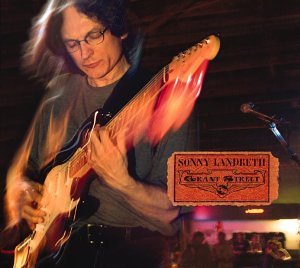
Recorded over two nights in Lafayette, Louisiana this is an 'as it happened' recording. Why you would want to do it any other way, when you can generate the animal excitement that Sonny Landreth does on stage beats me. There is a neatness to his recording live in the converted fruit warehouse on Grant Street because Landreth played with both the bands on the night it opened, Red Beans and Rice Revue and Clifton Chenier.
His career since then has seen him play on Jimmy Buffet's smash hit Licence To Chill, receive a Grammy nomination for The Road We're On and caused none other than Eric Clapton to say of him: 'He's probably the most underestimated musician on the planet and also probably one of the most advanced'. Believe me you'll not underestimate him after listening to Grant Street.
This is all bout catching the excitement and passion of white knuckle rock/blues. Landreth, in the company of David Ranson on bass and Kenneth Blevins on drums provides an hour blood, sweat and tears soaked blues culminating in the breathtaking 10-minute Congo Square.
But before you're left gasping for air by the finale, artist and audience are pushed to the physical limit by the likes of Blues Attack and U.S.S. Zydecoldsmobile. This is not an album for the faint hearted, turn it up and hold on tight.
Michael Mee
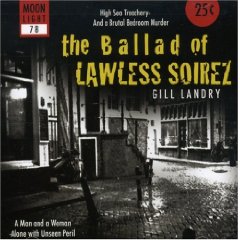
That's a hard G as opposed to Jill, the very decidedly male Louisiana born singer-songwriter a long time collaborator with Old Crow Medicine Show and his whiskey and dust soaked vocals sounding a few decades older than he looks.
You might suspect from the title that his debut solo album (he released six with the Kitchen Syncopators) spends a deal of time hanging around the Texicali border, and yes the title track's tale of a haunted rambler comes with Mariachi horns to go with the spooked sound of the saw, a dead man waltzes across desert nights with a gypsy violinist to recall the murderously cruel Magdalene, and Mexico pretty much speaks for itself.
But his songs of booze, murder, devil women and broken dreams ride the Southern goth rails through other musical influences too. Having spent considerable time on New Orleans, you'll hear that signature stomp brassing through Loneliness (where Cab Calloway surely rears his head) while Gasoline Legs and the Randy Newman piano ballad feel of Desiree both walk those French Quarter streets. And if Dixie's mandolin and violin flavours lean to melancholic country waltzing, the song itself was written the day after Mardi Gras and refers to the New Orleans brew.
Elsewhere, Poor Boy's feedback twang and brooding bluesy atmospherics stalk the Southern swamps, Ugly Town lurches drunkenly through Willie Nelson's 30s jazzy blues backyard, Mutiny makes its way through the Appalachian undergrowth and Coal Black Heaven's Fender noodled vision of the apocalypse and unobtainable salvation is hewn from the open cast seams of Kentucky's carbon vale of tears. A travelling man, you'll even find him going flamenco in some Brel dive for Anjolie's witty cabaret tango tale of a false hearted femme. With a rich line in imagery and narrative to complement his musical tapestries, if he's actually lived all these tales of hard liquor, hard roads and harder women, it's no surprise he sounds like he does. Here's hoping there's more tough times and bottom of the bottle experiences ahead to fuel further albums cut from the same cloth.
www.gilllandry.com
www.myspace.com/gilllandry
Mike Davies September 2008
Its title and recurring theme of relationship as a bucking ride inspired by her great-grandmother's boyfriend who signed on to join the rodeo during the Great Depression, things kick off with Young Girl's punky stomping and distorted keyboard pop addressing gender stereotypes before the playful clip clopping Romeo (on which she sounds like Zooey Deschanel) reinforces notions that you just can't rely on boys as she recalls being stood up on her birthday.
That same breezy kookiness can be heard on the Casio pop Clowns, but before you start thinking this is all fluff, bend an ear to Money In The Bank's strummed, mossily acoustic musing, French horn brushed on capitalism ("money in the bank, the night before you die what are you gonna buy?) or Little Miss Holiday, a bittersweet imagined conversation between two working girls, Jodie Foster in Taxi Driver and the child prostitute on whom she based her character. It's a potentially dark subject, but Landes' skill is to somehow make it all feel sweetly sad and tender. There's love's vagaries at its heart just as it provides the pulse of the album (the symbolic cover shows her riding a kicking bull), be that on the woozy electronic instrumental closer All Dressed In White, the harmonica and lurching rhythms of Wandering Eye, the brushed romanticism of Dance Area and, indeed, the jazzy tropical psychedelia sways of Love. And, just to remind you that there's country in the blood, Sweetheart of the Rodeo lopes along on a choppy bluesy backwoods rhythm with mouth organ fills and mandolin solo while Brighton celebrates a day in the seaside resort to a setting straight out of the Appalachians.
www.dawnlandes.com
www.myspace.com/dawnlandes
Mike Davies September 2009
Hailing from Kentucky but now resident in New York, Landes holds down a day job as a recording engineer, in which capacity she's worked with the likes of Joseph Arthur, Ryan Adams and Hem. When not twiddling knobs, she's likely to be found plying her other trade as singer-songwriter in the Big Apple's clubs. She probably makes more money behind the desk than behind the microphone, but if there's any justice that should soon change.
Having already released little heard but much praised debut album Dawn's Music and the mini-album Two, Three, Four, she's now starting to generate a substantial buzz beyond Manhattan's city limits with this self-produced third offering (featuring assorted Hems and Earlies in her band) earning comparisons to such names as Beth Orton, Susanne Vega and Cat Power.
Deservedly so with its beguiling blending of folk, bluegrass, country, jazz and electronics and a voice that can be witchily seductive one moment (the opening spooked hush of Bodyguard, and the percussive brushed I Don't Need No Man) and as innocent as a lullaby (the backwoods trad folksy jog of Tired Of This Life) the next.
As the use of instruments like glockenspiel, what sounds like a dulcimer, her beloved pink accordion and, on Toy Piano, a, er, toy piano, she's clearly got a nimble musical imagination, lulling you into country reveries with a dreamy Twilight and the Be Good Tanyas feel of Dig Me A Hole but then digging into what sounds like Tom Waits influences for the scratchy loose-limbed boho jazz-folk Picture Show.
Misted with a soulful melancholia that sounds like it's distilled and bottled the very essence of a 3am heartbroken dance, it just gets better every time you listen, her hidden stripped back wistful acoustic version of Petty's I Won't Back Down waiting as a final tantalising treat. Sign up for the Dawn chorus now.
www.dawnlandes.com
www.myspace.com/dawnlandes
Mike Davies February 2008
Mark Lanegan - Bubblegum (Beggars Banquet)
The title's ironic of course. There's nothing chewy chewy here, the fourth solo album from the erstwhile Screaming Trees founder and sometime member of Queens of the Stone Age. Instead, with guests that include Izzy Stradlin, Greg Dulli, Dean Ween, Joshua Homme and PJ Harvey, his throat scouring gruff vocal bends itself around musical shapes that variously conjure thoughts of Tom Waits (the swampy Wedding Dress which also incorporates a direct reference to Lee Hazelwood's Jackson), Cohen (When You're Number Isn't Up), early Lou Reed (Hit The City), Captain Beefheart (the industrial clattering Methamphetamine Blues), the haunted desert night prowls of Giant Sand (One Hundred Days) and The Stooges (the ragged scratched Driving Death Valley Blues and hard on psychobilly punk assault Sideways in Reverse).
Lacerating rock n roll and electrosonic experimentalism (Head, Can't Come Down) go head to head with the bare ballad slow waltzing Strange Religion, the gospel rooted Morning Glory Wine, Come To Me's tinkling musical box spooked country and a rumbling blues Like Little Willie John. Stained with nicotine, harsh with whisky breath and with songs both worm eaten with despairing darkness and burning with gravelly hope, it's his finest hour yet.
Mike Davies
Former frontman of Seattle's Screaming Trees and currently to be found providing a helping live hand with Queens of the Stone Age, Lanegan's latest solo outing is more likely to see him lined up along the likes of Cohen, Cave. Mark Eitzel and The Walkabouts with its contemplative, melancholic, dark American Gothic moods. His is a deep dark mournful voice riding a ghost horse through a sun-baked dust desert full of songs of damnation, loss and redemption, imbuing them with a sense of aching beauty. The haunting One Way Street instantly sets the quality level, the atmospheric instrumental Blues For D with its delicate guitar work tracery underlines his ability on the six strings while the title track wouldn't sound out of place on Cave's Murder Ballads, it and the superlative Pill Hill Serenade likely to rank among the finest of the year.
Mike Davies
Formerly of 80s outfit Small Change, Lang's been called Stoke On Trent's very own Leonard Cohen, presumably by someone who inadvertently misfiled his Dylan albums in Cohen sleeves and never noticed.
Truth is, variously recorded in Vancouver, Seattle, Scotland and Staffordshire, with Any Trouble guitarist Chris Parks, Gavin Sutherland and Americana singer Nancy K Dillon among those contributing, none of these 11 acoustic songs sound remotely like Cohen, musically, vocally or lyrically.
They do, however, bear testament to the role of Dylan, Guy Clark and John Prine among Lang's influences. Indeed, down to the raspy voice and kissed by pedal steel, the opening Under The Sun sounds like Bob at his most tenderly romantic while the melancholic What About You and the bluesier Roses And Rust are equally mined from the same seam.
Elsewhere Clark and Prine's colours can be heard streaking the bluegrassed fisherman's love lament Rollin ' Home and the crystalline, guitar ringing folk-country Radio Days while a spooked O'Casey's Ghost bears witness to Tom Waits storytelling and the lovely The Moon And The River nods gently to the tune of Let It Be Me.
However, as both writer and singer, Lang's much more than a mirror of his influences. Listening to that sepia burnished, cracked and nicotine stained voice is like curling in front of a crackling log fire, his melodies curl like fireflies in the night sky and his narratives of love steadfast, battered or lost ease open the heart to lodge in your soul. Listen to Between The Bells, a poignant trad folk flavoured snapshot of a worn down ageing boxer facing the final rounds of his career. If Springsteen hadn't been around it would have been a perfect theme song for The Wrestler.
Then, set to fiddle, dobro and mandolin backing, Button tells of a young soldier dying and buried far away from home and the girl whose coat once held the button around his throat, The Girl Who Chased Storms rewrites She's Leaving Home in a Canadian winter, and, harmonica and squeezebox adding melancholy, What About You calls upon Antony and Cleopatra and Spencer Tracy and Katherine Hepburn as testament to love's endurance.
It's an artist and album that deserves to be heard far and wide. Time to start a whispering campaign.
www.myspace.com/nurseryianlang
Mike Davies January 2010
I last came across this acclaimed Australian guitarist, singer and songwriter sharing the credits with Chris Whitley on the unjustly undersung album Dislocation Blues a couple of years back, but Jeff's latest offering to come under my radar is a solo release, a beautifully eloquent exploration of traditional modes of folk, country and blues that expands the boundaries of those genres and blends them all together to form a unique musical hybrid.
Jeff's astoundingly simple, yet deftly intricate, abundantly lyrical and utterly hypnotic guitar playing provides the backbone of the determinedly spare, wiry soundscape where usually the only accompaniment is Grant Cummerford's admirably economic and understated bass work. To provide just a little extra instrumental support for his sweet-toned, often plaintive singing voice, Jeff multitracks with additional instrumental colours from time to time, but the essential, almost primordial intimacy of his musical creations remains intact and very powerful indeed.
Jeff's own compositions (nine songs and one instrumental piece) form the majority of the disc, and their quality is consistently high with each individual vignette compellingly and naturally unfolding before your ears. The gently stirring ambience of the soul-searching Five Letters complements a hyper-restless yet genuinely haunting take on the disturbing traditional ballad of The House Carpenter, while Jeff's soulful version of the prison lament My Mother Always Talked To Me carries a deep resonance beyond its simple dobro accompaniment and paves the way for the enchanted balladry of Mooncoin, the weird disembodied experience of Ghosting On My Mind with its stabbing electric-guitar loops, and the all-hands-to-the-pumps call-and-response finale Newman Town.
The album's title, nautical slang for blind drunk, may give an impression of careless or wilfully exaggerated behaviour, but this belies the vivid introspection of Jeff's music and the sheer thoughtfulness of his inspiration. It's an intensely masterful, endlessly fascinating and richly rewarding set that may well end up on my year's-best-list.
David Kidman May 2009
Australian Lang lists some of his influences as Skip James, Blind Willie Johnson, Jimi Hendrix and Ry Cooder. He's off to a good start, then. Whatever Makes You Happy is one of eleven albums by Lang and is the latest to be released in the UK. The opener, The Save, is Americana, Folk/Blues – describe it as you will. I will just say that it is fantastic. It also has a trowel listed as an instrument – certainly the first time that I have heard of this! Switchblade has some impressive National guitar work and he sets his standard here. Alive In There is plaintive and sedate and You Should Have Waited is Country Rock of a high standard – think Poco. Orange Roughie is a short electric riff and he adds Suzannah Espie, to great effect, as a vocal accompanist on By Face Not Name. The pair provides lovely harmonies and excellent Americana with the best guitar work so far. This is a top song. Next up is Rain On Troy, which has a calming effect and is one that I could listen to it all day.
The Day I Got Chewing Gum Stuck In My Hair is contemporary electric rock with the grateful addition of some brass and lap steel. Rejected Novelist Fails Again is another great title but the song is so short and probably pointless unless I'm completely missing the irony. You Tremble has gentle acoustic sounds and Sleeping is contemporary Indie acoustic. Slip Away has Lang back on lap steel and National guitar. This builds up into a very relaxed Alt. Country/Folk Rock with superb guitar work. The Road Is Not Your Only Friend is played at breakneck speed and is manic modern Folk but the eponymous title track calms things down completely and emphasises what a prodigious guitar player he is.
David Blue July 2007
In 23 years as a celebrated singer and songwriter, k. d. has steered an often perilous course through an often annoyingly diverse array of material, with rather unpredictable results; even among her fans, few have been able to honestly say they like everything she's produced. On Reintarnation, however, k. d. goes right back to her country roots, presenting a consistent collection that intermingles choice cuts from her landmark country-inflected "cowpunk" albums with fresh recordings of material from the outset of her professional recording career. Following on from a re-recording of k.d.'s first single, Friday Dance Promenade, come two songs from her first full album, 1984's A Truly Western Experience; then we get three tracks from k.d.'s 1987 major-label debut Angel With A Lariat, and one from Shadowland, her album of country standards. There's also three tracks taken from k.d.'s soundtrack to Even Cowgirls Get The Blues, and no less than seven from 1989's superbly-named Absolute Torch And Twang collection. Finally there's Changed My Mind, a previously-unreleased song that k.d. wrote with Ben Mink over 20 years ago. The Patsy Cline influence is strong all throughout Reintarnation, and you can't ever fault k.d. for her authoritative grasp of the stylings of her heroine or for her skills as a country vocalist. Curiously, after all this time k.d.'s early work sounds less radical than it appeared at the time, more orthodox, more mainstream even, than its "cowpunk" image; time does weird things to one's perspective, I know.
David Kidman, June 2006
k. d. lang - Hymns Of The 49th Parallel (Nonesuch)
It's impossible to argue with the choices made by k. d. lang for this tribute to the music of her native Canada. You'd have to be a bit barking to baulk at Neil Young, Joni Mitchell, Leonard Cohen, Jane Siberry, Ron Sexsmith and Bruce Cockburn.
And I wouldn't read too much into the fact that Young, Mitchell, Siberry and Cohen get two songs while Cockburn and Sexsmith just the one. This album has the intimacy of personal choice and anyway, chuck in the, at least couple of dozen great Canadians that aren't featured and, hey presto, you have an ongoing series. Now that's what I CALL music.
For a musician who so epitomizes the spirit and attitude of today it is still quite surprising just how 'classic' lang's voice is. After The Goldrush, which opens the album, is softened around the edges and becomes quite eerie, a timeless classic whichever way it's done.
k. d. lang is undoubtedly one of the great 'interpreters' of a song and her collaborations with Tony Bennett and Roy Orbison show that her talent crosses the borders of both style and generation. Her version of Joni Mitchell's A Case Of You is full of heart while on The Valley she instinctively understands the power source of a song. Here it's a ballad but it could just as easily be anything else, it's the honesty and sincerity that are the telling factors.
It really should be no surprise that this is as good as it is. The combination of 11 great songs, their country origin is irrelevant, these are all truly great songs and one of THE voices of the modern age make this a potent mix.
But just listen to lang take Leonard Cohen's Bird On a Wire, she examines it from all angles and makes it something uniquely hers, it's a process to marvel over and a result to enjoy.
But even that is outdone by the other Cohen track that appears, Hallelujah becomes vast and hymnal it's the definition of the album's appeal.
Hymns Of The 49th Parallel may well have started out as a 'tribute' to her fellow Canadian musicians but it is also proof positive of the special talent that is k. d. lang
Michael Mee
Daniel Lanois - Shine (Anti, Inc)
Although he's contributed to and composed soundtracks (Million Dollar Hotel, Slingblade), it's been ten years since the Quebec born French-Canadian producer released his second album, For The Beauty of Wynona, since which time he's twiddled knobs on albums by names such as Willie Nelson, Ron Sexsmith, Emmylou Harris and regular clients U2 and Dylan. Finally though, he's managed to grab some studio time for himself, returning with another collection of tracks stamped with his trademark sense of atmospherics and wistful, yearningly melancholic vocals. He's also rediscovered his love for steel guitar, to which end Transmitter, one of several instrumentals here, is drenched with it to the extent of sounding not unlike a moody Wout Steinhuis. Elsewhere you'll find the ambient spookiness of Matador, electrobeat noodling on Space Key and the haunting spare, sadness drenched playout that is JJ Leaves LA.
But it's the vocal numbers that lovers of Acadie will want to know about, and perhaps reflecting the artists with whom he's worked, the places he's been, the musical mood embraces folk, blues, country and understated rock. I Love You opens proceedings with one of the album's two guest stars, Emmylou Harris lending her tones to the song's swampy everglades feel where electro owls hoot and drums clatter. Then it's Bono's turn on the co-penned Falling At Your Feet, a folk flavour of tinkling pop that calls to mind the Everlys. On then to the cascading As Tears Roll By with its rolling bassline, Lanois' high pitched breathy voice and gospel-blues colours. The blues are very much in evidence on Slow Giving, its slow acid laced balladry calling to mind Hendrix in general and Angel in particular, though it wouldn't be hard to argue for the influence of Bowie, Marvin Gaye and the Isleys too. If you want to play the comparison game then Sometimes has a distinct Paul Simon feel to it while the jaunty title track (recorded in Mexico) skip could sit easily in your Randy Newman collection.
Above all though, the album breathes with the distinct essence of late night Lanois, vintage malt sipped by candlelight, the flames flickering over memories of lost lovers, hymns from sad hearts and poems of life's rich mystical mysteries. Working with drummer Brian Blade but playing most of the instruments himself, it's a spare but deeply textured work, as intimate and personal to absorb as it must have been to create.
Lanois has said that peer closely and you'll find the political thread of the songs, the Tower of Babel reference in As Tears Roll By for example, but chances are that you'll prefer to darken the lights, lay back and let it seep into your bloodstream. "I wanted the record to be one of those that you put on and you never take off," says Lanois. Good call.
Mike Davies
Last Night's Fun (alias concertina wiz Chris Sherburn, singer/guitarist Denny Bartley and uilleann piper Nick Scott), have been performing together as a folkie "dream team" unit for around five years now (Chris and Denny as a duo for much longer), and each time you hear them, or see them live, you're bowled over - still. You think they can't get any better, but then they knock you out all over again. However, such is the trio's unrivalled presence live in concert that even their legions of devoted fans might view a new live album release with a degree of caution, not just because this is the trio's second live album release (the first, Live At The Wharf, came out under the Sherburn-Bartley-Scott moniker not long after the partnership had begun), but because you just know you simply can't ever encapsulate the combination of pindrop attentiveness and almost unbridled hilarity that's a hallmark of their appearances on stage (not even on a DVD perhaps). Admittedly, it's obvious (more so than with many live albums) that the trio's distinctive live presence can never be fully reproduced (not even on a DVD!), with that characteristic emotional pendulum swinging so wildly from the unbridled hilarity of their off-the-wall between-song/tune banter and commentary to the deeply serious (though still Fun!) music-making that commands in an audience a pindrop attentiveness and concentration comparable to that emanating hotly from the musicians themselves. LNF share that particular kind of emotional pendulum with the esteemed Vin Garbutt, with whose between-song repartee Chris's might (at least in terms of its function within the set) be said to have a certain kinship (in this respect, if a LNF live album were to faithfully reflect or portray the complete experience, then you'd need a multi-disc box!). Having said which, LNF always give value for money musically too, and this new hour-long disc, recorded in February this year at Birmingham Arts Centre, presents eight choice items from the trio's current repertoire, with a few tantalising glimpses of their banter (mostly around the very start of tracks). Perhaps more than on previous occasions, there's a weighting towards songs rather than tune-sets (five out of the eight selections here); having said that, one of the noteworthy features of LNF's approach is the way they dovetail songs into tunes so very naturally, building up and on the atmosphere created while affording opportunity for typically stunning displays of showmanship. Their entirely natural individual and collective virtuosity is as astounding and powerful as ever, and always amounts to so much more than a mere vehicle for the session-style improvisation it superficially resembles and from years of experience in which activity it clearly draws its main inspiration. The songs on the set cannily mingle stuff they've been doing for donkey's years (no, not Sullivan's John! - I mean Roseville Fair...) with some newer additions to their repertoire (Next Market Day, Tom Joad), while the current showpiece for Nick is the stunning air Autumn Child by Brendan O'Regan. For the benefit of those not in the know, it has to be said that Denny's vocal style is a bit of an acquired taste, with its reliance on drone centres. In this respect, it's probably his interpretation of Whisky In The Jar which will most likely be the sticking point for the unconverted, though I just love Denny's distinctly idiosyncratic way of treating the melody to all manner of wayward but passionate keening, rendering it well nigh unrecognisable to yer average punter who's used to the rabble-rousing Luke Kelly hearty pub-folk singalong approach (Denny's version just rollicks in a different way, that's all!). So there ye have it: fun not just from last night but for every night - a permanent record of a seriously vibrant trio who are still a real force to be reckoned with on the live circuit, an act that I for one never tire of seeing ...
David Kidman
David Kidman
The eternally youthful concertina player Chris Sherburn and singer/guitarist Denny Bartley have, after years of ultra-hard gigging as a well-respected duo on the folk circuit, finally teamed up on a permanent basis with elfin uilleann piper Nick Scott, calling themselves Last Night's Fun. But you'll have fun a-plenty on every single night you see them live, for a typical gig is as likely to leave you just as breathless with laughing (at Chris's introductions), as speechless at the trios superlative individual and collective virtuosity and musicianship.
But this CD, the trios second release (a live album came out a couple of years ago), takes the LNF experience onto another plane entirely. Even if you accept their considerable instrumental and vocal prowess as given, the power of the performances on Dubh is literally quite stunning. The first thing youll notice is that its abundantly clear all three musicians are totally into the music, and play with a passion, determination and unstinting commitment thats hard to beat among contemporary exponents of Irish traditional music, certainly among those based in this country. The second thing youll notice is the complete assurance of their technique (whether on tunes or songs), creating a vital and immediate listening experience each time (this is no mean achievement, especially considering the number of times you hear indifferent versions of some of the pieces elsewhere!).
Yet the trio take the brave step of beginning this album of Irish music with the eight-minute Ploughman And The Furrow, which ingeniously marries the slow air Roisin Dubh with Dennys singing of a version of John Barleycorn taken from a poem by Orkney writer George Mackay Brown. Pretty unusual, but the way Denny builds and develops the vocal line from out of Nicks quiet, eerie drone is nothing short of amazing. And, like much of the rest of the album, recorded in one live take. Dont be intimidated by the bands cover portrait, or by the albums title (a Gaelic word meaning variously dark, black, brooding, mysterious, which is more a reflection of its seriousness of purpose and its overall majesty and scale, as subsequent tracks reveal.
Perhaps the most immediately noticeable progression from Chris and Dennys duo recordings is artistic rather than obviously colouristic; Denny has always impressed me as a singer of real distinction, but lately, with the recent release of his solo album (Midnight Feast), his interpretative powers have moved onto another plane, on which this new LNF album focuses. Theres a high degree of measured breadth, strength and internal discipline in his readings, giving the performances an almost epic quality that befits the timelessness of the tradition within which hes working. All of which is stated not in the least to denigrate or belittle the stirring contributions of both Chris and Nick. Their absolute tightness and togetherness when playing in unison makes it all the more effective when they veer away on independent lines. And with Dennys fantastic guitar underpinning and developing the rhythm, who needs bass and drums and programmed beats?
The sheer sense of drive and momentum on the instrumental sets is thoroughly contemporary in sensibility, but never merely thrashy. The albums closer is a masterstroke, where a spirited tune-set falls away onto the bleak and intense sean-nós of Aisling Gheal. This album is stupendous, both a landmark release and a seriously important contribution to the modern presentation of Irish traditional music.
www.lastnightsfun.com
www.adamailorder.co.uk
David Kidman
To celebrate her 25th anniversary in the business, Larkin decided to make an album featuring 25 acoustic versions of love songs she'd written and recorded over the course of ten albums during that time. Of course, anyone can just go back and do unplugged versions of their old material, so she also invited 25 artists she's admired, worked with and who have been her inspirations to duet with her, sending them the acoustic recordings and giving them the artistic freedom to reshape them as they saw fit.
She clearly has a very impressive phone book, the two disc set featuring a veritable roots music who's who, though I have to own up and confess Italian born guitar maestro Beppe Gambetta (St. Augustine), Birdsong At Morning (Home) and Michigan's Merrie Amsterburg (Inside Your Painting) were blind spots on my listening highway.
Amsterburg also turns up as part of The She-Las. This one's a bit of a cheat really, since the group doesn't actually exist but was put together for the occasion to give Larkin the chance to sing with sister Sheila along with old friend Catherine David. Listening to Lost And Found the four should do this more often.
With names that include Martin Sexton (whistling the intro to a bluesy Lately, the oldest song in the set), Shawn Colvin, Jonatha Brooke (providing musical atmospherics on Only One), Jennifer Kimball (her old musical partner in The Story), Chris Smither, Peter Mulvey and Catie Curtis, it would be exhaustive to go through all the contributions. However, I do have to point you in the direction of some personal highlights, headed up by the distinctive presence of Bruck Cockburn on Open Arms, a song on which he originally guested back in 1995. This time he brought his guitar too.
Roseanne Cash's pure, heartfelt tones bring a hymnal grace to Closest Thing, David Wilcox's honeyed voice blends perfectly with Larkin's smoke on The Cranes, Suzanne Vega adds sensual heat to Pablo Neruda, Janis Ian beautifully complements Italian Shoes while Mary Chapin Carpenter adds her own strain of heartache to Chained To These Lovin' Arms and Dar Williams is clearly sensitive to the poignancy of sharing Good Thing, Larkin's late mother's favourite song. However, perhaps the most individual contribution comes from Erin McKeown who, singing just a whispering percussive echo beat behind Larkin and playing jazzy piano and organ, turns Beautiful into quirky avant folk-jazz. A labour of love in all senses, let's hope she doesn't wait until her 50th to do it again.
www.pattylarkin.com
www.myspace.com/pattylarkinofficial
Mike Davies May 2010
Patty Larkin - Red = Luck (Ace)
Covered by names as diverse as Holly Cole and Cher and even awarded a Patty Larkin Day by the city of Boston, the Iowa born singer-songwriter's tenth album may further Regrooving the Dream's use of loops and electronics but it's essentially a consolidation and celebration of her strengths as a folk rooted performer. Embracing Celtic, pop and Middle Eastern influnces, filtering in R&B colours here, a bouzouki there, Ben Wittman and Gideon Freudmann providing trademark lap steel and cello sounds, it's an assured, mature and absorbingly contemplative work.
As you might gather from a press blurb that talks of meldings of Beth Orton, Guy Clarke, Dylan, Richard Thompson and Me'Shell NdegeOcello, it's a fairly diverse tapestry of moods and songs, the title track itself a reflective dew-on-the-branches acoustic guitar and voice instrumental.
Too Bad comes at you with ringing plangent guitars, picking up the tempo to forge a driving slice of rootsy rock while also on the upbeat Louder is a simple let your hair down masala of rock, Celtic dance, and jazzy Middle Eastern vibe that throws in clattering percussion, sintar, accordion, flute, fiddle and a raft of electric guitars around the simple line "this old world is getting louder."
Elsewhere The Cranes harks to fairly traditional acoustic folk that uses winged migration as an image for a collapsing relationship, All That Innocence adopts a slinky hazed jazzy groove, 24/7/365 tumbles on a snaky bluesy rhythm with its contrasting laid back verse delivery and the whispered urgency of its chorus line and Children's reflection on lost innocent days shuffles a lazy rhythm beneath those weariness-veined clear vocals.
Although social commentary bites on Birmingham (which musically evokes Bruce Cockburn) as she reflects on the working poor and the country's economic disparities, it's the personal - and through that the universal - that informs most of the material. Poignantly Home, a simple vocal and acoustic guitar tune, which calls to mind the quiet sadness of Janis Ian (an on which you can just hear a swallowed sob at one point) is one of two songs that came out of 9/11, the other, the equally sparse and edgy Normal, a striking conclusion that being crazy these days, is, well normal.
For me the stand outs though are the head up stand tall defiance of the mid-tempo Mary Chapin Carpenter rocking Different World, the semi-spoken love lifts you up that is St Augustine which features American-Irish outfit Solas with Larkin showing that Dylan clip to her delivery. And Italian Shoes, a Kathy Mattea, mountain air, smell of pine, jumble of confusions cocktail about communication as the singer finds herself unable to articulate what she feels without having to say "I love you." A grown up album for grown up ears in a grown up world.
Mike Davies
The last two mini albums of the Lovell sisters' year long seasonal project don't much change the musical climate, although there is, perhaps, more of a slight chill in the air than the sunny predecessors. As before the writing credits are pretty much evenly balanced between Rebecca and Megan with each album featuring one co-write, the girls playing lapsteel, dobro, mandolin and acoustic guitar augmented by Mike Seal, Daniel Kimbro and Chad Melton variously on piano, banjo, drums and bass.
Bluegrass and country are the basic templates with rock and folk filters applied on different occasions, Memories, the bluesy Fall From The Tree and Horseshoes And Hand Grenades on Fall and Winter's uptempo Taller Than A Tall Man fitting comfortably into the Fleetwood Mac and Stevie Nicks end of the spectrum while things like Trance, Spooked, Cure For The Common Cold and the acoustic Free Like A Bird are closer to 10,000 Maniacs.
I don't think they're ballsy enough to warrant the Dixie Chicks comparisons, but as their four seasons collection proves, you can't argue with the musicianship, harmonies or songwriting chops. Annual membership is recommended.
Mike Davies May 2011
The new musical trading name of the Lovell sisters, Rebecca and Megan, following the departure of Jessica to wedlock and college, it seems a tad strange to be releasing an album called Summer just prior to Christmas. But then Spring, the first in the four part seasonal series, appeared in August and, in theory, Fall should be out here in early Spring with Winter to follow around June. Which, given the current climate changes, may make perfect sense.
Musically, it's a fairy sunny confection of bluegrass pop and modern country with oodles of pedal steel, mandolin, banjo and ukulele, kicking off in sprightly form with Praying For The Bell and Sea Song before curling the tempo down on Wrestling A Stranger and the funky soul country of Natalie.
While piano waltzer By The Pier stands out, I'm not persuaded they have distinctive or individual enough voices to stand out from the crowd, a feeling the final three bluesy but unmemorable live tracks do little to assuage, though full marks for invention in transforming Massive Attack's Teardrop into a blue grass number.
www.larkinpoe.com
www.myspace.com/larkinpoe
Mike Davies December 2010
The Lark Rise Band was formed in May 2007 by Ashley Hutchings as a direct result of his being asked to perform at the event commemorating the 60th anniversary of Flora Thompson's death. Since then it has performed, all over the UK, Ashley's music from the original Keith Dewhurst plays (based on Flora's Lark Rise To Candleford trilogy) as well as some new pieces written especially by Ashley. Lark Rise Revisited (this album) includes several of the latter - including a cover of the theme tune from the BBC drama production of the trilogy - plus some unpublished songs from the original productions. Also interpolated are half a dozen evocative passages from the book, read by Judy or Ashley, but it's the music that is the key to the feel of the whole enterprise, the music that (as Ashley says in his booklet note) "continues to inspire us, uplift us and raise our spirits". The Lark Rise Band consists of Simon Care, Judy Dunlop, Ruth Angell, Mark Hutchinson and Guy Fletcher, who are clearly inspired under Ashley's leadership and turn in some very fine performances here. High points are Ruth's Queenie's Bees (a lovely portrait of one of the book's special characters), a wonderfully bleak rendition of Richard Thompson's Bad News Is All The Wind Can Carry by guest (and fellow Rainbow Chaser) Jo Hamilton, a touching 'Til The Time We Meet Again (originally written by Ashley for a 1985 Leicester theatre production of Lark Rise), and Issy Emeney's poignant Lark Rise (Alf's Tune) - written for, but not used in, the recent BBC serial. Even the kids' chorus acquit themselves credibly on the May Song. And Laura's Song (written by Ashley with Cathy LeSurf for the late-80s eco-series The Wild Side Of Town) gets a timely revisit, relevant as ever. My only reservation is with the setting of Bonny Labouring Boy, a tad too lush for my taste. Inevitably there's a certain episodic quality to this album, in spite of the unifying concept, and it's hard to escape a final impression of mild bittiness, so I'd recommend judicious use of the skip or programme buttons. But it's still a worthy addition to the ever-expanding canon of Ashley Hutchings' concept projects.
www.myspace.com/thelarkriseband
www.talkingelephant.com
David Kidman August 2008

Flame Of Wine (a literal translation of Lasairfhíona Ní Chonaola's own name in Irish) turns out to be the lady in question's second CD, and it's a treasure, no exaggeration. How on earth Lasairfhíona had slipped under my radar with her debut An Raicín Álainn in 2002, well that's a mystery, sure enough! She's a singer deeply rooted in the sean-nós style of her home on Inishere (Aran Islands), but unlike most other noted sean-nós singers her voice is of the gentle and breathy kind (she's been described as "like an Irish Kate Rusby", a tag which, though it contains an element of truth, doesn't convey the extra special qualities of ethereal expressive shading that Lasarfhíona's voice possesses). Her singing is pretty, yes, but also very satisfying interpretatively, with a thoughtfulness and substance underlying the attractive surface quality; it's wispy, yet also very immediate in its impact. Flame Of Wine, unlike Lasarfhíona's debut CD, rings the changes by including four songs sung in English alongside the expected majority-quotient of performances in her native Irish. One Morning In June even alternates lines between the two languages, and very engagingly so. Galleon is a departure too: Lasarfhíona's own composition, it's a particularly fine example of the personalised expression of a universal theme (love), and was inspired by the long maritime tradition of the Aran Islands and the strong connection between Galway and Spain; I do hope we get to hear more of Lasarfhíona's songwriting in the future. Other highlights here include the two unaccompanied songs - which include a supremely poised rendition of the established sean-nós repertoire piece An Raibh Tú Ar An gCarraig - and The Lonely Valley (fetchingly done to the familiar Carrickfergus tune), the bulk of the text of which Lasarfhíona learnt from her grandmother. Livelier moments come with Sí Do Mhamó Í and a fun children's song The Rabbits' Dance. For even more variety, Lasarfhíona also presents a couple of comparative oddities: Aoibhneas An Ghrá (Love's Enchantment) is a creative semi-spoken, semi-sung/intoned setting of a piece of Irish Bardic poetry, whereas the title track pits Lasarfhíona's enchanting soft wordless keening against a gentle drone. Finally I must remark on the excellent sound of the album and the magical supporting musicianship: Máire Breatnach, who has co-produced the disc (and who was also involved with Niamh De Búrca's fine album which I reviewed here a few months ago), also plays fiddle, viola and piano, while Mary Bergin (whistles), Bill Shanley (guitar) and two bodhrán players also contribute. This is a lovely CD, which I'm sure I shall be returning to a lot.
David Kidman January 2007
If loving should be easy, so should reviewing this CD… but it isn't as it turns out. So let's start out with the biog - Jim's a native of Whitstable (Kent), though his personal brand of laid-back s/s folk-rock betrays no Kentish traditional influences. Much of the current album (his second, apparently) owes more to the lazy country-folk of The Band, with reflective melodies enhancing the narratives and emotions depicted in a very attractive manner. Strongest tracks are those later on in the album which, like Doesn't Matter Anymore, Undertow and House On The Hill, build on those characteristics. Rootsy touches are supplied by Jim's well-chosen crew of backing musicians, who include melodeonist Tim Edey, bass and drums from Matt Barwick and Phil Laslett, not to mention Geoff Richardson, Simon Lee, Richard Rozze and Andy Goodall on various guitar-type instruments and some stylish soprano sax from James Ross. Jim's own unpretentious guitar work complements the overall effect of his equally unpretentious songcraftI said that reviewing this CD wasn't altogether easy - that's because there's little to find fault with, while at the same time little to go overboard and shout about; the absence of any significantly weak material should, however, count for rather than against it; for it's a likeable product that should win Jim some more fans.
David Kidman
www.myspace.com/lastordersfolk
David Kidman August 2007
The Last Post - Dry Land (Bright Star)
The second album in his new guise from former In Motion Dublin singer-songwriter Alan Kelly was hailed by many as the Irish album of 2002 and its release beyond native shore should safely see it finding a home on 2003's best of lists too. Melancholic pop ballads are his stock in trade, delivered in a choirboy vocals and enfolded in the big strings layered sound (Waiting, It's All Over Complete with big brass finale) of Phil Spector, the sweet summer lush harmony dripping melodies (Only Thing That Eases The Pain, Change) of Brian Wilson and the country soul (The Midday Sun, Can't Wait Til Tomorrow, of Gram Parsons.
Pitched somewhere between The Prayer Boat and The Fat Lady Sings, with fellow Dubliner David Kitt taking lead on three of the album's stand-out numbers, it's music for the twilight hours when the sound of shattered hearts falling on rainswept streets drowns out the noise of the world.
Mike Davies
Together now for a decade, now settled into the current five piece line-up, augmented to include brass and pedal steel players for their live outings, this is the fifth album for an outfit touted as one of America's best roots rock acts.
It's a not difficult to see why given the muscular confidence with which they address their various musical influences, ranging from the classic rolling country of Anywhere But Here to blues (You), jazz (a trumpet and percussion shuffling The Color Blue), mariachi (Can't Come Undone) and mandolin dappled folk (a cover of AP Carter's Lovers Farewell).
Although frontman and sometime Washington Post music columnist Eric Brace handles the bulk of the writing, this is very much a band effort, guitarist Steve Wedermeyer (who penned Can't Come Undone) and former Jayhawks keyboardist Jen Gunderman very much part of the mix, the latter very much carving her name across I'm Coming Home.
The catchy title track gets the country rocking ball rolling with a full head of steam and a heading down the highway chorus. But, while there's not a weak moment here, it's the second number, Flood, that really makes the hairs on the back of the neck stand up sounding like some classic lost Richard Thompson cover with that sonorous ringing guitar and steady rhythm. In terms of album highlights it stands shoulder to shoulder with the moody bruised heart slow waltzing ballad Go Now while, a duet with Alice Despard, their version of This Wheel's On Fire would warrant a place on any self-respecting collection of Dylan covers. All aboard, then.
Mike Davies December 2007
Her 'band' (Colin Fletcher, Claudia Gibson, Jane Griffiths) sharing the billing for the first time, Oxford-based Lathe's fourth album finds her material moving further away from trad folk and more into the 60s jazzy blues variation vibe exemplified by the opening piano based, harmony vocals of Girl In My Pocket that marries Blossom Dearie, Kate Bush and, as David Kidman has previously noted on these pages, the pagan pixie sound of Pooka.
The latter would also be a touchstone for Good Enough which, with Fletcher's prowling double bass, might also suggest a late night jazz cellar session with Pentangle jamming with 70s jazz-folk duo Therapy.
Having previously nodded to Bush on previous releases, this time round she tackles one of her best known songs with a lovely, woodsmoked ethereal version of Army Dreamers which, arranged for acoustic guitar, violin and swoonsome vocals, has at times an almost madrigal feel.
It's a splendid cover, but, I have to say, overshadowed by the reading of While My Guitar Gently Weeps, transformed into a marvellous folk dirge that will surely have Medieval Babes kicking themselves for not thinking of it first.
The spotlight on the band extends beyond their name on the sleeve with violinist Griffiths taking the solo spotlight, conjuring Thomas Hardy country with the reverie of May Waltz before launching into John McCusker's sprightly Frank's Reel. She takes centre stage again on the album's other instrumental, pairing the Fletcher penned Waltz For Rosie & Matthew, another autumnal pastoral mood flecked with a tang of salty sea breeze, with the trad jigging Jonny Ward's Fancy.
As you'll have surmised, the album isn't by any means devoid of folk flavours, just that, like the Gibson-written lament for the times, Hostile, they predominantly come courtesy of the band rather than Lathe.
Having said that, her own piano arranged Broken (revisited from previous album Low Summer), is also a heady evocation of cobwebs, dusk-touched dew-hung meadows, and ruined churches that builds to another Bush-like interweaving of voices.
Indeed, as you'd expect from someone who also runs voice workshops, its the vocal arrangements that really stand out; achingly harmonising on The Moth by Pontypool songwriter Anne Lister, striking plaintive hymnal chords on the mingling of Hebridean sea shanty Mingulay Boat Song and Shetlandic Starka Virna, or wonderfully unaccompanied in three part harmony on what, to judge by the fade out distant applause, seems to be a live recording of Good Old Way, the Primitive Methodist Revival Hymn that closes the album. To take a cue from the album title, this is stellar listening.
Mike Davies November 2008
Taking its cue from the title track which uses the rows between residents and celebrants over the pagan festivals staged there as a springboard to lament the spiritual decline of the nation many, her own songs are very much thoughtfully concerned with the atmospheres of old England and the contemporary resonance of its passing. Listen to 100 Years inspired by the ruin of a manor in an Oxfordshire hamlet, Runaway which details ambiguous feelings about leaving and staying, the Beauty and the Beast like folk legend of Man On The Hill and even Beside My Love where the sanctuary of which she sings could as easily be a land as a lover. And, accompanying herself on piano as thoughts of June Tabor meeting Kate Bush come to mind, on Curlew she finds hope in the simple sound of a bird cry over the wild moor.
The traditional choices follow a familiar route of meeting true loves on a May morning (the largely multi-tracked a capella Searching For Lambs) and lovers lost at sea (Lady Franklin's Lament), but there's nothing predictable about her choice of covers. Paul Weller's English Rose is transformed into an almost classical folk song with bowed double bass and low whistle, Jane Griffiths brings violin to Lathe's piano for the spare elegiac and rich Two island Swans written by Gail Collins and Felix Pappalardi while no less than Raymond (that's Gilbert to you and me) O'Sullivan's Nothing Rhymed sees her accentuating the accent while texturing the liltingly melancholic arrangement with Indian harmonium and John Spier's melodeon. Producer and 12 string guitarist Tony Poole (yes, he of long lost and lamented legends Starry Eyed and Laughing) also contributes a track in the glorious open sky bracing mountain air of Come Away, a nigh folkily anthemic song custom built to be sung around bonfires, maypoles and the sort of festivals to which Avebury's born ancient witness. Looks like English folk just found itself another rising star.
www.abbielathe.co.uk
www.parkrecords.com
Mike Davies
This release is breaking the NetRhythms rules! As you know, we don't normally cover EPs, but we're prepared to make an honourable exception in this case, since this collaboration is seriously vital even though its five tracks weigh in at just over 22 minutes. In fact, I'm left wondering how on earth the protagonists had the time to get it recorded at all - much less come up with something so accomplished and considered. One thing to note as a special success is the pairing of the singing voices of Karine and Kris Drever - which is stunningly good (there had of course been a prefiguring of the potential of this duet partnership on Kris's Mark The Hard Earth album, but this confident new flowering just makes me hanker after more, much more in fact). The second thing to note is the clever choice of material.
The disc opens with a thorny Polwart-Lau original (the title track), the limpid questing poetry of whose lyric is set to a chimeric, busily shifting and tremendously imaginative - and slightly menacing - backdrop. After this, the team bravely dares to tackle Dave Goulder's celebrated January Man: in contrast to the revered cover versions by Martin Carthy and June Tabor, Lau vs Polwart in a stroke of genius yet entirely naturally impart its trudging lyric with a weary ticking pulse. Then comes Kris's measured yet telling rendition of Lal Waterson's statuesque Midnight Feast, arguably the finest of the disc's reinventions, followed by a haunting, welcomely all-acoustic re-setting of Blue Nile's hitherto over-synthy From Rags To Riches that lays the song's message bare (and vulnerable) in Karine's fresh, clear-sighted treatment. The disc's finale is a version of the epic ballad Lord Yester, with a Scandinavian-style lilting prelude beautifully played on the fiddle by Aidan.
If there's any justice in the world, then these guys must be granted the time-off to record a full album together, cos this is fab.Hegri Music/Lau Scotland Ltd.
www.karinepolwart.com
www.lau-music.co.uk
David Kidman June 2010
Much of the credit for this subtle change can be laid at the door of Lau's producer Calum Malcolm, whose in-depth appreciation of what Lau are about and what they can do, together with his guiding hand through the labyrinth of studio intricacies, has been invaluable in encouraging bolder textural and structural experimentation within both the existing template and the range of sounds available from the basic guitar, fiddle and accordion lineup (which of course sounds anything but basic in the expert hands of Kris Drever, Aidan O'Rourke and Martin Green!). The full-toned blend they achieve is nothing short of miraculous, their empathic musicianship never wavers and their creativity remains at a uniformly high voltage throughout the record. The splendid Lau combination of tunefulness, sonic beauty, hi-energy, innovation and musicality is, as ever, unique and irresistible, with its trademark bold gear-changes and life-affirming near-anarchy.
There's an almost cinematic urgency to tracks like the opening set The Burrian, where the spellbinding momentum and intricate note-patterns are driven into overdrive by Kris's turbocharged guitar around five minutes in, having journeyed through an unusual musical landscape embroidered by the distinctive white-heat gleam of guest Stuart Nisbet's aching pedal steel and capped with a wordless vocal choir (Karine Polwart, Corrina Hewat and Inge Thomson). Special mention must be made of Temple Of Fiddes, which brings atmospherics fully into the equation on an original strathspey-styled tune that develops into a typical Lau space-folk odyssey, also the mightily iconoclastic mid-section of Stephen's and the truly invigorating Salty Boys set. Then again, Horizontigo springs its yearning arabesques directly out of Kris's limpid guitar melodies, evolving into a silky, spacious sheen with almost psychedelic swirling, swooning from double-stopped fiddle, pedal steel and swelling accordion.
Arc Light also brings freshly persuasive studio revisits of items familiar from the live album: the Frank And Flo's/An Tobar set and the Les Rice song Banks Of Marble. The latter is one among three vocal tracks: the others, both Kris's compositions, being the admirably concise (and abundantly catchy) Winter Moon and the powerhouse folk-epic The Master. And as always, Kris is in such fine voice that we're left clamouring for more... which we get on the rather useful (and complementary) bonus track, Lau's serious but fun cover of the Beatles' Dear Prudence which first appeared on a Mojo cover-mount CD last year. All told, Arc Light is a portrait of three musicians at the top of their game yet still possessing (and showing) the potential for even more. I might be tempted to risk a bad pun and describe Arc Light as weld music on the highest plane: born of many international influences and absolutely blinding in its impact.
David Kidman March 2009
It's been a fantastic year for this sensational three-piece, with a best-selling album (Lightweights And Gentlemen) followed by a load of heavily-raved-about live appearances and culminating in the receipt of the Best Group Award in the BBC Radio 2 Folk Awards (as well as two further nominations).
It seems only fitting, therefore, that a live album be released to capitalise on the momentum thus far gained. It presents just over an hour of music recorded at what sounds like a typically fiery Lau gig, in December last year at Edinburgh's Bongo Club. I saw Lau a few weeks earlier during that very same tour, and I can testify to their tremendous live presence and equally tremendous musicianship, as well as to the sheer impact they have on an audience.
Each of the three musicians gives his all in a spontaneous display of intelligent showmanship: the more reflective moments are received with rapt attentiveness, while sparks really do fly (and the crowd whoop it up accordingly) on the more manic sections of their sets. These two musical poles are exemplified by the opening set (Stewarts), which starts deceptively calmly, almost leisurely, before building and erupting on the high-voltage final section with some bold flourishes, discords and admirably hectic playing.
Essential elements of the band's appeal are their particular strengths: hallmarks such as Kris Drever's unusually fine singing (the live set reproduced here includes three songs), Martin Green's crazily inventive accordion playing and wild-man stage persona, Aidan O'Rourke's alternately sublime and excitable virtuoso fiddle work - and of course the serious togetherness of Lau as a highly involved and totally involving performing unit.
All of these elements are present in full force on this live CD, which benefits from an absolutely excellent, truthful recording. Of the nine individual tracks, no fewer than three (Frank And Flo's, Sea, and Banks Of Marble, a setting by Kris of words by Les Rice), are recent additions to the already impressive set-list, compositions which maintain (and, I'm increasingly thinking, probably even surpass) the brilliant standard we've already now come to expect from this team. And even if the remaining six tracks are already available in studio form on Lightweights, there's still one hell of an extra frisson to be got from the live performance, and from this recording of it captured herein. Anyone wanting to hear what all the fuss is about with Lau is urged to seek out this live album pronto - that is, if they can't manage to catch the trio on their current tour...
www.lau-music.co.uk
www.myspace.com/laumusic
David Kidman April 2008
A bit of a supergroup this! Well, you might think that way if you already know the constituent members of this sparkling trio. First there's Kris Drever, Orcadian guitarist and singer who made a big impact with his solo CD Black Water last year; then brilliant fiddler Aidan O'Rourke (of Blazin' Fiddles) who more than proved his "Sirius" intent on a solo album a short while back; and last but not least ace accordionist Martin Green, who's already a veteran of key collaborations with folk luminaries such as Eliza Carthy and Kathryn Tickell.
Coming together under the (obscure and unexplained) collective name of Lau (no, it's not an acronym!), the three musicians have already gained a reputation for storming live shows, with a brief spring tour under their belt and an appearance on the main stage at Cambridge Folk Festival at the end of this month. The proof of this particular pudding lies also in the easy digestion of Lau's first recorded artefact, a full near-as-dammit hour's worth of their distinctive blend of folk music that encompasses both dance and song and that's been described as "sublimely anarchic" (not a bad tag, as it happens, although it belies the care they take with their arrangements).
Each musician's outstanding technical virtuosity is by now undisputed, but when they combine forces there's an additional chemistry that transcends tasty and rises above the heat of the moment onto another plane, so that even on record the impact is genuinely thrilling. Take the way a typical set of tunes (they're nearly all own-compositions as far as I can tell - my copy of the booklet has a printing error that has removed some of the track information and credits) will morph through a whole pack of influences from Balkan to old-time to Celtic to jazz in a way that's tremendously exciting even in this so-what, heard-it-all age; it's cleverly arranged, and consciously so yes, but part of the cleverness lies in the way it all keeps its spontaneity in the act of performance.
Seven out of the ten tracks are instrumental, mostly tune-sets of one kind or other, ranging from an ostensibly straightforward jig-set to Results, which turns a Latino/calypso-style lilt into a driving almost-reel; and the more reflective Gallowhill is a kind of slow air with some intriguing melodic turns. Probably best of all the instrumental tracks, though, is The Lang Set, two conjoined tracks which travel from syncopated hornpipe through swinging reel to strange mood-picture featuring E-bowed dobro and on to twisted strathspey Alyth's (in tribute to a Gaelic singer) and riotous dash to the finishing line, all in the space of around 12 minutes.
On the remaining three tracks, Kris treats us to his eloquent and gently expressive singing voice on a thoughtful rendition of Ewan MacColl's Freeborn Man and a couple of neatly-conceived trad arrs (Butcher Boy and Unquiet Grave). There's also a bonus track, Twa Stewarts, another extended piece whose forward momentum is deceptive. Lightweights is a "never in a million years" word as far as describing this league of "gentlemen" goes - although their feel for dynamics and embellishment can bring a lightness and delicacy of texture, there's never a lack of substance in their musical invention. An invigorating disc all told.
David Kidman July 2007
Jim's long-term credentials in the arena of country-rock are pretty impeccable, y' know, and when he comes up with a whole second album-full of songs that he co-penned with the Dead's lyricist Robert Hunter (the first being 2004's Headed For The Hills), with a truckload of star names helping out, then the result's just bound to be good or even better. So there it is – no disappointments, just solid craftsmanship and equally solid matching musicianship through and through – well, for the most part anyway.
Jim's easy-going vocal style might on occasion seem a touch too easy and effortless for some of Hunter's lyrics, but there's no question that his music is every bit the equal in terms of suitability of idiom - which for the most part is amenable country-soul-Americana with a touch of Southern rock. The drawback for the reviewer as well as the listener is that while each of the 13 songs is individually crafted and sounds just fine, the whole album (mostly) merges into a fairly seamless and unremarkable sequence which hits a mildly gritty groove and stays with it through its various guises and just a couple of times slips on out to the proverbial bathroom and leaves us in the company of a surrogate sitter (the cheesy ballad Far In The Faraway is an error of judgement that should have sank to the cutting-room floor on the first runthrough, and Good Together is just run-of-the-mill soul fodder).
But isolated moments do catch fire – the driving Turn To Stone, the genial honkytonker Between Your Heart And Mine, the bluesy strut of My Lips Are Sealed, the gentler Up My Sleeve, the plaintive El Dorado, to name five that stand out a touch from the rest – and sure, the playing's faultless; so I guess I ought to namecheck the contributions of Al Perkins, Kenny Vaughan, Stuart Duncan, Byron House, Steve Sheehan and Patty Griffin even if there's no room in my word-count for the rest of Jim's top-notch support crew. It's just that good playing, good singing and good writing together can't always prevent the final product from leaving an unavoidable impression of anonymity – the problem is, there are so many more distinctive albums on the market right now.
David Kidman December 2010
Country of the Buck Owens persuasion, this. Lauderdale's fifth album, was originally released this back in 97 and now forms part of a package of BMG reissues via their new alt-country label. Though more successful as a songwriter - having been covered by George Strait and Patti Loveless - he's got the baritone vocal chops to warrant his own parking space on the country charts, especially now that he's straightened out his earlier blues and soul influences to play it more down the Opry line. A little more spark in the production might give the impetus he needs, but as this album demonstrates, he certainly knows his way round a honky tonk tune and a heart in the bottom of a beer glass with In Harm's Way (keening fiddle to the fore), Goodbye Song, cheating song It's Hard To Keep A Secret Anymore and mountain hoe-down I'll Lead You Home with Ralph Stanley and his boys guesting among the particularly strong offerings here.
Other reissues titles include Lee Roy Parnell - Hits and Highways Ahead, Los Super Seven's Grammy winning eponymous debut, and Radney Foster's Labor Of Love
www.jimlauderdale.com
www.gravitylabel.com
Mike Davies
Seattle-based Rose is here following her superb 2008 release The Chicago Sessions with a record that's virtually-entirely a whole album of covers (I say virtually, since the title track of House Of Memory is an exceptional original composition by Rose herself that displays a sensitive and compassionate response to the suffering of an acquaintance from dementia). But even the prospect of an album-full of covers from Rose is a mouth-watering one, for Rose is the possessor of one of the most extraordinary singing voices on the scene: it's at once distinctively earthy and succulent, caressing the meanings of words with power and grace and a keen control of ornamentation and decoration that stays way to the right side of that line into fussiness. She lives and experiences the songs, and has clearly spent years getting to know them before committing herself to recorded interpretations (in her wonderfully honest liner-note she freely admits that some of the songs have taken her years to fully understand). Each individual song is caressed by Rose's voice, lovingly and intelligently and with a strong conviction as to exactly where she's taking its story and where she wishes to transport the listener in order to communicate its essence and meaning. Compelling is a well-worn adjective in some reviewers' vocabularies, but I'd only use it if I meant it - and I sure do in Rose's case, for every song she tackles is compelling in its freshness of delivery and execution. And hell, Rose even converted me to the charms of Somewhere Over The Rainbow, a song I've absolutely hated for years (and here she's also blessed with a gorgeous hammer dulcimer backing from Kat herself!).
Rose is also really fortunate in being able to call on such sympathetic accompanists as Kat Eggleston and Kate Macleod (the album's joint producers) to help her realise her artistic and emotional response to the songs. Other musicians and singers helping her out variously on this beautiful CD are Michael Kirkpatrick, John Dally, Jim Malcolm, Mark Graham, Kevin Almeida, Mike Saunders, Eric Yerlinde and Patrick Christie.
As a song-carrier in the truest sense, Rose proves equally adept at understanding, and then so carefully (and accurately) conveying the meaning of, traditional song, latter-day folk classic and contemporary composition alike. For a start, she gives us very fine, supremely thoughtful accounts of Across The Blue Mountains and Black Is The Colour, then a tender and genuine rendition of Burns' Red Red Rose and a playful Shady Grove. Two of the disc's highlights are left till last: a heartfelt, brilliantly harmonised acappella Angel Band and a glorious Broom Of The Cowdenknowes (the latter sporting a wonderful Scottish small pipes contribution from John Dally). Then, on the non-traditional items, Rose brings a new dusty passion to Woody Guthrie's Pastures Of Plenty and turns in strikingly attentive interpretations of songs as intrinsically different as Leonard Cohen's Suzanne and Kate Wolf's iconic Across The Great Divide (bravely done back-to-back here), while earlier on the disc having introduced me to Kate Macleod's inspirational New Homeland.
To paraphrase Rose's own liner-note-concluding observation, this song, like all those she performs here on this very special disc, is destined to weave and spin its way into the tapestry of one's own life. one's house of memory.
David Kidman November 2011
Rose is an enigmatic figure, of whom I've been able to discover very little beyond the fact that she grew up in Seattle, then in 2003 relocated to Chicago where she evolved her own special style of interpreting traditional Celtic and American folk songs (although she also tackled key songs from other genres). She recorded her debut album (Souvenir) under the guidance of master Irish musician Dennis Cahill, and The Chicago Sessions is its natural followup, at any rate in the spiritual sense. Production-wise, however, it's a quite different-sounding record to Souvenir, for it reflects Rose's more recent musical collaboration, that with her duo-partner, guitarist/composer/producer Mike Kirkpatrick, who helped her record the album in a few short sessions in late summer of 2007, calling on just three other musician friends (Devin Shepherd, Kat Eggleston and Jackie Moran) for occasional support. It's a gently intimate but also immensely powerful record, replete with warmth and an exciting, involving sense of presence, on which Rose's gorgeous voice is given exemplary prominence within imaginative, sublimely minimal yet full-toned musical settings. Rose responds intuitively and clear-sightedly to her chosen material, delivering the songs with a solid confidence and a sensuous intensity that's born both of thorough preparation and deep understanding. In doing so, she's not afraid to take a risk or two, and this invariably pays off. For instance, on the opening track, interestingly the disc's only non-folk item, to which the immediate reaction might be "aagh, not another version of Gershwin's Summertime!", but what Rose and Mike do with it is genuinely different and wholly inspired (Rose's perfectly poised vocal rendition entirely unexpectedly ushers in a fiddle-and-guitar jig for counterpoint midway through). Rose's version of Cold Rain And Snow, set to strange organ chordings and an ominous bodhrán tattoo, is quite literally chilling, whereas her well-judged acappella rendition of The Unquiet Grave is no less compelling for its pithy economy. Let No Man Steal Your Thyme is brilliantly matched with some eerie, resonant electronic treatment, and Barbara Allen receives a majestic and refreshingly punchy reading. I also really loved Rose's stylishly beautiful take on the Carter Family classic Storms Are On The Ocean. The last-mentioned three songs also benefit from Kat's wondrous vocal harmonies, by the way. On the majority of the tracks, it's Mike's crystalline guitar work that forms the predominant signature in the backdrop to Rose's individual and personal interpretations. It glistens and gleams, its flowing undercurrents carrying both singer and listener along unerringly – the sustained seven-minute timespan of The Snow It Melts The Soonest being a prime example of the way his artistry complements and inspires Rose's own. Only on Pretty Saro do I feel Mike overdoses on the effects pedal, his aural embellishments distracting from Rose's careful portrayal. But that's my only reservation, for this is such a treasurable record. And yet it also carries so much promise for the future, and so I do hope that with Rose's recent move back to Seattle she won't be ruling out the possibility of further increasingly fruitful ventures into the realms of folk tradition.
David Kidman March 2009
Northumberland-based Liz and Terry made their lovely CD Premier all of eight years ago, and it swiftly became one of the most treasured items on my shelf. In the liner note to its too-long-awaited followup, Liz now tells us that she and Terry had "only planned to make one CD"! But since Premier's main stated purpose was to protect Terry's own songs, and those few so far available on record only represent the very tip of the proverbial iceberg, it should have been only fair to Terry's muse that a second CD would be made (eventually!).
So here it is, although it presents a slightly altered emphasis in that this time round the selection of material is more representative of the totality of Terry's singing repertoire, with Terry's own thoughtful compositions (which themselves encompass a wide range of moods, emotions and approaches) comprising just eight out of the disc's 14 tracks. These, however, turn out to be extremely well complemented by Terry's eminently persuasive renditions of traditional ballads. He tackles five of these here, of which two are Border ballads, supplementing excellent versions of The Battle Of Alma and The Green Linnet; the latter (like The Death Of Parcy Reed) Terry performs unaccompanied – and most compellingly too. Having said that, Terry's epic rendition of the rarely-heard Hobie Noble (Child 189) proves a disc highlight, even considering the top quality of his own songs. Finally, for those compulsively totting up the tracklisting, the remaining selection is an affectionate take on George Chatt's Bonny Tyneside, which Terry originally learnt from his mother. Terry's great skill in interpreting traditional song notwithstanding, his own songs still provide the principal focus of this new disc, with examples representing all facets of his compositional expertise, from the gloriously evocative The Curlew On The Moor (which like Fareweel Regality sets present-day Northumberland alongside its sometimes violent history) to the charming Saga Of Timothy Rabbit and Midsummer Blue (a "fluff of a song" indeed!). One of the undisputed standout tracks is a powerful and stirring account of The Hexham Riot of 1761 which Terry was specially commissioned to write for a day of related commemorative events (though it ended up being jointly penned with Liz!). This latter opus bears all the hallmarks of Terry's distinctive songwriting style: generous spirit, humanity, a warm and passionate sentiment married to a strong, rousing and quirkily contoured melody, a forthright and confident riff and a wonderfully catchy chorus (I hasten to add: the latter may be of A-level standard, but not a word is ever superfluous or ill-judged!…). Terry also revisits two songs from the days of vinyl (as it were): I Do Not Want To Lose You (Harry Wharton, My Old Chum), last found on an old Pete Coe LP, and the magnificent anti-war, anti-nationalistic anthem The Walls Of Troy, which had been memorably covered by The House Band and is now restored to its original unexpurgated form. The oddball (non-riot, non-rabbit) contingent in Terry's writing is represented by the gleefully over-the-top C&W number Cowboy Song (the parodic impact of which is further enhanced by the wayward wailing of album producer Dave Maughan's steel geetar!).
Which brings me to the quality of the recording: it's absolutely superb, unerringly capturing the unique nuances of Terry's singing – which (like some of the words) can sometimes get a little lost in live performance beneath Liz's gloriously sturdy dulcimer playing. Also, Terry's guitar accompaniment, though immensely understated, is heard as an integral part of the texture too, while the balance with the very fine contributions of guest musicians Julie-Ann Morrrison (harp) and Kathryn Tickell (Northumbrian pipes, fiddle) is ideal too, capturing just enough of their adept and thoroughly idiomatic musicianship. Even after 71 minutes, I find I still can't get enough of Liz and Terry and their unmistakable musical voices. Now who was it waggishly suggested subtitling this disc Blood On The Lettuce-leaves?
David Kidman February 2009

This was actually one of my very favourite albums of 2001, and I still rate it very highly indeed. Back then I cautiously predicted a healthy measure of success for it, which, however, for some unfathomable reason, has so far not materialised. Liz and Terry are based in Allendale, Northumberland, and have both been carving separate paths on the north-east's folk scene for many years, but have only relatively recently combined their talents in partnership. Liz has been a member of that estimable group of ladies known collectively as Lucky Bags, who have produced two albums on the Fellside label that are well worth hearing, while Terry's been writing excellent and highly distinctive songs for some years, and though a respected solo performer could be said to have been hiding his performing light under a bushel somewhat; whatever, he's richly deserving of wider acclaim. Premier has a very appropriate title, which coincidentally represents both a former Hartlepool temperance hotel (bombed during an air-raid in 1940) and the absolutely top-drawer quality of the music within its generous 72 minutes. Attractive songs with strong melodies and genuinely interesting content, well sung with plenty of character (and highly personal yet - after close listening - far from impenetrable local accent!) by Terry, and for the most part accompanied simply but effectively by the winning combination of Terry's fluid guitar and Liz's various dulcimers. Premier is the product of three years of developing a healthy duo repertoire, and having seen them play live several times I can testify to the impressive extensiveness of that repertoire; although the main purpose of recording Premier was to protect Terry's songs (precious few of which have hitherto made their way onto record, unfortunately), it also demonstrates, almost incidentally, Terry's richly persuasive way with traditional material (on three tracks) and the duo's recently-acquired prowess at joint composition (four songs). Terry's own songs provide the main focus, and these show a canny talent indeed that can embrace an enviably wide emotional range, leaping in one bound from the delicious regional humour of The Bus Tae Morpeth to the sublime and moving Death In March which constitutes Terry's deep and very personal response to the death in 1941 of novelist Virginia Woolf. The heartfelt Winter's Weary Snaa contrasts starkly with the uproarious Futures Marketeers, while The Granite is the stirring story of the collier brig that broke up in a storm off the North Gare in 1888. And not to mention the catchy, unashamed "pop song" Jemima; in fact, if this and at least two other songs had been claimed to be lost Jez Lowe masterpieces I'd not have been surprised, for the two writers share a defiantly quirky sense of fun and a real aptitude for the deliciously sly turn of phrase. Having said that, I reckon that Liz and Terry's joint compositions are also equally fine - also, incidentally, embodying the very qualities we admire in Jez's writing: i.e., a gentle and appealing sense of fantasy lurking amidst both the nostalgia and the broader humour. And to break the songs up, about midway through the CD, an interlude is provided by a delectable, sprightly modal tune of Liz's on which her own dulcimer is ably accompanied by the harp of fellow-Lucky-Bag Julie-Ann Kay. And as a bonus the album is superbly packaged and annotated too. My only (miniscule) complaint with this fine CD is that we don't get to hear just a bit more of Liz's singing! But this disc really is an absolute treasure, which you'll not regret tracking down; do so, and you'll give Liz and Terry the incentive to record a follow-up; or better still, get your local folk club to book them - they're stars!
David Kidman
Ever since the mid-80s, Stevie has been actively involved in the Scottish traditional and roots music scene; his celebrated stint with the band Iron Horse preceded many years as sideman with various bands and instigator of many diverse projects including work for TV and radio. His talents as multi-instrumentalist, arranger and composer are well showcased on Standing Alone, which I was surprised to discover is his first ever true solo album. And that means completely solo, multitracked. Although stringed instruments are very definitely Stevie's forte (guitars, bouzouki, mandolin, mandola, dobro, tenor banjo, basses), he's no disgrace when it comes to the low whistle or Scottish smallpipes either, while concertina, hurdy-gurdy and percussion are brought out from time to time to vary the instrumental texture even more. Many of the compositions on this album are Stevie's own, with tunes by Alistair Anderson, Chaz Stewart, Jan Garbarek, Donal Lunny/Declan Sinnott, Angus Lyon and Billy Pigg making up the rest; there's even a nod to prog-rock with a version of Jon Anderson's Soon (from Yes's Gates Of Delirium suite). So all in all, there's a healthy variety in pace and mood to keep this from becoming just another instrumental showcase project, and it makes for a highly listenable 62 minutes.
David Kidman
A new set from solid down-the-line bluegrass gospellers that won't spring any surprises: replete with expert playing and singing, quality songs etc etc. that won't set the world alight - and nor are they meant to. When Mr Lawson and his chums are hot and cookin' then they turn out a pretty satisfying dish, but when they're in preachin' mode they can border on the sanctimonious - and there are a couple of tracks here that fall that way by the wayside. However, compared to earlier offerings this is by and large a more creditable set and some of the songs are real gems where the actual performances lift them out of the potential rut: I'm thinking of The Selfishness In Man, Mississippi River and the thoughtful title cut in particular. All the usual elements are in place exactly where you'd expect them - rippling mandolin, deft guitar picking, swooning fiddle, chugging banjo, bounding bass, and of course those time-honoured harmonies... predictable you might say, suitably unchallenging, more of the same old same old, but their fans clearly love it, and will continue to love it for time immemorial. There's also a bouncy instrumental cut to send things along nicely midway through the disc - we could do with more demonstrations of their chops, you might think, but after all their mission lies in the songs... It's with songs like The Phone Call however, that things turn a mite too mawkish, and that's where I part company with Doyle. And there's an unnecessary gimmick at the end of the disc in the shape of a "repro" retro take of the final song, the joyously simple Carter Family-like Can You Hear Me Now? - it's a great little song, sure, but hey, we don't need another take in 30s sound do we?!... Otherwise, existing DL&Q fans won't be disappointed with this workmanlike disc, but it's preaching to the converted in more ways than one: it all sticks to the well-worn formula, so there's virtually no chance of making any new converts.
David Kidman July 2007
It's been a very long time since Tim's last solo album (True Colours), but to be fair he's kept himself more than fully occupied with the New Scorpion Band, not to mention his active parallel career in the theatre as an actor/musician of some repute. For this new collection of songs and tunes with associations to Dorset (where he lives), Tim has enlisted the services of fiddle/viola player Colin Thompson (with whom he'd worked on the 2007 WildGoose disc of Hampshire Dance Tunes), fellow-New Scorpion Band member Robin Jeffrey (Victorian and alto guitars, mandolin, laouto, percussion), and Gabriel Laycock (12-string guitar), to flesh out the already quite sumptuous sound of his own duet concertina, melodeon and harmonica.
Tim, who's also an excellent singer by the way, has long been recognised as a particularly sensitive and thoughtful interpreter of traditional song with a winning way with original compositions in the idiom, while he has a real gift for researching and preparing for performance his chosen repertoire. Which in this case is a well-balanced hour-long programme that contains some surprises nestled in the midst of its partially-familiar tracklisting. This "courtly" version of Write Me Down, for instance, which comes from the singing of Joseph Elliott from Todber, North Dorset, and an unusually jolly-sounding John Barleycorn (which was, bravely, collected by the Hammond brothers whilst on a cycling trip!).
The Turtle Dove takes the "collated" version from the pages of Frank Purslow's Marrowbones volume, which itself was based around the brothers' manuscript collections, from which emanate several other songs with distinctive and beautiful melodies, notably the closing item on the disc (the delightful Farewell She, from the singing of Marina Russell of Upwey near Weymouth). Outside of the source material from the Dorset song collections, Sea Strands contains three of Tim's own settings: that of dialect poet William Barnes' evocative The Bwoat is as gently compelling as that of Hardy's The Night Of Trafalgar is melodiously stirring, and perhaps unexpectedly both of these eclipse the lengthier ballad Death In The Nut, which takes its inspiration from Duncan Williamson's story. The CD's menu also intersperses three life-affirming tune-sets that are full of enjoyable touches and neat textural contrasts.
Putting it simply, this is a wholly engaging disc, supremely well planned and performed, sympathetically recorded and well annotated: a veritable model of what a folk CD should ideally aspire to.
David Kidman October 2010
If you've ever pondered what Bjork might sound like were she to sing country, blues and Western swing, then fellow Icelandic songbird Lovisa Elisabet Sigrunardottir is the answer with her hushed, childlike voice and songs of heartbreak, loneliness and being at the end of your tether as the dawn comes up.
Working with musicians that include BJ Cole on pedal steel and dobro and Matt Radford on stand up bass, it's a spare, uncluttered but intoxicating sound that opens in Cowboy Junkies feel with I Forget It's There and proceeds to conjure thoughts of the days of steam radio, the Louisiana Hayride and such country luminaries as Kitty Wells, Patsy Cline, Lefty Frizzell (whose The Reason Why My Heart's In Misery she covers here), George Jones and Tammy Wynette.
In recent year's Scandinavia's produced any number of country acts that can easily stand alongside their American counterparts, but this is something of a first for Iceland. Given the crooning swing On My Own, By And By's carefree skip, the Louvins-like title track and wryly generically titled soft shoe shuffle The Country Ballad, it's a highly auspicious entry.
www.laylow.is
www.myspace.com/baralovisa
Mike Davies March 2009
This is a welcome CD reissue for a juicy rarity from the beginning of 1975 that was originally only issued in Germany on vinyl. Indeed, even Wizz Jones fans might be forgiven for not knowing of its existence! So here's the background. In the early 70s, Raymond "Wizz" Jones was but one of the classy British acts who had come through the 60s on the crest of the British folk revival but were by then forced to establish themselves on the European gigging circuit (where their work was appreciated!), particularly in Germany - which meant spending ever more time abroad, hence the provenance of this album. But to backtrack slightly: the band that recorded as Lazy Farmer, which was "very much a social thing" rather than a formal gigging band, comprised Wizz himself, his wife Sandy on banjo, ex-COB member John Bidwell on flute and guitar, Jake Walton on dulcimer, hurdy-gurdy and guitar, and Don Coging playing a second five-string banjo, with all but Don sharing vocal duties. It was an interesting lineup to say the least, with an unusual and fresh sound whose sheer instrumental range was, inevitably, beset with potential tuning problems. Much of the album (Sandy's vocal parts aside) was recorded in one take, and its full sound more or less reproduced the sound of the band playing live. Its dozen tracks include a small contingent of lively adaptations of fiddle tunes taken from the book produced by the album's dedicatee (American banjo player John Burke), the remainder consist of a Ralph McTell original (Standing Down In New York Town), Wizz's own When I Leave Berlin (which he'd previously recorded two years earlier for the small Village Thing label), Derroll Adams' Love Song and a healthy clutch of sensitive new arrangements of traditional songs. It's a delightful set, with some energetic and eminently assured playing that belies the chalk-and-cheese nature of the band's unusual (and seemingly unwieldy) instrumental complement, and it certainly does not deserve the obscurity thus far accorded it. So hats off to Sunbeam for exhuming the original tapes. Don't let the unduly kiddie-twee cover art fool you, this is a highly musical album of more than passing interest, and worth adding to your collection.
www.wizzjones.com
www.jakewaltonmusic.co.uk
www.sunbeamrecords.com
David Kidman, July 2006
J.P. LeBlanc - Take Me Back (Self Produced)
LeBlanc is a new kid in town and on the basis of this album, he'll be around for some time. He has a hand in all 13 tracks on this, his first full-length CD and his repertoire shows he is no one trick pony. He starts with Black Cat, providing some clean guitar licks and there's some class organ work from Johnny 'Porco' Theodore. The title track has a whispery intro and he displays a voice that belies his tender years - could we have the new Stevie Ray here? In fact, I'm not the first to have likened him to the great man, and I won't be the last.
24/7 is a fast blues with snappy guitar and the talent just oozes from this boy. It's hard to believe that he's only 19!! He slows the pace down a little for Velvet Paintings. I'm sure that Clapton would be pleased to produce the guitar work on this. The revs are up again for Make Up Your Mind and there's plenty of the now customary guitar pyrotechnics. There's an acoustic slide intro on the simple, effective and deliberate blues, I Think It Was Love.
The strangely titled Ticket Smile is a driving, relentless boogie and there's a slow Cajun feel to My Hearts On The Line - further evidence of his versatility and the latter is very relaxing. What's It Gonna Be wakens you up again with screaming guitar and Theodore's wonderful organ playing - this is a top performance. It Hurts Me So is a slow piano based blues with sultry harmonica from Joe Murphy and more evidence of LeBlanc's quick fingers.
The snappy drums and staccato vocal & guitar on Got Me Goin' are a good lead into the slow burner Don't Tell Me, which features some fine slowhand guitar. This would be a classy closing track but for the bonus track, a French language version of My Heart's On The Line, entitled Mon Couer A Tes Pieds.
I still can't believe this guy is only 19 and I can only sit and wait for his next album.
David Blue
Adios King (titled after Kerouac's reported eulogy on hearing of Neal Cassady's death) builds on the increasingly healthy reputation Louis gained through his previous album Reverie. It contains a set of 13 new compositions (all but two are Louis's own, the others are by the CD's cover artist Gina Phillips) that place him with his guitar (or banjo) firmly in front of you right in the same room. The immediacy of the experience mirrors the immediacy of his narrative vision, wherein the tales and emotions of "those close to the edge" (invariably life's losers) are directly conveyed. If you can latch onto Louis' witty insights and keen depictions, then you'll be appreciative of this set, which seems to fine-tune those key qualities better than on Reverie (where even the record's producer Bob Rupe felt that the tracks on which Louis played solo were its best). There's a more transparent quality to this new album altogether, with a definite quality to the images that Reverie's occasional obscurity prevented Louis from achieving consistently; having said that, one or two of the songs on this new set (like Evangeline) appear truncated, over before they get the chance to say all they need to. But that stricture certainly doesn't apply to Montreal, Cup Of Strong Black Coffee or the delicately personal When You Fall, which are all high points of the set and standouts of observation. (And the appealing, easy-rollin' country-blues of I Never Said could almost have come from a Chris Smither album! ) Louis's guitar work, which has usefully (and I think accurately) been described as having a "rolling Piedmont fingerpicking style exemplified by Etta Baker", is attractive and really complements his singing voice. In the end, if you didn't quite "get" Reverie, I'd recommend you give Louis another chance with Adios King, which you're sure to find more accessible and satisfying.
David Kidman June 2007
The name Lee Harvey Osmond will not be familiar to many readers I fear - its knowing jokiness would've been lost on me, and I might not have given this rather awesome and thoroughly enchanting disc a chance at all, had I not been alerted to the fact that LHO is effectively a nom-de-guerre for Blackie & The Rodeo Kings' perennially hyperactive guitarist Tom Wilson. He's always been a mercurial figure, hard to pin down musically - and visually too, it seems, for few but diehards even noticed his presence on last summer's series of odd internet video clips that had been attributed to LHO.
In effect, the LHO brand-name is, though ostensibly Tom's new band, more an impromptu artists' collective, providing a conscious vehicle for Tom's desire to bring back to folk music the working-class grime, "the bottom end, the groove, the darkness". Its genesis lies in a November 2006 travelling music festival (Roots On The Rails) which took artists and fans on a cross-Canada train trip that involved nightly performances and musical interaction and featured acts that included Blackie, Cowboy Junkies and the Skydiggers. Tom was co-writing songs with Skydiggers' Josh Finlayson, which eventually formed the basis of A Quiet Evil, also inspired by themes from the Kennedy Suite, a pet project of the CJs' Michael Timmins that was centred round the Kennedy assassination. Perhaps it's misleading to dwell on the latter, for aside from Parkland (a revisit of a Kennedy Suite track for which Tom had contributed a vocal part), A Quiet Evil's lyrical preoccupations focus farther and wider, from the ominous whispered relationship conundrum of Blade Of Grass to a slow-boiling dispute over aboriginal land rights (The Love Of One). Tom's core "band" (Andy Maize, Michael & Margo Timmins, Aaron Goldstein, Brent Titcomb and Ray Farrugia) draws heavily from the aforementioned combos as well as the Sadies and Junkhouse, while sundry other guests also contribute telling cameos to the proceedings, but the total sound-picture is never unduly cluttered or distracting. The album sessions produced a loose but powerfully atmospheric vibe, delicately judged and executed, with quiet and subtle guitar pyrotechnics and gentle pedal steel and keyboard touches layered over soft-brushed percussion. Perfectly suited to Tom's dark, often sinister visions, in fact, but also making a considerable virtue of sonic understatement. The songs seep into your almost by osmosis in fact (pun definitely intended!) ...
The heart-melting number I'm Going To Stay That Way (co-written with Tom's ex, Cathy Jones) features Tom duetting with Margo Timmins, and Tom "walks the line" somewhat on the shuffle-beat Queen Bee. Tom then tops up his own compositions with a handful of covers, including Timmins' Angels In The Wilderness (which receives a standout vocal performance from Tom), David Wiffen's Lucifer's Blues (on which Tom employs a laconic spoken delivery, and the old Velvets rouser I Can't Stand It (slightly grungy but groovy and driven, yet it doesn't quite work as the album's conclusion). Taken as a whole, however, A Quiet Evil satisfies greatly outside of any pseudo-conceptual considerations, and Tom's dark concerns (with their carefully-matched musical settings) richly deserve to be taken seriously.
David Kidman June 2009
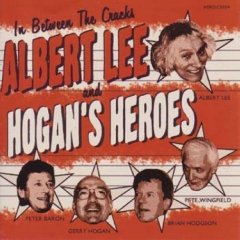
If you wrote a book about popular (as opposed to pop) music and created a character that had worked with The Everly Brothers, Van Halen, Emmylou Harris, Jimmy Page, Richie Blackmore and Jerry Lee Lewis, the first thing is that you'd get a visit from the men in white coats and secondly, you'd find that guitar legend Albert Lee had got there before you.
To call Lee one of the backbones of British music, is to undersell his contribution. It appears that wherever and whenever great music has been played, either Lee, or someone he has worked with, hasn't been far away. And when producers went looking for real musicians to make their 'stars' sound good, it was to Albert Lee they turned.
And yet in the fifth decade of his being a professional musician, he shows no sign of either slowing up or becoming tired of the life.
Given his illustrious CV, it would be perfectly understandable to think of In Between The Cracks as Lee plus Gerry Hogan, Peter Baron, Brian Hodgson and Pete Wingfield. Not a bit of it, all are highly respected musicians and it's to all that the credit for a stunning album belongs.
If you, like me, yearn for the days when musical notes were not preceded by $ signs then you're in luck. While neither Lee nor Hogan's Heroes are in the first flush of youth, their passion for and enjoyment in playing remains undimmed. In fact, experience may have taught them how to enjoy it all more. In Between The Cracks is an album to be savoured and mulled over like fine wine, not gobbled down like a Big Mac and chips.
It also provides a meeting place for the very best , there's a bit of British blues, a deal of country, the zenith of which is a marvellous rendition of I Am A Man Of Constant Sorrow and a vigorous hybrid where everything seems to collide and then form a superb whole.
While I Am A Man Of Constant Sorrow, is undoubtedly a highlight, it is merely one of many. Lee and the band play their rock n roll with relish and Before I Grow Too Old rescues the genre from becoming a nostalgic curio and breathes fresh life into it.
That all five are fantastic musicians is a given, they are not only talented players but skilled at holding an audience in the palm of their collective hand . However it's the spirit and lust with which they play that is the album's real surprise and joy.
In Between The Cracks could well be one of those albums that flies below the radar of deserved commercial success, it may have too much substance for an instant world, Only with You touches a nerve that lies raw within us all. However, the lasting impression of album and band is that there is plenty more to come.
www.albertleeandhogansheroes.com
Michael Mee Kidman 2007
Immortal as the words of the time-honoured Junior Walker hit from which this album takes its title, Albert's axe prowess is both legendary and invariably stunning, so any album he makes is guaranteed to contain stupendous musicianship aplenty. But once that title track's gotten out of the way, Albert springs a surprise on us - he moves across to the piano to augment his guitar playing on several cuts, to round out the picture he wishes to portray, of him as a more than capable multi-instrumentalist, an aspect of his artistry that he's tended to underplay up to now. He turns in equally credible keyboard work whether in honky-tonk or Jerry Lee mode. The choice of material, too, may spring a couple of surprises, even knowing that they represent songs that Albert's known and loved for years: Jimmy Webb's The Moon Is A Harsh Mistress, for instance, is transplanted to the tender side of bluegrass, while Richard Thompson's Dimming Of The Day is blessed with a neat Nashville-country treatment (for which Albert also stages the masterly coup of bringing in his daughter Alexandra for duet vocal). Other successes here include John Hiatt's yearning classic Rock Of Your Love, while Albert also revisits Leo Kottke's Julie's House (he'd first played on the Emmylou Harris recording of the song!). Whatever, the hallmark of Albert's playing is invariably a tasty, unflashy accomplishment within a solid and idiomatic groove infused with years of country and blues sessioning. Just revel in his closing solo on the rocker Didn't Start Livin', his brilliant extended workout on Payola Blues, and his sparring with long-term partner Buddy Emmons' pedal steel on Working On Love! Albert's choice of sidemen is unerring too, making this a most satisfying record.
David Kidman Sept 2006
That's All Right Mama is an exhaustive 79-minute compilation gathering together sessions recorded by Albert for producer Derek Lawrence between 1968 and 1970, many of which have up to now received only a limited (if any) release. There's a pair of singles and an unissued album that were recorded in 1969 for the Bell label, tracks recorded both as solo artist and for Albert's road band/alter ego Country Fever, and finally eleven tracks recorded for an unissued Black Claw album. Most feature the basic band lineup with Albert backed by B.J. Cole, Chas Hodges, Harvey Hinsley and Mick Burt, and it would seem that the only differentiation between the two bands was whether Albert or Chas took lead vocals! The cuts on this compilation all prove likeable forays into that reliable ol' brand of turn-of-the-decade accessible country-rock. No great discoveries perhaps, but just committed and efficient workmanlike covers of staple genre material (Dylan, Band, Diamond, Haggard) spiced up with a handful of rock'n'roll classics, boosted by a few Lee or Hodges compositions showing their mastery of the authentic honky-tonk idiom. A couple of Albert's own finger-lickin' instrumentals are tucked away in there too. Good solid stuff, very much of its time but standing the test of time and still sounding authoritative today.
David Kidman
When I was younger - much younger - I had a mate called Meff - don't ask - who was rather keen on a little boogie. Not the old-time, rolling piano kind of boogie, more the guitar-driven kind as delivered by such exponents as the Allmans, ZZ Top and their ilk. Rocking boogie, I suppose you could call it.
It was common in those days to put together cass tte compilations of favoured tracks by one's favourite bands and, with Meff in mind, I compiled a rather nifty series of C-90s bearing the amusing monicker, or so it seemed at the time, "Hey, Meff, D'ya Wanna Boogie?".
Time's ground on, I've not seen Meff for 20 years or more and C-90s are all but consigned to history, but, were I still compiling, there'd be a few tracks from this, Alvin Lee's latest album, that would be earmarked for inclusion, because, as is evidenced from the first track, "Let's boogie", the old guitar slinger can still, erm, boogie.
"In Tennessee" fulfils a long-held dream of Lee, to play with Elvis Presley's near-legendary guitarist, Scotty Moore, and came about after the two met in London in 1999. A musical friendship was spawned which culminated in their locking horns at Moore's studio in, funnily enough, Tennessee. Moore pulled in old cohorts drummer DJ Fontana, double bassist Pete Pritchard, pianist Willy Rainsford and Hammond organist Tim Hinkley and, thus, one of the tightest, rockingest little bands was assembled.
Lee says: "These guys can learn a song after one listen and put down a great take in one go." So productive was the partnership that all the album' s 11 tracks were on tape within only two days.
Throughout, the playing is exemplary - classic rock'n'roll with each player knowing exactly what to play, and when, and with none over-egging this most satisfying of puddings. Particular mention should be made of the role of Fontana and Pritchard who comprise an awesome rhythm section with some of the most tasteful drumming to be heard anywhere. You couldn't get a fag paper between 'em!
But what of Lee himself? He wrote and sings all the songs and it's clear that he's having a great time - singing with the odd, quite noticeable, Elvis inflection and playing his trademark Gibson with clarity, imagination and no small amount of skill and dexterity.
He is, of course, most famous for leading '70s blues-rockers Ten Years After and for having what were commonly held to be the fastest fretboard fingers in the west. With a nod to his past, the album winds up with what was his and TYA's signature song, "I'm going home", here possibly lacking the raucous attack of youth, but more than compensating with the sagacity and patience of a couple of decades' experience.
So, is it worth Alvin Lee fans of old investigating what he's up to now? Well, if they like traditionally flavoured rock'n'roll played with passion, verve and a sense of fun, definitely. He, like all of us, is not getting any younger, but he's got the chops and the good sense to look back to the roots of the music he loves and, with the help of some of those that were there at the beginning, recreate a little of that old-time magic.
And, on the off-chance my old oppo's reading this, I'll ask the question one more time: "Hey, Meff, d'ya wanna boogie?"
Fred Hall
Often touted as a male answer to Norah Jones (for whom he's provided opening act support), Lee's sophomore solo album doesn't set out to fix anything that's not broken. Still packed with soulful, r&b tinted pop that will prompt more comparisons to Ben Harper, Bill Withers, James Taylor and, here and there, even a mellower Mick Hucknall. Often relying on an acoustic framework, nothing works up a sweat, content to let the groove ease along, shading to gospel on the slow swaying Careless, pulling in organ for the country blues soul Skipping Stones where you might even find yourself thinking of Ray Charles, and plinking along with a banjo in the watermelon patch on the 40s flavoured Sweet Pea.
Largely focusing on songs of bruised love and dented relationships, there's a sense of resignation on numbers like Southern Girl (imagine Neil Young channelling Dobie Gray) and the slow soulful The Wind that he's not fated to find lasting companionship, a mood which, with the addition of the battered family roots sadness of the pedal steel hued Long Line of Pain, serves to make this all a rather melancholic listen. Still, he perks up on the title track, a bluegrass number in disguise that sounds a little like a slowed down Queen of Hearts, suggesting that even when you listen to this alone in your room, wallowing in post break-up misery, you'll still be able to find a rueful smile and the urge to tap the odd toe.
www.amoslee.com
www.myspace.com/amoslee
Mike Davies April 2007
From Rush, Canadian front man singer/bass player/keyboards man and more, Geddy Lee steps out from his normal roll of gathering thousands of rock muzos into stadiums and showing them exactly what Rush can do. Now, with this album, Geddy is doing his solo thing. Alex Lifeson (Rush guitarist) did the same a few years back with his album Victor with excellent effect. This offering from Geddy is truly great also. Is there no end to what these guys can do, even by themselves?
The contents of My Favorite Headache are a wonderful combination of great melodies, excellent guitar and bass, and solid drums, all adding up to what you'd expect from a super group front man. Top marks, I bought it! If you like good rock, good songs, good production, good grief! Its good. Dramatic chords, powerful and combined with some interesting string arrangements - check out the ending of Working at Perfekt.
My ending thoughts. This album brought back memories - allow me to indulge. Showing my age; a teenager with a vinyl copy of Farewell to Kings turning on the deck - that Mercury label offering at that time shaped my perception of rock music with dramatic effect. And today, Rush still do well and fill stadiums. Geddy on his own may not even play these songs live, but one fact is true, his songs and musical playing ability are excellent.
Paul Wood
Julie Lee - Stillhouse Road (Twinbeat)
Throwing shades of jazz, folk and blues into the pot she serves up the goodtiming fiddle swing of Made From Scratch and Soapbox and the bluesy Sojourner Truth and James, but it's on the more yearning, plaintive ballads she shines brightest; the avowal of faith in the Dolly-ish Your Love, the stars waltzing Beautiful Night, the simple quivering Til The Cows Come Home and, best of all, the near hymnal Many Waters where her tremulous voice, accompanied by Krauss, takes to the heavens and back to earth again in her unadorned affirmation of love.
Mike Davies
This has been knocking around for a few years, but the recent upswell of interest in old-school country has upped her profile - and gigging diary - sufficiently to warrant a reminder. A Nashville based singer-songwriter with an acoustic guitar, quivering crystal stream warble and roots in folk-roots and blues, she's also very much a Christian country artist.
Recorded as live in Nashville's Downtown Presbyterian Church back in mid 98, it's a very simple, stripped down organic sound that well suits the sentiments in the songs, the lyrics to several of which are credited to The Bible while others come from sources such as hymns, poems, and, in the case of Pilgrim, Bunyon's Pilgrim's Progress. Lee's own contributions also frequently draw on scripture.
It's not blatantly Godbothering material any more than the old mountain music songs that inspire much of the sound, but it is informed by faith and spirituality, be it in the salvation themed, harmonica flavoured Stranger No Stranger (which is based on both Frederick Buechner's book The Hungering Dark and the old hymn Come Thou Fount of Every Blessing), the devotional submission of Not My Will with its haunting wooden flute, or Birdsong which takes its celebratory words from the poem by a child of the Holocaust. Not for everyone, but those of similar musical and religious persuasion will find much to enjoy.
Mike Davies
Phil Lee did not release his first album, 'The Mighty King Of Love', until the age of 49 and this follow-up shows that age is no barrier when it comes to launching your recording career. The 12 self-penned mini-classics on You Should Have Known Me Then are a prime example of the great music that is out there, if you can be bothered to go and find it.
Good For Me is good old-time rock and roll and a fantastic way to open the album. As Phil says "For best results: Crank it up. Babylon with its gritty lyrics is Tom Petty through and through and he even looks like him in some of his photos. Jay Bennett, John Stirrat and Ken Coomer from Wilco help out on this one as they do on the understated Just Some Girl. These are Alt. Country at its best and they will grow on you.
Carl's Got Louise is a rhythm and blues thumper which is humorous but effective lyrically. Keith Taylor lends some excellent lead guitar. I'd imagine that this is a favourite in Lee's live set. 2 For The Price Of 1 and Any Harder Than It Is are country tinged with all the ingredients. The latter is blessed with some plaintive vocals and Taylors crisp guitar is there again.
Jemima James is a country blues with Richard Bennett providing National Steel guitar. Effective use of distortion on the vocal gives an 'authentic' feel. From the lyric on this song I don't think you want to cross this woman!!
Daddy's Jail. Lee's all revved up for this one. A tale of rebel youth and not wanting to be thrown into daddy's jail (his father was a lawman).
Faces In The Window is an acoustic, country tear-jerker that shows Lee is a rebel with a conscience. He shows that lyrics do not have to be visually hard to be hard-hitting. The easy to listen to Nobody's Gotta Know is in the Tom Petty/Steve Earle mould and It's Crying with vocal assistance from Alison Moorer no less has Phil adding a touch of Roy Orbison into his voice. Their voices work very well together on this.
The closing, title track has Phil playing guitar, singing and Dylan-esque harmonica - nothing else. The humour is there again as it has been throughout the album but he shows that he has a dark side as well. Lee says that the songs on the album are mostly true and if that is the case then it is no wonder it took him so long to start his recording career.
www.shanachie.comsampirt.co.uk
www.phillee1.com
David Blue
With a voice as whispery as his whiskers, the York based 21 year old is the latest to be saddled with the next big introspective singer-songwriter hype, an impossible task that places undue pressure on his debut album to be the British Bon Iver.
It certainly opens well with the breathy Pictures, plucking a simple watery acoustic guitar line as he presents a series of 'what ifs', slipping softly into the equally hushed, pretty Box Of Stones with its tick tocking rthythm, soothing violin, choral backing and seafaring imagery. The problem is that the mood never changes throughout, producing an album that caresses you so softly that you may well doze off before it reaches the end.
Which isn't to deny his gifts. Shine is lovely shimmering folk pop steeped in romantic innocence, Atlas Hands conjures the summery starlight mood of The Byrds circa Notorious Byrd Brothers, 1904 has that laid back Jack Johnson shrug and, nodding to Ryan Adams' version of Wonderwall with its guitar loops, the dreamy Butterfly Culture neatly encapsulates the album's themes of sex, faith, love and lies.
Again demonstrating his fingerpicked style and Elliott Smith influences as well as warm gypsy violin, the title track is another treat, but there's so little differentiation between the numbers that they work best in bite size pieces rather than a single serving. He's certainly worth exploring, but next time round he's going to have to build up the arrangements and vary the pacing if he wants to build and sustain a career.
www.benjaminfrancisleftwich.com
Mike Davies August 2011
Doug Legacy is one of those fellows you automatically classify under the heading musician's musician. The multi-instrumentalist has toiled away on the sidelines for many years, working with the likes of Rickie Lee Jones, Billy Joel, Rod Stewart, Todd Rundgren and Paul McCartney. His regular live outfit, the Zydeco Party Band, have recorded several rollicking albums and score a 110% cool rating for being the house band on the Muppets Tonight television series.
Dougs latest release Sittin On Top of the World sees him team up with Swiss blues outfit the Donkey Biters for a fiery CD, which is full of standards by the likes of John Lee Hooker, Howlin Wolf and Ray Charles. As a singer and pianist, Doug Legacy is hard to fault. His boogie-woogie playing, Zydeco accordion and gravely voice put him in the league of Dr John and Professor Longhair. And just like those legendary figures, he never lets things get too mawkish or down-hearted. The joy in his playing is infectious. He also manages to bring some of his friends along for the ride, with guest appearances by Mark Shark and Lee Thornberg. The Donkey Biters are no slouches either. Having played such prestigious events as the Montreux Jazz Festival and toured with harp player Mojo Buford, they are as down-home as it gets when it comes to the blues.
The 13-track CD swings along at a frenetic pace, like a bourbon-drenched house party in the Big Easy. Like a bottle of Jack Daniels, songs like Earthquake and Hurricane, Back Door Man and Walkin to Lousiana should best be enjoyed late at night, with friends. The good times always roll when Doug Legacy is in the house.
Jamie Hailstone, July 2006
www.myspace.com/otispfunkmaster
The band's biography claims that the members of The Legendary Train Hoppers come from four of the best bands in Fort Wayne, Indiana. I say claims because on the evidence of Ramble On it is difficult to believe that Fort Wayne, or indeed Indiana, boasts a better band than this, never mind four.
The Legendary Train Hoppers and Ramble On provide two reasons why the term Americana is necessary. Their brand of music lives in the gaps between genres, not country enough to be true country, nowhere near country and western and not rock 'n' roll enough to nail their colours to that particular mast. Rather perversely the combination of all these is also a little difficult to pin down.
And all that originality comes from the potent mix of talents supplied by the seven members of The Legendary Train Hoppers. As Ramble On progresses it simply refuses to be tied down or constrained, you get the distinct impression that there is no great career plan about it all. The only ambition the band seems to have, is to play the kind of driving, spine-tingling music it would like to hear and play it to the best of its collective abilities.
And it's that sense of freedom that allows Ramble On to fly high and free. The band captures a rough-edged sound so perfectly that it becomes infectious. The lack of any pretence and total absence of 'machine -tooled' country rock slickness, means you're never quite sure whether the band is in total control of tracks like Not Amused, for a great part of the track, the band members seem to be playing independently of each other and when they do eventually collide, the friction created generates a crackle of electricity.
There's also a streak of fun a mile-wide running through the music, in another century The Legendary Train Hoppers would be the kind of boys that made Saturday night hell for god-fearing folk, This is a band with a good time on its mind. But there's also a classic feel to Ramble On, The Banks Of The Cumberland is an old-style country music, family tale, describing the exploits of Trainhopper Matt Kelley's grandfather who was, you guessed it, a train hopper and may or may not have written the Roy Acuff hit Wabash Cannonball. Whether he did or not matters little because it provides the fuel for one of the album's standout tracks and one that also captures the essence of what makes this a great album and anyway, the truth never got in the way of a great song before, so why should it now?
On Ramble On, The Legendary Train Hoppers have picked the pockets of country, rock and blues and used the treasures of each to brilliant effect. It's an album without grand ideas but it's one that is full of fulfilled potential and one that is a pure joy from first to last.
www.trainhoppers.net
www.myspace.com/thelegendarytrainhoppers
Michael Mee, July 2006
Vivienne Legg comes from a long line of traditional singers in her extended family of Orchards, Leggs and Renals. This disc of brand new recordings of Viv's singing (made by John Adams down in Cornwall) aptly follows on from the two earlier Veteran releases of Legg family members (Viv's mother Sophie and aunts Charlotte and Betsy on Catch Me If You Can, and her brother Vic on I've Come To Sing A Song). Viv's own singing betrays not a hint of nerves or unsteadiness - even though, as she readily admits, she had originally needed "a big push" from her mother to go out and sing these songs. I'm so glad that Sophie succeeded, for Viv's wholehearted embracing of her mission to keep all these old songs alive has given us a splendid, and entirely enchanting, disc. She is now able to bring to a wider audience the songs that Sophie, Charlotte and Betsy sang; these mostly consist of her individual versions of broadside texts (Erin's Lovelie Home, Young Sailor Cut Down, The Banks Of The Clyde, Saucy Sailor), interspersed with a strong contingent of sentimental songs (The Prisoner Lad, Downhearted Soldier, The Prisoner) that have remained in Viv's family repertoire although some of them have all but disappeared from elsewhere. Then, some other songs, like The Poppies In The Corn and Quaint Little Cottage, are acknowledged as being of obstinately untraceable origin! I really like the way Viv sings: compelling and commanding, yet with a loving caressing of details of phrasing that doesn't degenerate into mannerism (with the possible exception of her rendition of the music-hall ditty Mary Ann Matilda, which maybe rather asks for it!). Viv's superbly characterised take on the ancient traditional ballad The Broomfield Wager is very attractive too. The 16-page booklet has full notes and Viv's own biographical memoir; texts are available on Veteran's website.
David Kidman
Seeing the album cover and the title, not to mention sharing her name with the isle of Celtic spirituality, I confess to my heart sinking at the prospect of some sub Enya ethereal warbling or, worse, the sort of new age meditation music you tend to find providing the musak in heavily scented Glastonbury emporiums or National Trust shops.
Mercifully, while the shruti box playing Leigh did grow up in the remote Findhorn community (though she was born in Australia), she appears not to have been exclusively nurtured on Celtic mists and myths. Indeed, the opening track, Peaches in The Summertime (inspired by and filching lyrics from American folk standard Shady Grove), is much more akin to a tinkling summery Corrs pop song without the stadium overkill.
Which isn't to say she doesn't draw on a rich musical and cultural heritage. A jaunty The Girl He Left Behind harks to a trad 18th century Scottish ballad, I Let You Go (reworked from her debut album) is inspired by a Tennyson poem, Let Erin Remember is a breezy pipe trilled folk rock tune with lyrics from Irish poet Thomas Moore's tale of Malachi, a 10th century Irish King, while The Selkie conjures the Gaelic legend of the man who falls for the maid of the sea.
Elsewhere Blackbird fuses a pair of trad Irish ballads, Must I Be Bound is based on 17th century lament The Water Is Wide (and does sound a touch Clannad, to be honest), Brown-Haired Maiden is a setting of a Scots Gaelic ballad and Blow The Candle Song is a 21st century melodic update of a 1920s courting song.
Things come over a bit 'hello sky, hello clouds' when she talks about writing Trees while meditating in a park and finding comfort from grief in the 'wise and healing tree beings' (the while, even if the song has been adopted by the Trees For Life charity to save the depleted Caledonian forest. it would require far less cynical ears than mine to not wince at its 'thank you for your leaves' lyrics.
However, skip buttons are made for such occasions and the album avoids the earnest fustiness that sometimes hovers around nu-trad folk, Leigh's pure voice weaving its magic to particularly good effect on the final semi-acapella hidden track No More Tears.
www.ionaleigh.com
www.myspace.com/ionaleigh
Mike Davies April 2009
Mark Lemhouse - The Great American Yard Sale (Yellow Dog Records)
This is Mark Lemhouse's second album for Yellow Dog and follows his much acclaimed debut, Big Lonesome Radio. He has added banjo and electric lap steel to the National steel and electric guitar of the first album and it's a short banjo burst that introduces Scarlet. After this, the song explodes into life and this original Americana shows how good a lyricist Lemhouse is. Banjo and lap steel abound on Paper Sack and this laconic tune just feels and sounds like America personified. I'm Worried is a simple yet effective country blues and Lemhouse's lived-in voice turns this into a classic - brilliant!
Leroy Feller's Blues has distinct Johnny Cash influences and would not out of place on a cowboy film soundtrack. Lemhouse is a born storyteller and this tale is a standout amongst standouts. Never Me is not blues and it is not Appalachian but an amalgam of both. The sparseness of banjo and voice highlights the fact that this guy can sure carry a tune. The roots theme continues on Cluck Old Hen, a traditional song given a rough, earthy makeover by Lemhouse and Salem, a splintered country offering that shows his lyrical talent again - 'I'm cold like a rock in the shade' is an example.
The excessively long titled Nothin' In The World Can Stop Me Worryin' 'bout That Girl is a high standard country blues/rock based acoustic classic and leads into the slightly less wordy The Unofficial Ballad Of Story Musgrave. This is early Dr. Hook style country and, like the other tracks, has Lemhouse doing most of the work with only a couple of people, if any, helping out. The Queen Of Easy Street has a full-on sound and slide guitar to the fore. This has another of his simple and effective lyrics such as, 'She's always painting the town with someone else'. This shows his prowess as a guitarist and there's a musical saw in there somewhere, just listen!
Hazy is a return to the starkness of guitar and vocal as Lemhouse drawls his way through to the final track, You're A Bastard. This is good fun country and, when you think about it, it's really what we all want to say every now and then. It's a great way to finish a classy album.
www.marklemhouse.com
www.yellowdogrecords.com
David Blue
Wire's Fragile gets a unexpectedly successful transformation into strummed folk-country, GG Allin's murder ballad Layin' Up With Linda is delivered in perfect pastiche Lou Reed, Waiting Around To Die stays true to the Townes template while among the more obscure choices there's the 70s psychedelic funky wah wah of July's Dandelion Seeds and Yesterlove, a terrific sparse darkling folk reading of a song by 60s British psychedelic outfit Sam Gopal (which featured future Motorhead man Lemmy on guitar), complete with tabla backing in honour of the original.
While Liv Tyler doesn't actually ruin the hushed, near spectral Hey, That's No Way To Say Goodbye chances are you will want to reach for the skip button when a tuneless Kate Moss takes the vocals on a reboot of club hit Dirty Robot (surely Dando must have better chat up routines than 'do you want to sing on my record?'), but otherwise this is exactly the sort of mixtape you'd put together for a mate to listen in the car.
Mike Davies June 2009
Belfast-born but now residing in Galway, Noel's a singer-songwriter who creates original songs that, though steeped in Irish tradition, are not easy to categorise; he's also a gifted flute player (and teacher) and proficient mandolinist and guitarist. In the 70s he travelled extensively in mainland Europe and the area around the Great Lakes before stints with bands Rakish Paddy, the Rambling Boys Of Pleasure and the Druid Soul Band, then finally released his first solo CD, No Trouble At All, in 2003. Musically, Noel draws his principal inspiration from the ground-breaking work of the McPeake Family, Dubliners and Clancy Brothers, with a strong influence from the innovators of Irish music of the heady era of Sweeney's Men, Declan Corey and Brendan Hearty, with nods towards the cheekily quirky offshoots of that scene like Dr. Strangely Strange and Tir Na Nóg. Noel clearly has great respect for tradition and his roots, and presents his stories-in-song in a masterly way that sketches their emotional import and allows the inherent nostalgia to blossom without giving in to sentimentality. He uses lyrical language (it's been described as reminiscent of the Gaelic song tradition), which tends to tumble out in a torrent of words (as notably on the delirious imagery of the title song); at times there's the distinct feeling of the rhythms of speech or conversation (Starin' Fortune In The Face), at others of a kind of lilting incantation (Silence Is A Delicate Thing). Forever Sinking is an intriguing song that in its chorus threatens to turn into Peggy Gordon! At its more florid moments, eg on songs like Mackerel Sky, Noel's singing style can be curiously reminiscent of Vin Garbutt, while at other times (Billy Buller's Finger) his phrasing and attack also reminded me of Terry Conway. For the most part, the musical palette is simple and restrained, the character of the accompaniment to Noel's guitar or mandolin is very much determined by Adam Costa's wiry fiddle playing; accordion, banjo and bass appear but fitfully, and Noel himself only picks up the flute for one song. This release has considerable musical charms, which are enhanced by the attractive booklet artwork and design.
David Kidman May 2008
Korby started out his career in bluegrass, notably as lead singer and guitarist for the Barbed Wire Cutters, then began putting out solo records, of which the first I heard, Bellingham, impressed me a lot when it came out back in 2004. Since then however, I'd not heard much of him – tho' I learn he's lately been appearing alongside Steve Earle and Emmylou Harris and opening for Keith Urban and Nickel Creek so things can't be all bad! King Of Hearts, though ostensibly the followup for Bellingham, marks a new departure for Korby, in that it presents a more rock-oriented slant on Americana than any of his previous efforts. Korby also now takes his turn in the producer's chair, and proves himself extremely adept at getting exactly the right balance of elements and textures to put his songs across and display his considerable musicality. The standard guitar/bass/drums lineup (Korby, Andrew Simmons and Scott Mercado) has seldom sounded more persuasive either, especially when (as here) augmented gently by occasional lap steel (Mike Grigoni), Hammond (Michael Connolly) and some beautifully etched extra harmony vocals. The whole affair exudes a compelling and varied alt-country groove, in fact, on which I was pleased to note that Korby's not lost that wonderfully heartfelt, hushed and intimate singing style that he so naturally uses to express his increasingly intriguing lyrics. This is an album of standout compositions in fact, all shot through with what's already been dubbed a lived-to-tell-the-tale honesty, from the deeply felt autobiographical Cedars Of Lebanon and Dog Down To The River through to the funkier philosophy of If It Is and the coy come-on of Wandered Out Too Far; Korby also moves into Kennedys territory for the more poppish Billygoat and Bored, though with no loss of artistic credibility anywhere down the line. And the time-stands-still beauty of Angel Of Mercy haunted me long after its four-and-a-half minutes had elapsed; I just had to put the track on repeat immediately 'cos the ensuing Come Closer and the fun bonus track Myspace Song, being rather slighter material, didn't quite sit right thereafter. That comment aside, I still rate King Of Hearts very highly indeed; it's quite an achievement, and I predict I'll be making a serious effort to catch Korby live when he tours the UK this spring.
David Kidman January 2007
Although Idaho-born, Pacific Northwest-based Korby's been lead singer and guitar player for noted bluegrass outfit the Barbed Wire Cutters for around four years, this almost-solo effort is my first taste of his artistry. Although billed as a solo outing, Bellingham features almost as prominently the tender dobro playing and equally tender singing of Mike Grigoni. It's a fresh-sounding yet timeless-tinged calling-card for the two musicians that by rights should bring them both considerable acclaim. Several times when playing through this set I was potently reminded of the kind of low-down-high-lonesome blend of Gillian Welch and David Rawlings, such is the intimacy and delicacy of the bond between Korby and Mike; it's pretty special to behold. Korby's songwriting talents are rather formidable too, for he proves himself a master of both modern-day Americana - you'd be hard-pressed to forget Traded By Diamond or Papercuts or Shed A Little Light after only one hearing, for instance - and inspired folk-homage (Old Shenandoah is an affectionate remembrance, told as a portrait of an old seadog). Well, perhaps just one or two of Korby's songs aren't quite as immediate in impact as those I just mentioned, but those are the highlights after all and his command of that authentic bluegrass-Americana niche is awesome and the album's audial signature is always impressively powerful and most evocative. Think Doc Watson and Norman Blake filtered through Gillian Welch and Jeffrey Foucault, and you're probably gettin' close. And the album's one cover (the Louvins' Angels Rejoiced Last Night) proves perfectly in keeping with Korby's artistic vision too. Oh, and I forgot to mention that Korby and Mike bring Jolie Holland in for some very occasional, but delicious background vocals. All in all, I reckon Bellingham a really outstanding album, one that I'm sure I'll be returning to often in the coming months.
David Kidman
David Kidman
Neruda and the equally cello heavy Dido serve an opening course of minimalist, atmospheric rural chapel folk before Make It The Mountain arrives, shuffling round on a brushed country melody, to be followed by the title track's psych blues jam, the vocals distant in the mix behind wailing guitar and sounding like she's singing to herself.
Production values are largely non existent, but it does give the album a similar down-home cabin feel to the likes of Bon Iver and co as Leonhardt's strength with words and slowly beguiling melodies slowly work their magic.
There are a couple of things you'll need to work at, notably the dissonant, rumbling gospel Let The Wretched Come Home, but there's treasure to be found in the spare maternal themed, trad flavoured Black Madonna and Me And Abigail, both with just Jeff Rady's resonating guitar accompaniment. The broken and destructive relationships respectively fuelling the mournful, fiddle stroked backwoods hymnal folk of More Rope and the late night hillside stargazing mood of Line Of Fire provide album highlights, while the acoustic Kerby Lane Jubilee wraps it up in classic early Joni style. Or at least until two further 60s tinged hidden tracks turn up, one which (possiblye called 24 Hours) I assume is actually bassist James Bullard singing and one which cuts seems to have run out of tape before the end and which suggests Leonhardt might have some Tanya Donnelly records among her collection.
Mike Davies November 2009
At first acquaintance (and I'm not sure exactly why), I quite warmed to this Norwegian singer-songwriter on Heartbeat Radio (his sixth album). But then, not all the time. His is a somewhat quirky presence, edgy but not especially biting, and with an intelligent enough indie-pop sensibility and ear for catchy arrangement that offsets the rather eccentric (and inconsistent) nature of his invention. Sondre has a smooth, well-controlled singing style, and though not without a certain element of cutesy-posing in the phrasing and delivery that reminds me of Rufus Wainwright it doesn't always irritate or become a mannerism. He also has a penchant for orchestration, from Beatlesque Eastern-style string decorations (on the title song), showtime-cinematic flourishes (Like Lazenby): a tendency which can more often than not spoil rather than enhance the impact of his writing.
The unpredictability of Sondre's music is another stumbling-block: you never know whether the next song will immerse you in gawky chamber-pop, or savvy glittery psycho-funk (If Only), Randy-Newman-esque melancholia (I Guess It's Gonna Rain Today), or even blue-eyed soul (I Cannot Let You Go). There's sometimes too much overdosing on tricks and effects, obviously Sondre's attempts at trendsetting (or trend following), but they mostly fall rather flat. And some of Sondre's songs (the twee Words And Music for instance) really do verge on embarrassing. Yes, in the end (and despite best efforts) the nub of Sondre's talent proves more than a little elusive - if his music leaves any impression, it's one of stylishness but little lasting substance.
Some tracks bore quickly but then develop stature later, whereas others intrigue early on then soon wane, and others are ruined by the interpolation of unduly attention-grabbing grandiosity or unnecessary dramatic passages; then again, some other tracks are almost wilfully bland. The novelty of my initial admiration for Sondre's creativity wore rather thin during the course of the record, unfortunately.
David Kidman December 2009
Out of Bergen, current hotbed of Norwegian musical cool after spawning both Royksopp and Kings of Convenience, Lerche has already earned himself a Gold album and Scandinavian Grammy. There's definite hints of early Bowie and Al Stewart on display both vocally and in the folksy pop song construction of such numbers as Suffused With Love (where theramin comes into its own), Side Two, You Know So Well, and Things You Call Fate. But it's not all naif young man with a guitar and a sensitive heart stuff and On And Off Again, Virtue and Wine, Modern Nature and the hypnotic gigolo swaying opener Dead Passengers it's clear his record collection includes a fair representation of Bacharach, Cole Porter, Beautiful South and 60s Gallic pop crooning too. Beck seems likely to be a comparison that pops up in the reviews and Lerche himself cites the High Llamas whose Sean O'Hagan has arranged strings on three of the songs, but Momus and Arthur Liman could easily be names that comes most to mind too. A bit cheesy in places, but well worth the investigation.
Mike Davies
Holly Lerski - Life Is Beautiful (Sanctuary)
Mike Davies
Chris Leslie - Dancing Days (Talking Elephant)
Fairport's fab fiddler brings us a sort of concept album that's a highly personal tribute to, and sincere evocation of, the spirit of morris. It's mostly done solo (overdubbed as needed), but around half of the time with the selective aid of mates (mostly fellow Fairporters Peggy, Nicol, Sanders and Conway, also Ashley Hutchings and Mat Green in cameo appearances). But it's not, emphatically not, just a whole album-full of predictable retreads of morris tunes. Sure, there's new arrangements of the chestnuts (Princess Royal, Speed The Plough, Old Tom Of Oxford, Haste To The Wedding etc etc.), many from the celebrated Oxfordshire sides naturally, but Chris dresses these up stylishly while retaining the essential feel of the dancers being driven by the power of the music to move along the "ancient rhythmic paths well trodden before". His talent is (as he himself describes it) to ensure the tunes are "given a little stretch"! As well as the fast-paced dance tunes themselves, Chris also includes two vocal tracks – one's a jaunty setting of a poem by Janet Blunt (an early song and dance collector in Adderbury during the early years of this century), and the other's Chris's own superb song The Dancer which emphasises the concept of the ancient power of the dance, which along with some of the slower mood treatments creates a potent and timeless atmosphere all their own. Several of the dance tunes are arranged fairly straight (tracks 2 and 8 for instance), some with Chris showing off on bouzouki or mandolin as well as violin (listen to the gentle grace of his quite spooky arrangement of Old Marlborough for instance, contrasted with the sheer verve of the Sweet Jenny Jones/Brighton Camp/Beaux Of London City set at track 9), whereas on others Chris employs more unusual instrumentation (kalimba, Native American flute, percussion) to complement the more orthodox instrumental sounds. It all adds up to an invigorating musical experience that transcends the "accepted" boundaries of morris by affectionately driving the tradition forward while fondly casting a backward glance at its heritage. And the final track (A Secret) includes an unbilled stepping rendition of Happy The Man where "his thoughts take him back to the old dancing days" to round off the tribute – just so.
David Kidman
Jeana and Siobhan (winners of 2008's BBC Radio 2 Young Folk Award then nominees for the following year's Horizon Award, you'll recall) are definitely fast-rising stars on the Scottish music scene: their 2009 debut album In A Bleeze was a real breath of fresh air that made a selling point of their beautifully blended voices and accomplished, intuitive musicianship.
The followup, Shadows Tall, builds on the promise of the lasses' debut in fine fashion, as you can hear right from the outset on the opening track, an assured rendition of the cinematic ballad Johnnie O' Braidisleys that's set to a restless accompaniment of piano, marimba and guitar with telling use of added percussion. It's an indication of the skill and thoughtfulness of the duo's approach that here, as throughout the disc, the inventive and interesting arrangements never swamp or distract from the lasses' telling of their stories-in-song. The core ensemble of Ewan MacPherson (guitars, mandolin), Mattie Foulds (cajon), Kevin McGuire (double bass) and Signy Jacobsdottir (tuned percussion) provides an ever-intriguing musical backdrop that springs some subtle melodic and rhythmic surprises while remaining unobtrusive.
The lasses' vocal performances are exceptional by any standards: I particularly enjoyed Siobhan's stirring account of Ian Sinclair's poignant anti-war song The King's Shilling (never done better, I'm convinced), here very relevantly coupled with a sensibly unrushed and finely balanced acappella duet account of Buttermilk Hill. And placed right at the end of the CD is the disc's second showstopper: a spine-tinglingly poised yet eerily sure-footed version of Richard Thompson's mournful and strangely neglected masterpiece The Great Valerio.
Other really special moments include The Lost Licht, Siobhan's own intensely-realised setting of Violet Jacob's heart-rending poem depicting a mother's grief, and her plaintive rendition of Kate Rusby's Who Will Sing Me Lullabies? (here aptly conjoined to two verses of an Orcadian dialect lullaby). So, as you can gather, Siobhan and Jeana's choice of material is uniformly inspired, with a keen use of creative juxtapositions. If I've any complaint about this record, it's that we don't hear quite enough of Jeana's excellent fiddle playing – she tends to concentrate on piano and harmonium, only picking up the fiddle for three of the disc's eleven tracks (the lone tune-set, placed midway through the disc; Jeana's fanciful big-top waltz that permeates Valerio; and the merry drinking-song Blyth, which is capped by a jointly-penned instrumental, Thorsvoe).
As with the lasses' previous CD, the studio feel is close-knit and intimate (with Mattie in the producer's chair this time round), and it's impossible not to be drawn in. Their debut was extremely promising, but the followup has raised the stakes considerably and the result is really very impressive indeed.
www.jeanaleslieandsiobhanmiller.com
David Kidman August 2011
Jeana and Siobhan, winners of 2008's BBC Radio 2 Young Folk Awards, proudly present their debut CD, on which they perform a well-balanced mix of traditional and contemporary songs with a couple of tune-sets thrown in for good measure. Orkney-born Jeana plays fiddles (hardanger as well as standard fiddle) and piano, while both Jeana and Siobhan sing – and extremely well too. Although each of them has a distinctive vocal timbre (Jeana's gentler and softer, Siobhan's arguably more full-toned and feisty), and they take it in turns to lead or solo individual songs, their voices blend together quite spine-chillingly to give an eerily close-knit, almost sibling quality – they must be heavenly in a live setting!
There's an intimate, close-as-live quality about this disc, even though it's obviously a studio-based recording, featuring as it does a host of "session musicians". That unpretentious catch-all grouping hides under its bushel some of the finest talents on the Scottish music scene: Innes Watson and Brian Miller (guitars), Lorne MacDougall (pipes, whistle), Martin O'Neill (bodhrán), Davie Henderson (djembe) and Kirsteen Miller (backing vocals),and last but emphatically not least the album's producer Brian McNeill (fiddle, concertina). The lasses' choice of material is significantly inspired, with often unusual arrangements of traditional songs that, while of strong character, are sufficiently pared-down to enable full concentration on the words and the (uniformly excellent) singing.
The disc's opening salvo is a forthright rendition of the bold tale of The Burning Of Auchindoun, capped by a scintillating classical-style piano tune of Jeana's own devising. The following track couldn't be greater contrasted: a beautifully expressive treatment of Phamie Gow's valedictory Goodbye To The Sea And Sailors, and one of the disc's standouts – another of which, coincidentally, is Michael Pentergast's Three Sailors (a real discovery for me), on which Jeana's delivery put me in mind of Karine Polwart. Other back-of-the-neck moments come with the intense, unaccompanied Mary Mild and a mildly epic (Winterset-style) treatment of Time Wears Awa'. Siobhan's own deeply-felt composition Familiar Faces is an early indication of another potentially strong facet to her musical personality. Some intriguing harmony work sets the seal on Jeana and Siobhan's keen interpretation of David Francey's Saints And Sinners, while on Mad Tom Of Bedlam the lasses are clearly having great fun with some near-insane vocal interplay that teeters on the edge! For the disc's closing item, Jeana and Siobhan forsook the studio – The Parting Glass was recorded live at the awards concert, and has a great sense of occasion (complete with audience participation). Yet, although the songs are the principal focus of the disc, the two instrumental sets show Jeana's stirring and movingly lyrical fiddle playing as a tremendous talent that fully complements her vocal prowess.
This album is one hell of an achievement, notwithstanding other factors such as Brian's guiding hand and all those fine additional musical contributions which, sensitively managed and in due perspective, steadfastly refuse to eclipse the personalities of the two lasses, who I'll be watching closely following this abundantly impressive debut - a mighty hard act to follow, indeed.
www.jeanaleslie-siobhanmiller.co.uk
David Kidman June 2009
Introduced in 2002, it's taken eight years of explorations and on and off recording sessions between solo projects to provide the final selections that comprise the collaborative debut by LA's singer-songwriters Tom Brosseau and Angela Correa. It's been worth the wait.
Working from a starting point of Leadbelly,Guthrie and Sister Tharpe, the sessions embraced stripped down harmony vocal and guitar arrangements of American standards and traditional folk songs, thus the album roams across the years from crooningly minimal version of calypso Rum And Coca Cola, Woody's Pastures of Plenty and a muted take on Kay Starr hit Wheel Of Fortune to more 'recent' numbers as John Prine's late John Garfield Blues and a chorus shorn a capella cover of Dylan's The Lonesome Death Of Hattie Carroll.
To be honest, the latter doesn't really come off, sounding all rather flat and uninvolved, a far better unaccompanied track being their playful thigh slapping and finger clicking run through of Green Door.
Correa takes the solo spotlight for Deep Purple and The Band Played On, both of which conjuring images of her singing on A Prairie Home Companion, as does Brosseau with Cocktails For Two (a song which will unfortunately never escape from Spike Jones' clutches) but it's their shared voices that give album its nostalgic charm, most wonderfully so on the opening The World Is Waiting For The Sunrise, a 1918 ballad best known from the million seller by Les Paul and Mary Ford.
There's obviously a lot more material lying around from the sessions, so hopefully these too will surface. The worst thing they could do, though, is succumb to the temptation of a studio re-recording polish.
www.lesshelleys.com
www.myspace.com/lesshelleys
Mike Davies November 2010
The tracks are mainly acoustic guitar based with traditional accompaniment of bass, drums, violin and occasional pedal steel. The straight-forward arrangements serve the songs well as the interplay between the instrumentation and vocals is striking and creates a sense of drama and dynamics that really highlights the strong lyrics.
As you'd expect from a roots themed singer/songwriter disc, the songs have a slight downbeat feel with stories of unrequited love, loss and soul searching setting the overall theme of the disc, but far from being run-of-the-mill singer/songwriter fare, the songs are well written, distinct and compelling stories.
Her vocals are the immediate standout, they're both confident and fragile, and the perfect vehicle for this style of song – the fluidity and expressiveness in the vocals is matched by the excellent musicians and instrumentation and the two compliment each other perfectly.
This is an excellent album full of intelligent songs beautifully performed by a talented singer/songwriter and a strong group of musicians. Very highly recommended.
www.fishrecords.co.uk
www.alanalevandoski.com
Neil Pearson, Fish Records
Fish Records are suppliers of singer/songwriter, folk & acoustic music based in Shrewsbury, England
It must have been difficult being Mark King in the 80s. A member of a hugely successful band, acknowledged as one of the best bass players in the world and the man who was instrumental in bringing the bass guitar from the back of the stage and stuck it firmly front and centre.
And yet, throughout its heyday the highly infectious jazz/funk that the band played better than anyone else was never quite accepted by the musical elite. Loved by the fans, Level 42 was never quite hip or cool.
Anyone who lived through the 80s will undoubtedly be pleasantly surprised to be reminded of just how good the band was, just how deep King's bass riffs ran and just how funky Phil and Ronald Gould and Mike Lidup sounded. Without being particularly exhilirating, Running In The Family and Lessons In Love are instantly and fondly recalled, what's more it's impossible to stand still while listening to the Definitive Collection.
The look and sound of Level 42, epitomised the 80s. Emerging from the anarchy of the late 70s, it was a cool, collected breath of fresh air to hear a band of accomplished musicians treating their art with due respect. King and Co also laid the foundations of the New Romantic revolution which followed.
Anyone too young to remember the band first time round, may be taken slightly aback to learn that Level 42 did not gain the worldwide success that this collection suggests they deserve. That's made all the more puzzling becasue the band's sound is not quintessentially British.
There really is nothing comparable to Level 42 around today, I suppose Jamiroquai came closest but even that's a pretty tenous connection. Level 42 were a band of their time, they made great, great music, a combination of jazz, funk and soul that was warm and inviting. So why has the band been denied its rightful place in our hearts and will the Definitive Collection put that to rights?
Michael Mee, Editor, Hawick News
If bands like the Levellers didn't exist, we'd have to invent them. How else would we know that we were alive?
As the strangled(!) tones of George Bush that introduce this recording from Reading's Hexagon fade away, the band themselves explode into life. It may be commercially less rewarding, but somehow fitting, that the Levellers are recorded playing the not so exotic Reading and Buxton (CD2 features an acoustic performance from the Derbyshire home of trendy water), because their brand of punked up folk rock should remain as close to the people as possible. This is a joint enterprise between artists and audience and, even through the medium of DVD, you can feel the passion and sweat from both.
What you get from Chaos Theory is a hard-working band at the height of its collective powers. From the initial white-hot whirlwind of the first three tracks, the performance grows and develops organically. Chaos Theory isn't just a show, it's an affirmation that talented musicians pouring their heart and soul into the music can still create a thing of wonder.
On much of Chaos Theory in general, and 61 Minutes Of Pleading in particular, the band has built and added attitude and spirit to the legacy of the likes of Lindisfarne, just as the Geordie boys were the 'enfant terribles' of folk rock in gentler times, so the Levellers take no prisoners, they are ready and able to sweep all before them.
For once, CD2 is worthy of the title 'Extras', Live Extras features guests like the 'good as ever' Maddy Prior, Billy Bragg, Rev Hammer Nick Burbridge and Nick Harper and shows that if you root your performance in something solid, anything is possible. The intensity of the band playing acoustically easily matches the ferocity of the electric version. Both incarnations keep the umbilical folk chords unbroken, they've just been taken to a wild place that belongs to the phenomenon that is the Levellers.
Michael Mee December 2006
For his 24th solo studio album (three as Sr Vincent Lone), Leven has elected to work solely with multi-instrumentalist regular collaborator Cosgrave, observing that he felt his best recent work involved their interplay between them. He's certainly not wrong when it comes to the results here, a musically slimmer album perhaps but certainly up there with Lovers At The Gun Club and Fairytales For Hardmen.
The songs apparently mostly written in various German hotel rooms while touring and recorded in Cosgrave's Dartmoor home studio, it opens in a familiar Leven Celtic folk blues mood with Swine Fever Blues, lines about being in Captain Beefheart's band and being a woman walking the Scottish hills in a long black veil reflecting images that raced through his mind during his delirium.
You wonder if he was suffering flashbacks when he came up with the self-descriptively titled Spooky Berlin Hotel Song which interpolates a gothic foreboding chorus of Knees Up Mother Brown that adds to the unsettling mood spun from lines about ancient bullet holes and the ghost of a child with broken bones.
Written in a Hamburg hotel foyer as opposed to a room, Deep Purple Cloak is one of Leven's broken heart numbers, a sort of slow core Walker Brothers tune about falling in love with some colleen, her ardour cooling, catching her with another and, as per the first verse, watching while she moves her stuff out.
With its references to a Leslie Phillips style ding dong' and William Blake, I'm not entirely sure what he's on about in To Live And Die In Levenland other than somehow life seems to get away from you like a penny on a marble floor, but it was apparently inspired by Frankfurt's Gothic cemetery (where one of the graves carries a Blake quote) and features the terrific image of 'licking dreams from the blade of a knife'. It's got a lovely melody too.
All of the songs have some sort of autobiographical element, but Townes At The Borderline is one of the most specific, telling (in an acoustic style that recalls his subject) how he accompanied Van Zandt to hear the bells of St Giles as he sketches a poignant portrait in song of the late legend at the gig.
More deeply personal, he wrote the chorus of the bluesy Beware Soul Brother in an austere religious Munster hotel some years ago, but the arpeggio accompanied verses only came this year following the death of his younger brother, a loss that would also seem to be referenced in the downbeat hometown return The Kirkcaldy Book Of The Dead.
I'm not sure where the reflective Dagenham Dream fits into the scheme of things but it's as lovely as it is brief while the final song, A Kiss On The Cheek isn't even by Leven and Cosgrave, but is rather a poem written and played by film composer John Mayfield and spoken by mystical humanist Gola Wolf Richards, who'll all generously get a share of the album's royalties.
The last track, Backstage, Chelsea Club, Vienna returns to Germany, but bizarrely consists only of Cosgrave reading out the names of bands written on the walls of the club's dressing room over an instrumental from the soundcheck and various Viennese street sounds. It's a lot more entrancing than it sounds in print, but I wouldn't suggest requesting it at any of the upcoming gigs.
Mike Davies September 2011
You should know by now not to expect anything shallow from Leven's pen, and his latest studio offering is no exception. According to his blurb, we all walk two roads; the Royal Road and the Road of Poverty and Death. He's a little vague about what these actually represent, but says that when the two meet they form the Gothic Road. I guess it's a bit like finding the balance of the Yin and Yang, reconciling the pessimistic and the optimistic to forge a workable equilibrium of life.
Whatever the metaphysics - and it may all just be poetic smoke and mirrors - the album comes loaded with pop culture references. The slow march opening title track (guessingly about the need for clear emotional communication) quotes both Ian Curtis and Dylan amid its swirling guitars, the chorus line from Temptations/Marvin Gaye song 'Too Busy Thinking 'bout My Baby' turns up in the bouncy Cat Stevens pop of In A Shivering Blaze, and a sepulchral marriage of spaghetti Western and Eastern European chant Last Of The Badmen borrows its melody from Dolly Parton's Jolene and includes the misquote line 'please don't kill me just because you can'. The spare bluesy Song For Bass Guitar and Death's meditation on mortality even tips the hat to Mud's Tiger Feet. Dipping further into his record collection, he also includes a brooding jazzed over cover of Shadow Of A Man by punk poet Patrick Fitzgerald.
Elsewhere, again dealing with the enormity of masculine need and emptiness, there's the Celtic flavoured country blues John Paul Getty's Silver Cadillac (which may well contain a musical trace of Michael Martin Murphy's Geronimo's Cadillac) where a girl presses him hard against her honeyed bone.
Maybe it's to do with the prevalence of songs about having being dumped by or separated from a lover, but Leven's libido gets quite a working here. On Absolutely Joan Crawford (With A Bit Of Tilda Swinton On The Side) he fantasies about both them (Swinton snores, apparently) and Patsy Cline, but says he'll give them up if his departed lover comes home. But then sexual frustration rears its head again in the playful life on the road of Hotel Mini Bar where (again wryly indulging a wish to feel like a star) he dreams of being propositioned by Cher. Still, he does turn her down in favour of the fridge contents.
It's not all sex, death and celebrity culture names though. Pairing with 'fabled English renegade' (sic) Ralph McTell on second vocals, Cornelius Whalen is a tribute to the (then) last living member of the 1936 Jarrow marchers, an inspiration on how to live a life. Generosity clearly one of the required attributes, as with Lovers At The Gun Club Leven again gives over the final track to another artist. Here it's Welsh singer and co-producer David Wrench whose meditative (and Levenesque) piano ballad Island may come as a bit of a surprise to anyone familiar with his usual diet of camp synth pop.
Apparently Leven was a Kircaldy High School contemporary of the equally Fyfe born Gordon Brown. When it comes to enriching our lives, I know which one gets my vote.
www.jackieleven.co.uk
www.myspace.com/thejackieleven
Mike Davies April 2010
The other disc is a mix of studio and live material, the latter featuring five numbers recorded in Germany. Of these, three stem from the 2003 Acoustic Stories tour. The driving Classic Northern Diversions is preceded by a lengthy intro, spoken over strummed guitar, about the song's inspiration in seeing the despairing looks on the faces of the men in the streets of Belfast. That then segues into the broodingly powerful Extremely Violent Man and the self-examining My Philosophy, a song which, he explains, was inspired by a fit of depression and two London policeman who got him out of it.
The two other German recordings (presumably from the same tour, but a different venue) offer the wheezing, meditative Paris Blues (which appears on all four of the reissues) and Sting's Dead (Story Of The Sad Death Of The Well-Known Singer) which isn't actually a song at all but rather a 10 minute preamble about the trouble he got himself into on a Glasgow train when, in order to avoid the wandering hand of a gay passenger sitting next to him, he announced that Sting had been killed in a helicopter accident. You probably had to be there.
The three studio numbers feature Woman In A Car (which would later turn up on the current Lovers At The Gun Club), Autumn and Little Brown Box, the latter two, warm and reflective both, not, to the best of my knowledge ever having appeared on a studio album.
To bring the whole project to an end, the closing track, recorded at the 2002 Christmas party in Derbyshire with Joe Shaw and Kevin Hewick, is a full blooded wailing spooked blues version of Barefoot Days, itself a track that's only ever previously featured on the Summer edition of the Haunted Year cycle.
Mike Davies November 2009
Taken from a show at the Black Horse in Otley, Yorkshire, disc one actually opens with the studio recorded title track, Leven in familiar contemplative downbeat mood as he ponders on mortality with death always following a few steps behind while the live Desolation Blues is no less cheery as he sings of his dead heart and the funeral of his best friend. That would be partly about his old mate Scots John (not to be confused with Scouse John, another mate whose death he talks about in the sleeve notes) who provides the subject matter for a near seven minute anecdote. Indeed, the between number rambles often run longer than the songs themselves.
They're fascinating though, case in point being How He Met Joni Mitchell, Matt Monroe and The Chip Packet/Dirty Underpants, where he goes from recalling treading on Joni's foot in Soho to declining singing a request because, without the falsetto, it would sound like Matt Munro (note correct spelling chaps!) on smack, saying how he reminded him of greasy chip packets before recalling washing his pants while on tour as an intro to Washing By Hand!
Indeed, there's actually only time for six songs, the remainder being Billy Ate My Pocket's tale of infidelity and a close equine encounter, his lovely melancholic setting of Robert Frost's Stopped By Woods On A Snowy Evening and, with a lengthy irrelevant preamble about English history, the bleak parting shot of Exit Wound.
Save for two studio recordings, a version of the trad Nottamun Town and the romantic pessimism of Rain Of Kathleen (the lyric of which mentions 'defending ancient springs', the title of his 2000 album), the second disc comes from The Greys, Brighton and, once more, includes a wealth of Leven banter, subjects here including the Daily Telegraph, a gender conflicted New York plugger, regional styles of complain, a Bethesda chip shop, and a school Viking history lesson.
There's more songs for your money this time though, with Universal Blues, Marble City Blues, Single Father and, on a marginally sunnier note, the Celtic soul pop not exactly much sunnier Working Man's Love Song. Having already appeared on both Winter and Spring, Paris Blues makes it a hat trick, segueing into the a rather fine version of the David Thomas penned Down By The River with the Pere Ubu singer making a guest falsetto wail and improvising about how "it's hard being a Brian Wilson fan". Disappointingly, the duet on You've Lost That Loving Feeling mentioned in the press release, isn't actually on the disc, but this is still a summer to savour. What fond pleasures will Autumn hold, I wonder.
Mike Davies July 2009
The second double instalment of his ltd edition fan club live recordings to get a general release, these stem from 1998 and 1999 respectively. The former is taken from a performance at the Water Rats in London and features the Celtic Soulmen (Michael Cosgrave on keyboards and Stephen Hannigan on uillean pipes) with several of the songs takes from 1994's The Mystery of Love Is Greater Than The Mystery of Death. The latter is a recording of the fanzine's annual Christmas bash with the Stornoway Girls, celebrated in the plush environs of Milford's British Legion Club in deepest Derbyshire.
"Don't go expecting light entertainment", he quotes from a Guardian review on Man Bleeds, after warming up the crowd with his arms-linked swayer Farm Boy, proceeding to underscore his often overlooked sense of humour. But then, the paper's right in that Leven's songs often come with dark shadings in his musings on emotional dysfunction, masculinity, and the human condition and bouncy singalongs do not characterise his albums and live shows. What you do get though are passionate, intense performances drawn from a love of folk, jazz and blues with set highlights here in the shape of Night Lillies, Hannigan's showcase on Glenarm/Burning The Box Of Beautiful Things, the cheery Deep Choking Wooded Death Fix, a wailing Gaelic infused Call Mother A Lonely Field and the deep brooding title track. Not too many laughs there, but his between song Erotic Football Results anecdote does suggest he could have had an alternative career as a stand up.
Unlike its companion CD, Greetings leavens (see what I did there!) original material with a selection of covers that underline his influences. The set opens with a fine version of Dylan's She Belongs To Me, to which he adds Van Morrison's Madam George, a 70s chicken scratch funk take on Bill Withers' Who Is He And What is He To You? and a brace of Velvets in a gorgeously world weary Pale Blue Eyes and a suitably ragged rowdy Waiting For My Man. From his own songbook there's Walking In Argyll from The Argyll Cycle. Listening To Crows Pray off Fairytales For Hardmen, and Paris Blues from Defending Ancient Springs but, the real treat has to be a rare return to Doll By Doll days for a heart stirring revival of their monumentally majestic classic Main Travelled Roads.
With the Summer and Autumn releases still to come, this is adding up to quite a very good year for Leven fans.
Mike Davies May 2009
Over the past 25 years, Leven has released 16 solo albums (one as Sir Vincent Lone), most recently last year's Lovers At The Gun Club. You well be familiar with some of them, hopefully The Mystery of Love Is Greater Than The Mystery Of Death, Fairytales For Hardmen and Oh What A Blow That Phantom Dealt Me among them. However, unless you're a member of his Haunted Valley fanclub, sorry, appreciation society, you probably won't know that, since 1998 he's also released eight limited edition, mostly live, albums. With the demise of the Haunted Valley quarterly magazine, he's now making them commercially available as a set of four double CDs. The series kicks off with Munich Blues and Men In Prison, recorded respectively in Spring 2000 and March 2003.
The former stems from a performance at Munich's Cafe Muffathalle, a playful evening to judge by his between song banter (which includes his observing how, when anyone calls from Germany, he's always on the toilet), with a set list that features a rousing Looking For Love, the moodily Celtic blues Stranger On The Square, a haunting Single Father and, by way of a special treat, his muscular cover of You've Lost That Loving Feeling.
On that occasion he was joined by regular collaborators Michael Cosgrave and Deborah Greenwoood, but (save for the opening title choral track, lifted from Forbidden Songs Of The Dying West) the second album is firmly a one man show. Recorded in Bergen Men's Prison in Norway, it's also a lot more intense, Leven's intro spelling out his credentials by recalling his own troubled past of violence, drugs and prisons before launching, appropriately enough, into six minutes of Extremely Violent Man. He loosens up as the show develops, taking in Poortoun's memories of his birthplace in Fife, Irish ex-pats in London on Call Mother A Lonely Field, meditative bluesy ballad The Garden ("a drinking song") and a punchy Classic Northern Divisions before winding up with the jazzy blues The Crazy Song, by which time the audience is clearly contemplating a mass breakout to catch his next show on the tour. The remaining six albums will be released over the course of the ensuing year's next three seasons.
www.jackieleven.co.uk
www.myspace.com/thejackieleven
Mike Davies February 2009
In his blurb, Leven reckons this one of the best albums he's ever made. I doubt anyone's going to quibble with that, though it's a little disorienting when the first thing you hear, the 'psychosexual voodoo redneck' title track (a wry observation on the connectivity of firearms, sex and machismo inspired by a car trip with and stories told by Irish Canadian transsexual professional killer Shannon Doyle) actually features the liquid sleaze vocals of Johnny Dowd. He also takes spoken verse duties (Leven handles the sung chorus) on the sax soaked, neon lite rainy sidewalks slow funk groove of The Dent In The Fender And The Wheel Of Fate. A song about revisiting his dad's old yellow Lada, it's one of several numbers reflecting on the past and lost connections.
There's the memories of young crushes and runaway lovers on The Innocent Railway, the sense you can never truly go back on My Old Home's warm Celtic soul (think Van Morrison doing Springsteen's My Home Town) and the tender acoustic Woman In A Car (also inspired by dad's car and his parents) while I've Passed Away From Human Love is an aching lament of loss and the gospel blues doo wop Head Full Of War examines destructive inner rage.
It's a rich and eclectic album. Olivier Blues is a straight rewrite of blues chestnut My Babe which he claims to have grown from a fireside lyrical to and fro with Sir Larry, To Whom It May Concern is a spoken Irish mist setting of a poem by Kenneth Patchen, the jaunty countrified Fareham Confidential a snapshot of a city of lost souls which borrows the melody from Top Of The World and is surely the only song to namecheck Somerfields.
And, by way of a matching bookend, the last track, the yearning hymnal Americana of Heart In My Soul, not only hands over to another voice, American singer-songwriter David Childers, but is actually lifted from his own Hard Time Country album. Quite how the royalties work I don't now, but I think it's fair to say they don't come much more idiosyncratic, intoxicating, fascinating and generous than Leven.
www.jackieleven.co.uk
www.myspace.com/thejackieleven
Mike Davies August 2008
Jackie Leven - Shining Brother Shining Sister (Cooking Vinyl)
Don't be misled by the musical buoyancy of the globetrotting Irresistible Romance with its skirl of pipes and drums fade out, inspired by Peter Aykroyd's London even this hymn to the wandering spirit is full of ragged street kids and figures trapped in relentlessly imprisoning jobs. Here are songs concerned with loss - be that through death, ended relationships or the passing of industries - or, as on Another Man In The Old Arcade, the halting resolution to try and not let things slip away.
As one might expect from a man who's been down the abyss and up the other side, the despairing realisation of wasted life and misguided anger evident on Classic Northern Diversions or the dreams blown away in the country hued Heroin Dealer (a bitter fable about a guy Leven once knew) is counterpointed by such rays of optimism as the hope of healing offered by A Little Voice In Space and the enduring centuries spanning love of 1798.
The latter is a setting of a poem by Ciaran Carson, which like the inclusion of lines by Edith Sitwell, Rilke (short horror story Faces spoken by David Thomas), ee cummings (read by Ron Sexsmith), Robert Bly (who provides his own spoken word contributions) and Russian writer Osip Mandelstam, restates Leven's commitment to the form in a world and an industry where the power of poetry is largely overlooked. I'm not sure that individually any of the songs here match up to something like, say, The Sexual Loneliness of Jesus Christ or Exit Wounds from the previous album, but the cumulative effect is haunting while the evocative trumpet instrumental Dust Elegy is something quite special.
Mike Davies
What, you may reasonably ask, is an album by the guitarist with Southern hair metal outfit Firehouse doing in the Netrhythms reviews? Well, for a start it's got nothing to do with hair metal and everything to do with country fried Southern Rock in all its shades. Secondly, as the man points out, save for two exceptions (one of which is Tim O'Brien's Walk Besdide Me) the songs are near or over a century old.
Written in 1937 by Vera Hall, slavery spiritual Trouble So Hard has had many a cover, most notably by Moby, and Leverty brings his own groove with growling electric blues riff and wah wah guitar funk. Best known via Johnny Cash's arrangement, trad gospel blues Run On is taken at a brooding pace with sepulchral banjo backing, Boll Weevil (the Blind Willie McTell version) gets a heavy rock interpretation with plenty of axe riffs and a muffled vocal while, generally given a yearning acoustic interpretation, Nine Hundred Miles is here driven along at a choogling pace by slide guitar and some more tasty soloing.
Elsewehere you'll find a ZZ Top riffing take on African-American spiritual Wade In The Water and ramped up country blues Samson & Delilah, a number recorded by both Rev Gary Davis and Blind Willie Johnson but popularised in 1977 by the Grateful Dead. The Dead are also among the many who've recorded the traditional Rain And Snow (others include Be Good Tanyas, Peter Rowan and Pentangle), and Leverty takes the high lonesome acoustic country approach with just a hint of bluegrass.
Backing vocals on that come from wife Kristina who plays a much larger role on the other more (relatively) recent number, a cover of Percy Mayfield's Hit The Road Jack that sticks closely to the classic Ray Charles version but with a nifty guitar solo at the end.
Save for her contributions and the wailing harmonica on the closing Man Of Constant Sorrow, Leverty plays everything on the album which he also produced, engineered and mixed while, keeping things in the family, the striking artwork comes from his grandfather's woodcuts of life in the deep south.
If you think traditional American roots should be approached as you would a dusty old library tome that might crumble to the touch, Leverty probably won't do it for you. If, on the other hand, you're prepared to take the past and give it a shake of the present while respecting the origins, this album deserves your attention.
Mike Davies July 2010
A New Jersey based singer and jewellery designer, Levine should have a word with whoever designed quite possibly one of the least appealing, most unflattering album covers I've ever seen. Get past that, however and you'll discover a pure voice that recalls the young Judy Collins and Sylvia Tyson and, while not a writer herself, some lovely acoustic arrangements of songs by both well known and unfamiliar artists.
Paul Simon's songbook provides two covers, faithful readings of lesser-covered numbers Leaves That Are Green and April Come She Will. the latter featuring some fine slide guitar work from Pat Wictor. Lesser known perhaps, Michael Smith's The Dutchman, a song popularised by Steve Goodman, sees her duetting with the husky Si Kahn on a version that perfectly captures its yearning loneliness while, backed by two acoustic guitars, she offers a suitably bluesy take on Gershwin's well worn standard Summertime.
Kahn himself wrote When I Sing With You specifically for the album, but I suspect most of the other contributors will mean little the audiences beyond their own circles. Like Levine, they deserve a wider appreciation, most especially Nancy Cassidy whose Woody Guthrie-like Hallelujah is, with its upright bass and mando/guitar is one of the highlights alongside Bob Wright's Celtic flavoured Immigrant Dream, Levine's harmonising with Terry Rivel on Rowland Salley's acoustic folk strum Killing The Blues, Pat Wictor's I Will Walk With You and, the oldest song here, Bob Franke's nativity-themed Straw Against The Chill.
Very much in the vein of mid to late 60s American folk music, as well as the two comparisons already cited I'd say anyone with an appreciation for such artists as Stan Rogers, Gordon Lightfoot, Joan Baez or Judy Small will find Levine very much to their tastes.
Mike Davies March 2013
Henrik Levy - A Letter From A City Man (Zip)
Dedicated Nick Drake completists may find this offering from the Stockholm singer-songwriter guitarist of interest because Drake's former string arranger, Robert Kirby, is involved with three of the tracks; Court Song, The Teacher and, best of all, Cage-bird Song. To stay with the rest though, you have to want to fill a space in your 60s Greenwich folkies collection because judging by such songs as Tombstone Man, Thirteenth Man and Anna's Song that's patently where Levy is currently living his musical life.
Nothing wrong with that, especially if you happen to have an affection for Peter Sarstedt who looms large over Ground Leaf Love and you can overlook a tendency to overwrite and a little too much influence from Dylan. Your life won't be the emptier if you never hear him, but he won't waste your time if you make the effort either.
Mike Davies
From the beginning of 'For Now' David Lewis' lightness of touch on acoustic guitar & sprightly, light voice speak of very English 60's & 70's songwriters.
The engaging frailty & slightly fey timbre of Lewis' voice is reminiscent of Al Stewart (who provides backing vocals on 'You Don't Know'). Without being derivative he nods to Stewart elsewhere, notably in the Spanish feel & trumpet of 'Let the Sunlight Dry Your Tears', reminiscent of 'On the Border'. There is a brave cover of Nick Drake's 'Northern Sky' on which Lewis manages to stamp his own character & it is a testament to the quality of his songwriting that this does not seem out of place. Elsewhere there are hints of English folksong & the late 60's London scene playing of Bert Jansch et al.
Lyrically there is a directness & an almost naïve simplicity without cliché. Words are clearly important to Lewis but pretension or complex wordplay are shunned in favour of effective communication.
Three songs are co-penned with long-time collaborator John Wesley Harding who also provides vocals, guitar, organ & mandolin. The other significant voice is former Green on Red member Chuck Prophet who contributes a variety of tasteful chiming, shimmering & bowed electric guitar textures.
The album has a good variety of feels resulting largely from a mix of simple & full arrangements. The original plan was to build gradually from voice to full band as the album progressed. From the relatively spartan acoustic guitar, lightly dressed with minimal backing vocals & piano in 'Your Kind of Madness' to the lively full band 'The Rain Stops Everything' or the 'People get Ready' style vamp of 'Weary Traveller' the production by Harding & Scott Matthews retains an open, nicely unpolished feel.
Somehow the overall package gives the feeling of a 'old friend', an album rediscovered after languishing in the depths of the record collection for a number of years.
James Hibbins April 2002
Two blues legends create a party that you just wish you could have been at and with an atmosphere that money can't buy. Recorded over three days, one at Albino Red's house and two at Furry's, the album is split in two with Bukka White to the forefront in the first half and Furry Lewis on the second. It's easy to see and hear that the two of them were great friends and had a healthy mutual respect.
Bukka's opener, Hello Central, Give Me 49, is delta blues at its best and from there he launches into Grey Haired Woman, Little Woman's Bed and the frenetic Tip And Eight Boogie. Grey Haired Woman is strangely hypnotic even with the sometimes unrecognisable lyrics and the guitar work on both compliments Bukka's gravely vocal. Hambone Blues has a party feeling and it is here that the aforementioned mutual respect is most obvious.
I'm Drifting is a favourite of Eric Clapton but this is the original and is the best of Bukka's tracks. Furry joins in on the fun time song, Bukka's Goodtime Swing before Bukka signs off his section with the classic boogie of Please Ma'm.
Furry Lewis's style is completely different to that of Bukka White, his slide guitar and vocal intonations providing a welcome contrast. Going Away Blues is a good introduction to the slide guitar of Furry Lewis; he even slides his wrist and elbow up and down the frets. He follows this with the classic John Henry and he jokes that everyone is close their ears as he's singing it only for Bukka White. He proceeds to perform one of the best versions of the song that I have heard. Some of the songs through the album are interspersed with talking and banter between the pair and their friends, Albino Red, Little Man, Bob West and Calvin Gill. Picks are swapped, drinks glasses are heard and there's a lot of joking going on just as you would expect in any group of friends - it's just that two of these friends just happen to be blues legends.
Skinny Woman is typical Furry Lewis with his staccato vocal delivery. Bukka impersonates a woman with a high-pitched 'That was so nice'. Loud laughter follows a discussion on a lady that was napping on Furry's bed. Old Boy Blue is short and fast but I hope that it's not me that he's singing about! Let Me Call You Sweetheart could almost pass itself off as a country waltz and Furry's voice is at its most plaintive. He shows his diversity again on Farewell To Thee which I swear has some Hawaiian licks in there somewhere. Mama's Fish has a spoken introduction and leads into some of the finest guitar work on the album.
The set finishes with the spiritual When I Lay My Burden Down and what has become my favourite Furry Lewis song, Kassie Jones. The former is an emotion-filled classic played for his mama and I can see why David Johansen and The Harry Smiths chose to cover the latter. It is a perfect way to round off the album. I can only say that I wish I had been at that party. Sleeve notes by Mike Duffy and man of many talents Bob West, are as informative as ever and up to the standard that I've come to expect from Arcola.
David Blue
Jenny Lewis's 'day job' is as a member of LA quartet Rilo Kiley, a band whose third album More Adventurous gained, among others, Elvis Costello as a fan, they have also had the 'honour' of opening for Coldplay on a recent tour.
But in the quiet moments between studio and stadium, Lewis wrote and recorded this little jewel of a solo album and, had it not already been used, the title More Adventurous would have fitted it perfectly because on it, she's exposed herself to and immersed in a wide spectrum of tastes.
The quandary with the opening song, Run Devil Run, is just how did an LA girl carry off a piece of Southern, tub thumping, hand clapping gospel with such style? The answer is, she was aided and abetted by Chandra and Leigh Watson, aka the Watson twins, Kentucky sisters who bring an authentic and raw edge to the album.
But the common thread on Rabbit Fur Coat is Lewis's spirit of adventure, the powerful imagery created by the lyrics of The Charging Sky is matched by the sweet joy of her voice on Happy and the deeply personal Born Secular, where Lewis and the twins capture the essence of the very best girl groups of the 60s and in the process capture your heart as well.
But the zenith of Rabbit Fur Coat is not the title track, around which everthing rotates, but an imaginative and stunning cover of The Traveling Wilbury's Handle With Care. Along with Ben Gibbard, Matt Ward and Conor Oberst, Lewis wrests the song from that most illustrious of company and injects it with the unstoppable energy and freshness of the young.
Michael Mee, February 2006
The youngest sister of rock'n'roll legend Jerry Lee comes with a predictably assured pedigree, and her career went from strength to strength, crossing many musical genres, following her first sessions for the Sun label in the early 1960s. Latterly living in the UK, Linda has ensured through her powerhouse piano-pounding performances that there's always a demand for her live appearances. Only last year, she recorded a limited-edition fan-demand-driven album, somewhat unoriginally titled Rock 'n' Roll, which deliberately attempted to re-create the authentic Union Avenue, Memphis sound on a collection that ranged stylistically from out-and-out R&R boogie to soulful gospel and a snatch of country balladeering. The present issue is described as a deluxe repackage of Rock'n'Roll, presenting the original dozen tracks alongside six not-quite-as-recent (ie undated - assumed late 90s), previously unreleased demos performed by Linda and her daughters Annie and Mary Jean (aka The Lewis Three). For me these latter cuts are the most interesting, for they showcase Linda's bluegrass leanings in a spare acoustic goodtime sibling-harmony setting that simultaneously conjures up the classic family backwoods 'grass combos and the golden age of western swing (and even, on the first cut, the Andrews Sisters); the efficient choice of songs includes one by Rosie Flores (Bring It On) and two by Kasey Chambers (You Got The Car and Last Hard Bible). Having said that, though, the twelve Rock'n'Roll tracks are well enough managed, with bucketsfull of gritty "goodness gracious" flash-rockabilly spirit and an ambience that certainly achieves the desired level of retro-authenticity, if at times some of the material is of necessity rather derivative. But hey, you could do so much worse with any one of the never-ending host of unimaginative R&R tribute bands. It's good to have this package, most specially for the demo tracks.
David Kidman
Laurie Lewis & Tom Rozum - Guest House (Hightone)
Superlative contemporary old-timey bluegrass from this underrated duo on a sparkling set of 13 contrasted selections (mostly songs). Only three are from Laurie's own pen, however, a fact which proves the album's only (minor) disappointment – and these three are placed right near the start of the CD. The album sets off at a cracking pace with a modern-day cautionary tale of Willie Poor Boy that drives along to the tune of Woody Guthrie's Philadelphia Lawyer, then settles down with Laurie's beautiful Everly-Louvin-inspired duet Since You Went Away. These two cuts are a hell of a hard act to follow, and the rest of the CD puts in a tremendous show and almost makes it; there's an unexpectedly stunning version of the traditional Tramps And Hawkers with some wondrously lonesome fiddle work from Laurie herself, for starters. The contrasts continue on through the CD, with a gently driven rendition of Kate MacLeod's Alaska, and then two gorgeous Hazel Dickens songs (My Heart's Own Love and Scars From An Old Love, the second of which Hazel herself had nominated Laurie to sing), bookended by the gleeful abandon of Old Dan Tucker (learnt from Grandpa Jones), and a nicely poised, reflective acapella take on Claudia Schmidt's Quiet Hills (another hitherto undiscovered and unheralded gem) and a brand new recording of Si Kahn's Just A Lie (one of the few songs from Si's Been A Long Time album that Laurie and Tom didn't actually play on at the time!). I also loved the duo's refreshingly cheery uptempo rendition of the much-covered Slim Willet classic of over 50 years ago Don't Let The Stars Get In Your Eyes. And I can't not at least mention the tunes that are brought into service on two of the tracks – high-quality, inspirational pickin' and fiddlin', make no mistake. Yeah, Laurie and Tom sure have the knack for finding top-drawer songs that really suit their musical talents, and this unstintingly satisfying album will definitely please their fans old and new.
David Kidman
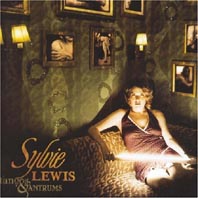
Title quite likely inspired by Elton John, the soft voiced London raised, LA based singer-songwriter's debut a lovely evocation of earlier days, brushed lullabies wafting on a gentle breeze of 40s jazz lounge and cabaret crooners.
Ah, Norah Jones you think, but there's no hint here of the mannerisms that afflicted Jones's second album. Rather Lewis glides along on frothy swing and late night torch with an unaffected lightness of touch teased out on acoustic guitar, piano, strings, and horns, variously evoking the moods of Paris cafes at dusk, early morning smoky cellars and dreamy lovers walking hand in hand by the riverside.
It's veined with a delicious wit too. The jaunty but subtly bitter flugelhorn flavoured All His Exes clearly indicates her love of Cole Porter and Noel Coward, Rockwell's Blues charts the end of a relationship by way of Norman Rockwell's paintings with a gypsy mazurka middle eight, while on the lazily lounging Piaf styled chanson Promises of Paris she notes that "all the women there are beautiful, but the men can be quite rude. There's magic floating in the air, and sex appeal in the food."
If this tickles the attention then you'll find much to love here. Laced with observational gems, hued in nostalgia (New York offers a metaphor for past relationships, Old Friends recalls just that) and veined with all shades of romance from insecurity to devotion, each track turns up another nugget.
My Rival, for example, in which a 17 year old laments that her older opponent in love has all the advantages (she doesn't have to be home on a curfew for a start) but that age will eventually prove in her favour. Or the barely there slow waltzing Valentine's Day where, conjuring thoughts of Deitrich sitting in some tropical beach bar late at night, she sings of "Henry and I will never be friends. He has these wandering hands you see. Snuff out the candle so we can't see, anything, anymore. Only feel." Turn off the lights and soak up.
Mike Davies

Cards on the table first - ex-submariner Tom's one of my very favourite performers on the folk and maritime circuit - live, he's simply one of the most entertaining and engaging, with a tremendous personality, a compelling larger-than-life presence and demeanour belying his size, a fantastically strong voice and an immense (and varied) repertoire; and he's written loads of damned fine songs to boot (and he does!). But somehow, the full force of the Tom Lewis experience never translates quite so successfully to record, each release coming with a caveat of some sort - whether it's an over-eclectic selection of material (Mixed Cargo), the 17-minute shaggy-dog tale of Bunts (Sea-Dog, See-Dog) or minor production quirks. In this regard, Poles Apart is no exception, and the reader needs to be made aware of its idiosyncracies (though in this instance I'd view most of these as positive rather than negative aspects).
Firstly, you need to know that Poles Apart is a collaboration (dare I say "cross-pole-ination"?!) of the talents of the indefatigable Mr. Lewis and a group of Polish singers and musicians. Their voices work very well together (not betraying the fact that the recordings were indeed made remote from each other); in suitably storming fashion, Tom takes the lead (mostly) on a great selection of shanties and sea-songs of one sort or another, which range from more familiar fare (Rio Grande, Randy-Dandy-O, Roll The Woodpile Down) to some less wellknown shanties (Bear Away Yankee) and representatives of the music-hall era (the wonderful ukulele-ridden Wreck Of The Nancy Lee). So far so good, for the performances are idiomatic, forthright and spirited, with a credible blend of vocal timbres and creative (and selective) use of instruments.
The "multi-cultural" approach in itself is not a problem, but if taken too far it can lead to a peculiar kind of disorientation for the listener, and it's here that some will part company with Tom I suspect. The opener, Stan Rogers' North-west Passage, starts off being sung in Polish, as are some parts of One More Day, while Tom's classic Marching Inland suddenly lapses into Polish for the penultimate chorus, which threw me overboard on first hearing! The side-by-side juxtaposition of two different variants of General Taylor (Stormy/Walk Him Along John) is a great idea, and well sung too, but it's spoilt for me by the distraction of imported sound effects all through the first variant.
However, even with the above minor reservations (and whether you view these as serious miscalculations is a matter of personal taste), I'd still definitely recommend purchase of this CD (particularly to the maritime enthusiast), for a variety of reasons. Primarily the excellent performances (dare I mention the highly "Polished" harmonies?!) and recording, the inspired and totally consistent choice of material; then, last but not least, the attractive slimline CD packaging, which has been designed and manufactured with full consciousness of environmental concerns (everything except the CD itself is bio-degradable).
David Kidman
J.J. Light is better known as Jim Stallings, whose major claim to fame was as sometime bassist with Sir Douglas Quintet (he played on the band's iconic Mendocino album). Spurred on by West Coast Pop Art Experimental Band frontman and guru Bob Markley to look back to his Native American roots, and he funded (and co-wrote with Jim) the resulting LP, which was recorded at LA's Liberty Studios in 1969 along with a bunch of sessioners that included two brilliant lead guitarists (Gary Rowles of the Forerunners and Ron Morgan of WCPAEB) and members of the Electric Prunes and Derek & The Dominos. Stylistically, it ranged from the "tribal rock" of Heya! And Na Ru Ka (both based on traditional Navajo chants set to west-coast-inspired backings) to political comment (Indian Disneyland), intensely personal soul-searching (Gallup, New Mexico), sub-Dylanesque philosophy (While The World Turns To Stone) and more self-conscious first-person narratives with a NI perspective. The album has its lame moments, sure, but these are made up for by the hypnotic vocal work and searing lead guitar fills, and the collection as a whole is stronger than many similarly obscure albums of its time (interestingly, it was never issued in the States although the title cut scored heavily, even charted, in European countries). This timely reissue of the original 1969 Heya! LP is topped up with eleven tracks from an acetate of a recorded-but-never-released followup LP, and the UK single-mix of Heya! Itself. The acetate tracks are variable in sound quality, but not anything like as bad as acetate transfer usually are. Musically speaking, these tracks provide evidence that Jim still had plenty of ideas, even though some give in to more commercial sounds and some employ a full-bore brass-and-choir overkill; there's also a song Low Rider Rule that bears an uncanny resemblance to War's Low Rider. The bonus tracks make for an intriguing adjunct though, and worth hearing to complete the J.J. Light story.
David Kidman June 2009
An infectiously catchy collection of folk streaked indie pop delivered in Webber's tremulous warble, it lobs highlight after highlight. Opening track Antonia Jane wins you to their side from the start with its dreamy classical piano backed roots rock and crooning 'someday soon' chorus hook then I Knew catches you offguard with its infectious pulsing Suicide electronica rockabilly beat and the echoes of Tyrannosaurus Rex stirred with 60s reverb pop and fizzy New Wave.
You'll hear, perhaps, shades of Mazzy Star on the military slow march of the darkly quivering Dreamer as strings shower across it like shooting stars, but then they swerve again with The Times bounding along on a stabbing piano and bongo gallop before gathering to a crescendo that gives way to the echoey Gregorian chant feel of Never Seen and the fragile, fuzzy drunken waltzing mountain folk History with its la de da swaying finale.
Duetting on Honest Man they sound like a folksy Nancy and Lee backed by Neil Young but it's the Cowboy Junkies whose smoke wisps across the gorgeous reverb guitar honky tonk melancholia of Waiting For The Sun To Rise.
They stumble slighty with the folk blues rumble of Wondering What Everyone Knows not having quite the same compelling magic as the other tracks despite a gathering chorus swell, but they recover for the closing track, Take Me Home's six minute slow narcotic desert blues that, fading away on a lengthy organ drone and swelling synthesis strings, reminds me of Procol Harum at their most soul achingly Salty Dog majestic. Infinite pleasures indeed.
www.myspace.com/lightningdust
www.lightningdust.com
Mike Davies December 2009
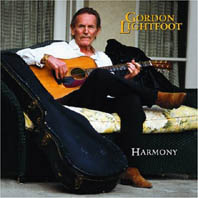
David Kidman
"What music is this?" will be the question on many lips on hearing this magical and unusual disc. It's not an easy question to answer, for it could come from anywhere and yet comes from everywhere - folk music and culture (both acid- and of Celtic and English traditions), interlaced with world sounds and found sounds in a compelling and unique combination; both of our time and of antiquity immemorial.
LightGarden is an eclectic new duo comprising David Moss and Masha Kaestner: those of a certain persuasion will fondly recall David as a guiding force behind fab Whitby-based folk-world-Celtic-roots trio Banoffi, who called it a day a few years back, and he's now re-emerged from the art world to make sweet music once again. David's ultra-distinctive soft and melodious voice and stirring instrumental technique (bouzouki, fiddle, mandolin etc) form the primary signature of LightGarden's intriguing textures, underpinned and enchantingly enhanced by Masha's keyboard work, drones and florid embellishments (harmonium, piano, church organ) and occasional voice (gently earthy, with shades of Björk or even Nico but not as deeply sinister). Musical reference points might include wyrd-folk (Third Ear Band, Forest, Incredible String Band), maverick indie-folk (Sharron Kraus, Pamela Wyn Shannon), early Velvet Underground, even some art-goth, and a healthy dash of Eastern European exotica. Experienced live, LightGarden are both hypnotic and uplifting: the two musicians create an intimate, almost confessional ambience and a constantly intriguing spatial tapestry of musical delights; and, while no CD can ever replicate that direct intensity, Travelling Light's ten tracks give a pretty fair idea of the duo's repertoire and world-view, while also affording them the opportunity to experiment with some creative multitracking and layering of sonic textures.
The bulk of LightGarden's music is self-composed: firstly, the album showcases several of the duo's song-collaborations, which, while depicting or expounding stages on their spiritual journey and embracing philosophical explorations, dwell at the doors of our perception, remaining wholly accessible within that serene, peaceful, floaty-Banoffi mode. There are a number of instrumental pieces too, which resonate with serendipity and when at their most episodic exude life itself in all its manifold glories while embodying elemental echoes of medieval, Balkan, eastern and ambient musics and glistening with experimental timbres and insights. Masha also gives us a personal, almost incantatory rendition of a Finnish folksong. But the oddest track on the CD is its closing eight-minute sound-collage, on which Masha intones deeply meaningful verses from a 14th century Persian (Rumi) text to a backdrop of the dawn chorus (the latter feature, bewilderingly, either irritates or calms depending on your mood at the time, it seems).
Finally - and importantly - I must mention that a key element within the uniqueness of the LightGarden sound is that of overtone singing, an ancient (Mongolian) vocal technique that produces an unearthly, weird and totally wonderful sound, a harmonic drone that (a) once heard can't be forgotten and (b) you'll either love or hate… it contours perfectly with the sound of David and Masha's instruments and voices, and its glacial, piercing intensity is both enervating and curiously soothing. I do hope I've managed to convey something of the special quality of LightGarden's music: enough to encourage you to investigate with an open mind their brave, subtly sensual and inspiring music that determinedly inhabits its own unique space.
David Kidman June 2009
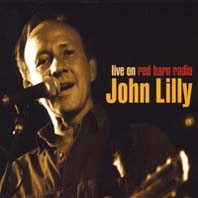
Broadcasting out of Lexington with a mixture of talk and music, hosted by Brad Becker and presented by Tom Brown, Red Barn Radio offers a showcase for musicians who celebrate and keep alive the music of Kentucky. Based in Charleston, West Virginia, Illinois born Lilly is one such name, performing both his own material and songs by such names as Jimmie Rodgers and the Louvins. As Becker says in his introduction, "he writes new songs that sound as old as the hills, and performs older songs like they were made yesterday."
Armed with just acoustic guitar and a dusty voice that recalls Hank Williams and Rodgers alike, most of the material from this May 6, 2009 broadcast is self-penned but, unless you knew otherwise, you'd be hard put to say which out of Good News/Bad News, Broken Moon and Johnny Don't Drunk was original and which was from the archive.
Featuring Lilly's historically informed, chatty introductions and asides, it's rather like turning on the radio and finding you've somehow tuned in back down time to some 30s hillbilly station.
The set features a cover of Rodger's No Hard Times, Lilly proving a fine yodeller on both that and his own A Little Yodel Goes A Long Way, Roadkill is a broken heart song with some wittily amusing imagery, Tore Up From The Floor Up showcases his fingerpicking blues guitar work, and Spirit (Bend Close To Me) recalls the family Bible songs of the Carter Family. A particular delight is his cover of Rod Stewart oldie Gasoline Alley, which restores it to the Depression era period that is its spiritual home.
Devotees of old school roots country should certainly seek this out and discover what other gems might be lurking under the Red Barn roof.
www.myspace.com/johnlillymusic
Mike Davies March 2010
John Davy November 2007
Although he grew up in Greenock, Gifford has lived in Fife (Dunfermline) for more than half his life. He's had a long-standing involvement with Dunfermline Folk Club, and played a key role in establishing the New Makars Trust which supports the development and performance of songs about life in Scottish communities; indeed, he was director of the Trust's early projects. But Lately Seen ... consists of 13 of Gifford's own songs, topped up with two settings of Burns (from one of which, Winter O' Life, comes the CD's title) and a further two non-originals – Scott's Rosabelle and the traditional Collier Laddie - all of which receive pleasing performances with nicely turned, mellifluous guitar accompaniment by Gifford himself. Six of the tracks here have appeared on previous releases (including a 1996 joint album with Alex Mackenzie), but this CD usefully collects these together to provide a fairly rounded portrait of Gifford as songwriter. Gifford has written some attractive and accessible songs on aspects of local life and history in Fife (principally the East Neuk), the pick of these, The Auld Grey Toon, Across The Scotswater and Black And Yellow Of The Oilskins, containing some striking imagery. But many of the songs here are more concerned with Gifford's own personal journey through life, and these are more uneven in quality. Several of the songs are compromised in some way - for example, the otherwise satisfyingly evocative Cross Of Lorraine (a memorial to the French Free Navy which was formed in Greenock in World War Two) seems to have lifted the melody line of the first half of its chorus directly from Paul Metsers' famous Farewell To The Gold, whereas Waiting For The Calm is a bit like ersatz-Dougie-MacLean. Then, So Much and The Tuscan Commune, in attempting to make a virtue of being simple, merely come out trite, and not just because they have little to say in the final analysis; My Wee Bairn, a sincere expression of joy at becoming a grandparent, is altogether more successful I feel. There's not a lot of variety in Gifford's delivery, but he's found a pleasant style with which he's comfortable and he's enlisted a select few other musicians and singers to help him out on some of the earlier recordings on the disc.
Songs Of Mining Life is only just over half the length of But Lately Seen ..., yet within its 34 minutes we get no fewer than 19 songs, performed largely by Gifford himself mostly to his own basic yet full-toned guitar accompaniment. These songs were developed by Gifford with visitors to the 7 Pit Wynd, Coaltown Of Fife MAC bus project between 2002 and 2003. They document mining in Fife, an important part of the area's past, and largely use words taken from the mouths of local people, thus providing a human picture of mining life. Some of the songs have been put together by Gifford in collaboration with local schoolchildren, and this aspect comes across in their brevity and simplicity of expression, although in the end many turn out to be overly simplistic and rather reminiscent of children's rhymes or snatches of street songs as opposed to the kind of mining songs we're used to from the industrial-folksong tradition; they certainly lack the emotional thrust we've come to expect from songs of that genus. Most are simply too brief for their own good, with no sense of thematic or narrative development – even in those cases where the words seem to be crying out for such. The CD may be a true record of Gifford's involvement in the project, and it's good that these endeavours are preserved for posterity, but in the end the lasting impression is of an unfinished body of work and some largely insubstantial songs that probably won't see life outside their original context.
So, to sum up, well, these two discs probably form too inconsistent a collection to convince me that Gifford's a major songwriter waiting to be discovered, even if the best of his work has a certain unpretentious charm and a largely convincing feel for portraying local history and events.
David Kidman December 2006
It's a bit of a given that any album that features a number of different artists will be a mite uneven and to a degree variable in its impact, but there's a welcome artistic unity to this project that transcends its common theme and purpose. At times, inevitably, there are echoes of the breezy, goodtime strand of the archetypal Lindisfarne sound (the closest being Newcastle duo Suburban Atmosphere's reliable take on Remember Tomorrow), but I'd stress that each of the artists represented here brings an individual take on the songs, independently and commendably. Having said that, none are so radical or way-out that they would challenge or disturb fellow-fans, and each stays faithful to the spirit of the original song.
It's good too that the actual selection of songs (15 in all) turns out to be a fan's selection rather than a marketing bod's ideal of trotting out the same old crowd-pleasing greatest hits. Only two out of the 15 - Lady Eleanor and Winter Song (both of which everyone accepts as two of the key creations of the Lindisfarne universe) - are anything like widely covered elsewhere; Run For Home is popular, sure, and you sometimes hear Poor Old Ireland and Train In G Major in sessions, and occasionally No Time To Lose and Born At The Right Time, but the majority of the rest are more the province of the specialist Lindisfarne devotees. And even so, I suspect that even the diehard Lindis-fan will need to brush up somewhat - which is never a bad thing when it provides the chance to revisit and reassess songs that you never realised were so good!
What's so important here is that each song is chosen so that the love of the song, and an indication of its individual worth within the Lindisfarne canon, is uppermost (as opposed to being merely a personal showcase for the artist concerned). Temporally, the selections range album-wise from Nicely Out Of Tune right through to Promenade, but there's a slight bias towards the later material. The mastermind behind the whole project is Steve Foster, an American, who performs in the band The Fire Inn Lads with his fellow-musos from Indianapolis on three better-than-decent rocking guitar-band renditions (Born At The Right Time, Working For The Man and - especially fine - Train In G Major). Elsewhere, though, it's basically the north-east of the UK that provides the origin-point for the album's participants (naturally!).
The disc starts a little inauspiciously it must be said, with roving podcaster Alasdair Carter's quite basic vox-and-guitar rendition of Poor Old Ireland, which is segued (well, patched not entirely ideally, to my mind) into a more stirring version by the Jackdaws. But that's the end of the studio interventions, and consistency is improved thereafter. Local blues songstress Verity Burton gives us two of the standout tracks, including a superbly thoughtful take on The Things I Should Have Said, while the multi-skilled Andy Patterson plays and sings "everything" on his brace of contributions both taken from less-feted Lindisfarne offerings: the underrated Never Miss The Water and Soho Square (the latter ingeniously "fitted" with another Alan Hull creation). I loved Claire Barr's vocal on Mike Jessop's accomplished Americana-style Run For Home, while The Attention Seekers turn in a genial and well-contoured One World (one of two Amigos songs to appear here). Acoustic Circus supremo Simma contributes two live tracks, a touch rough'ready perhaps but certainly spirited enough for inclusion (No Time To Lose in particular motors along nicely - with uncredited sax and percussion to boot); while his third track, a rockabilly-boogie-inflected Dance Your Life Away, gets the feet tapping well. Talking of which album, and saving the best till last, Steve Daggett's collaboration with master steel guitarist Phil Armstrong on Shine On makes for a beautifully judged final gambit.
This affectionate and honest tribute disc is well worth seeking out.
www.lindisfans.co.uk
www.lindisfarne.de
David Kidman April 2009
Happy Daze was the second (and final) release by the Mk. 2 lineup of Lindisfarne (for Warners - following the expiry of the contract with Charisma, with whom Roll On Ruby had been recorded a year earlier, in 1973). Original members Alan Hull and Ray Jackson were joined by four newcomers: bassist Tommy Duffy (ex-Bell & Arc), guitarist Charlie Harcourt (ex-Jackson Heights), keyboardist Kenny Craddock (ex-Airforce) and Paul Nichols. Happy Daze was a critical and commercial failure in this country, but the States open-mindedly embraced it for what it was: a well-produced, clean-sounding and bravely eclectic record. To fans of the Mk. 1 band, however, it all seemed too mid-Atlantic and ballsy-commercial, even a bit of a mish-mash, for to their ears the Mk. 2 band's sound bore little resemblance to that of Mk. 1 for much of the album's length - all of which may explain why Happy Daze has never been reissued on CD until now. The latter observation has more than a grain of truth, sure, but that's not to say it's a bad album by any means, and taken on its own terms it provides some very pleasurable listening generally that well stands up to any comparisons.
Inevitably perhaps, the five tracks penned by Alan Hull provide some of the album standouts, notably the beautiful pastoral River (which would not have sounded out of place with the Mk. 1 lineup - in fact, its composition dates from the late 60s), which features some gorgeous harmony work and has a great sense of repose (it was recorded in the garden!). The catchy Dealer's Choice has a hint of Fog On The Tyne amongst its goodtime Band vibe, whereas You Put The Laff On Me takes things into the then-fashionable white-soul territory (and quite credibly too). Kenny's compositions also shine: the folky Nellie features some neat bass and mandolin amongst its faux-Blondel recorder setting, and the closing track Tomorrow is almost too deceptively simple and bears repeated scrutiny. Tommy was responsible for some good moments too, notably the catchy The Man Down There (another song that wouldn't have disgraced the Mk. 1 band) and on the rockier opener Tonight (a would-be-hit-single). And the playing is very fine throughout, with some particularly appealing fretless bass contributions from Tommy.
The jewel in the crown of this reissue, though, is the seven bonus tracks: priceless Alan Hull solo demos made at Wallsend in the late 60s, pre-Lindisfarne. Of these, only Where Is My Sixpence? has been available before (on the now-deleted We Can Swing Together compilation); but to say that all six of the other demos are worth hearing is an understatement. Dingly Dell and Alright On The Night were to appear on Lindisfarne albums, of course, and Alan later revisited (reworked) Picture A Little Girl on his Squire album, but the remaining songs may at first seem curious coming from Alan's pen (the Harperesque rant Doctor Of Love especially); whatever, the stunning quality of these songs is undeniable. It's hoped that further gems from David Wood's archive will be made available for a future collection.
As always, Market Square have done us proud with this welcome reissue, with excellently authoritative booklet notes from Lindisfarne specialist Jim Henderson and track annotation from Tommy Duffy. Complete lyrics for the Happy Daze album are provided - the only thing missing is the lyrics for the bonus tracks!
David Kidman September 2008
David Kidman
That'll be Lykke Li Zahrisson, an ethereal voiced 22 year old songstress from Stockholm whose self-confessional debut has been produced by Björn Yttling of Peter Bjorn and John.
Opening track Melodies & Desire lays out the stall with ice cave electronic soundscapes and spoken vocals, while skittering pop Little Bit takes a chugging train rhythm and pulse to backdrop her coy little girl delivery before the sax solo pops in to say hi. I'm Good, I'm Gone is a little funkier in a Swedish working in a coal mine sort of way, a jerky clattering marriage of Tom Waits, Kate Bush and Massive Attack.
A self-confessed misfit ("having trouble telling how I feel but I can dance, dance, and dance; she sings on the celebratory infectious indietronica Dance, Dance, Dance), her album's full of such skewed delights.
Listen up for the elfin Lily Allen-ish Let it Fall, a moody piano-led Bush surging Tonight, the glacial 60s pop flavoured Hanging High (imagine the Shangri-Las visiting Tokyo with Phil Collins synths), strobe staccato industrial-electro Complaint Department, Window Blues with its elephant plod beat and burst into Scandinavian operatics, and the rather lovely Everybody But Me. Get in early, it's highly lykke li (sorry) that she's going to be something of a sensation.
www.lykkeli.com
www.myspace.com/lykkeli
Mike Davies June 2008
Three months to go, but here's the first album to feature a song about (and titled) Christmas. However, while it has a definite festive melodic flavour with a cascading chorus of Greg Lake proportions it's actually about mortality. This alone is enough to endear the Sunderland singer-songwriter to me, but there's ample other numbers here to win a legion of devotees.
Playing everything on the album himself, as is immediately evident from the opening A Means To An End, he's one hell of a guitarist and while his finger-picking has been likened to Lindsay Buckingham, a more accurate and closer to home comparison would be Nic Jones and, via him, back to Davey Graham.
Vocally, he's perhaps reminiscent of Seth Lakeman, but with a strong Northern accent and while his default setting is folk troubadour (listen to the trad bedrock and Richard Thompson colours of Game Show Host, one of several stand outs), he builds a variety of styles upon this.
Trash with its distorted vocals nods towards the scuzzy rock blues of Come Together, Long Sunny Days is a dreamy slow swayer that suggests David Gray or Damien Rice, Man In The Corner a chugging meeting point between REM and early Lindisfarne, Peace of Mind employing scuffed trip hop beats behind his guitar and murmuring delivery and strong rock elements feeding into the hook heavy Kill-O-Gram (where he has an affinity with The Levellers) and the suitably motoring along life on the road title track (a touch of Tom Robinson perhaps).
Lyrically, the songs come armed with a social and political conscience (bankers, the media, Catholicism, instant gratification culture, ) as well as exploring self-doubt and the human condition and although he can sometimes be a touch clunky ("the exorcism of modern people's demons happens on the high streets') he's also capable of sharp observations and on the lovely Footprints with its 'walking in circles footprint wheels' line, unbridled romanticism.
Over the past three years he's averaged roughly 20 gigs a month (band solo and with his band), so assuming he keeps up the work rate he's statistically likely to be playing near you sometimes soon. You'd be advised to pay him a visit, but meanwhile this will tide you be nicely until you do.
www.paulliddell.com
www.myspace.com/paulliddellmusic
Mike Davies October 2011
Folks have been enthusing about 23-year-old Paul Liddell for some time in my earshot, so I was keen to receive this one for review as I hadn't managed to track him down yet! This Sunderland man has been compared to a young Damien Rice, a connection I must admit I hadn't made, but he's a bit of a workaholic apparently, "playing five gigs a week for the last four years", and he's built up a loyal fan base in the north-east. Whatever, at least on the evidence presented on this album, I'm not entirely convinced. There's a quality of sparseness to his writing - and performing - that's intermittently rather attractive yet equally often creates an unavoidable impression of unimaginativeness. A number of the album's tracks do make an impression - the opener Travelling Song has a tender ambience and a pleasant lilt, whereas Runaway's gentle rhythmic drive and laid-back ambience wouldn't be out of place in a Jeffrey Foucault set, and The Wooden Heart is refreshingly poignant with just a piano for accompaniment. But all too frequently, I sense that Paul's not realising his full potential on this album; the title track has a good initial idea but refuses to develop it substantially, and many other songs rely on cyclic repetition for effect and, again, refuse to develop their lyrical ideas or melodic cells. Too many of the songs also tend to be built on very similar alternating chords that just swing back and forth, and Paul's soulful vocal style gets a bit formulaic after a while. I do like Paul's lyrics, but they're shortchanged by the unambitiousness of the musical settings. Production-wise the album's a bit of a disappointment too, even though the feel of the bonus acoustic tracks recorded in Paul's project studio is sufficiently credible. Finally (and this is a fault common to many CDs nowadays), Paul's obviously lavished some care on the CD's multimedia element (which in addition to the bonus tracks includes picture clips and video material), but this somewhat annoyingly takes over the PC and prevents the audio CD from running, so I had to resort to the humble kitchen ghettoblaster for my listening (but before you jump back at me, I don't think this accounts for my reaction to the low-key production). Back to the bright reassuring beam of the lighthouse, then? - no, rather, it's a case of deliberately forsaking the old proven technology, and so "last man leaving, please turn out the light" I think.
David Kidman
Possessing a raw, gravelly voice midway between Janis Joplin, Bonnie Tyler and Lucinda Williams, Lie (pronounced Lee) has whipped up quite a buzz back in Norway, but she's also been busy getting her name known outside Scandinavia with gigs from Liverpool to Nashville.
Which is where she recorded her current album with producer Byron House (currently part of Robert Plant's Band of Joy) and session men that included Mauro Magellan of the Georgia Satellites, Dixie Chicks sideman Keith Sewell and Fats Kamplin whose pedigree includes Mark Knopfler, Nanci Griffith and Bad Company.
There's an Americana roots base, but it also comes dressed with the ringing guitar rock of Ashley Cleveland's Twilight Hour and Pirate's Heart (where at one point she sounds as if she's about to launch into Twist And Shout) and the funky Southern fried organ chopping blues of Dylan's Do Right To Me Baby and Little Feat's Home Ground.
These all suggest she's a live firebrand, but it's the mid-tempo numbers that really make the album shine, especially when paired with her honest, born of experience poignant lyrics. Solid recommendations here would have to include the opening smoky Black Swan with its soulful groove, countrified, emotion stained slow builder White Moth and dreamy piano ballad Winter Moon, featuring Grammy winning flautist Bill Miller.
However, the album's two stand-outs come in the shape of the quietly anthemic bruised and battered heartache of Solid Ground and the bittersweet, mandolin-flecked piano ballad Gambling With The Star that uses mountain climbing as a metaphor for hanging in there.
Rather unflatteringly, her press release refers to her music as a meat and potatoes meal. If so then it's best steak and Jersey Royals.
www.tinalie.com
www.myspace.com/tinalie
Mike Davies July 2010
This finely-presented new CD is conceived firmly in the tradition of the themed folk-song concept album (old-fashioned, you might say, but thoroughly welcome nevertheless). Where The Working Boats Went is the fourth release by Life And Times, a Bedfordshire-based duo (Barry Goodman and Graeme Meek) with an enviably solid (25-year) track record of writing and performing songs and music in the traditional idiom. Chronicling the story of Britain's inland waterways over the past quarter-millennium in song (and one tune-medley), it's an affectionate, insightful and largely nostalgic portrait, though not without bite, being tempered where necessary with realism. Where The Working Boats Went can be compared, if only a thematic sense, with the recent Bob Fox and Benny Graham presentation They're Coming Back To The Water, but Life And Times' project has a piquant and individual character all its own (and a concomitant strong sense of unity) by virtue of the fact that almost all the material therein is penned by Barry and Graeme themselves. Creatively using a variety of different narrators and viewpoints, the disc takes us on a loosely chronological journey from the year 1759 (when The Duke Of Bridgewater employed James Brindley to engineer Britain's first industrial waterway) through the proud and euphoric days of canal-mania, the inevitable decline of trade (due to competition from the railways) and the subsequent abandonment and disuse, through to the latter-day revival of canals as a holiday destination. And on our musical meander along the towpath, as it were, we're afforded enticing glimpses into the lives of those who people the canal network and those for whom it has been a whole, and rather special, way of life. Graeme and Barry have a keen feel for their chosen subject, and their writing is intelligently crafted, appealing in melody and well-observed imagery, and accessible in the best contemporary-but-sounds-traditional vein. There's the tale of The Ivel Navigation (set in a delightfully jaunty triple-time metre) and supremely poignant homages to Lock Keepers Of The Waterways and A Working Boatie Man, while the "poor old horse" even gets his tender but proud say (for he has Narrow Boats To Tow), and Carrying The Load is a gleefully infectious, almost music-hall-style litany of goods transported. Other powerful reminiscences embrace the personal hardships of waterway life (Iced In), which are contrasted with more sociable activities (the rock'n'rollicking A Bit Of A Do) and a spirited depiction of the competition between different types of narrowboat (The Row Between The Boaters), while Until The Cut Runs Dry is a perceptive, wistful and especially deeply-felt epitaph (all the more effective for being sung acappella) and A Light At The End Of The Tunnel pays sturdy tribute to those dedicated to restoring canals. Such is the quality of these original songs, their overall memorability (and fine chorus quotient), that I can envisage a number of them filtering through into wider currency very quickly indeed (not least, Lock Keepers sounds tailor-made for Martyn Wyndham-Read, Carrying The Load for Johnny Collins, Narrow Boats To Tow for Whaley & Fletcher…). The three non-original items are well chosen too: Dave Ritchie's Finest Of Them All (a competition-winning song telling of a record run down the Grand Union Canal transporting Guinness barrels!), the trusty "canal shanty" Push Boys Push and Jon Raven's setting of The Bold Navigators. Graeme and Barry's own performances strike an ideal balance between enthusiastic drive and gentle sensitivity, being accomplished and warmly-sung with a style and manner of musical accompaniment (melodeon/English concertina, guitar/bouzouki and occasional violin courtesy of guest Debbie Chalmers) that's perfectly complementary, being simply and effectively managed and genuinely attractive. In short, this is a real winner of a disc (and a touring show accompanying the songs is touring selected folk festivals and venues this summer).
David Kidman May 2009
Every few weeks it seems the latest big thing in guitar rock emerges from America. This year we've already had Train, not here's an LA trio who've already shifted two million albums back home and toured with Pearl Jam. Fronted by Jason Wade with his model good looks and raspy warble throat vocals you can hear Nirvana alongside REM and perhaps even a hit of pre-navel contemplating Radiohead, combining radio friendly pop hooks with the sort of post grunge currents that also wash through bands like Screaming Trees and, well Pearl Jam I guess. Lyrically they trade in nervy end of tether with lines about screaming out loud, finding the way back to sanity, pacing floors, voices in the head and generally scratching the itch beneath the skin. This they do without feeling the need to erupt into sonic squalls or punish their guitars, preferring to carve out keen-footed aching melodies where the emotion comes from within the song not from the ampage. Touchstone track is the American hit single, Hanging By A Moment, but while other stand-outs would be Trying, Only One, Quasimodo and the desperate seeking salvation yearning of Everything most any track at random offers convincing argument for their at least temporary right to the title.
Mike Davies
Eric's always been a bit of a regional cult artist, but his fairly recent move to the famous Alligator label has gained him wider critical and commercial acclaim, which he should be able to consolidate easily with Gulf Coast Highway. It's a funky Muscle Shoals-style mix of blues, roots, rock and R&B on which he takes his typically raunchy songwriting to soulful new heights. Its 15 tracks smoulder and burn with true deep-southern grit, each one a good-time slab of authentic steaming groove. And I swear I've not heard Eric in better voice! Rich, warm and lovingly phrased, but with the punchiness, precision and attack of classic Memphis soul busters. And Eric's crack backing band brings a freshness to the mix, an immediacy of delivery that really sets the seal on the writing. And a great drive to the rhythm section too. Even the small handful of more mundane electric-blues cuts have an infectious swing that helps them keep company with the heaving soul-stirring numbers and slinky, swampy ballads. The concluding track Raw Doggin' is a neat AWB-style instrumental to round things off. Favourite tracks? – aside from the Delbert McClinton and Waylon Jennings covers, probably Lullaby For Mary Ann, or the mambo-tinged I Can Get Off On You, or the low-down gospel-fringed Dirty Bird, but this is still a real classy collection.
David Kidman August 2009
Hailing from Toronto and now based in Nashville, Linden's a veteran guitarist, singer-songwriter, producer and session musician whose 33 year career has seen him work with a formidable array of blues and roots artists, most recently as guitarist for Emmylou Harris and collaborating with Plant and Krauss for their follow up to Raising Sand, as well as being one third of Blackie And The Rodeo Kings.
However, he's still found time for another solo album, a collection of folk blues and gospel that showcases his slide guitar. To be honest. I'm more impressed by his fingerpicking than his voice which, while perfectly serviceable for his chosen genres, isn't really individual enough to be distinctive. Blues fans won't have too much to complain about things like Devilment or Smoke Em All where he conjures such names as Sonny Boy Williamson and Mose Allison, while Built Right On The Ground and From The Water itself recall the music from O Brother, a soundtrack in which Linden was himself involved.
To these ears, he's at his best on the echoey 50s flavoured doo wop of John Lennon In New Orleans and the gospel country of I Have Seen A Miracle, but I remain more impressed by his achievements than this recording.
Mike Davies May 2009
Another one from the top German blues label, Crosscut. This time it's much respected Canadian Colin Linden. Linden has been an in-demand session musician and has produced albums for The Band and Leon Redbone amongst others. He met Howlin' Wolf at the age of seven and became friends with him until the Wolf's death in 1976. Not surprisingly, Linden cites Howlin' Wolf as his most significant inspiration. He opens this album with the eponymous title track, which is a Delta blues, written by Sleepy John Estes, with steel guitar and all of the classic stylings. This is a true blues with a strong vocal and lovely rolling guitar. This is followed by a well trodden blues theme on Go Back Old Devil. This is again in the classic Delta style and harks back to Robert Johnson. Blind Willie McTells's Broke Down Engine is painfully slow and, in his wailing vocal, Linden upholds the Delta traditions more than most I've heard recently - Robert Johnson must be an influence too. The self-penned Nowhere To Go is another up-tempo song; just voice and guitar, this is a nimble fingered contemporary blues. The spiritual A True Friend Won't Let You Down is just a lovely, well-executed song and T-Bone Burnett's There Would Be Hell To Pay takes you to the other end of the spectrum with its speakeasy evoking images and tales of love and death.
Colin's slide guitar gets another airing on You Can't Get The Stuff No More and the happy aura surrounding this song gives it a jug band feel – very good. The happy, bouncy feeling continues with the instrumental, Paramount before we are treated to the highlight of the album. I don't know if Keep It Clean is meant to be innuendo laden but I suppose that's the songwriters' (Tampa Red) talent. This is just a delight with lightning fast finger picking and a machine gun vocal delivery. Things are slowed right down to funereal pace for Champ. Electric guitar is introduced for the first time and it's modern but with a classic feel. The downbeat lyric fits in so well. Son House's Dry Spell Blues sees a welcome return to Delta blues and Linden plays this style so well. I love his acoustic slide style and a great example of this is on the spiritual, intense Trouble Soon Be Over - another highlight. He finishes with Tears Come Rolling Down and I knew there were some Robert Johnson influences in his playing somewhere. This is a downbeat finish but as the album has mainly been about classic blues themes I can think of no better way to wrap things up.
www.colinlinden.com
www.crosscut.de
David Blue, July 2006
The name might lead you to assume this was yet another Scandinavian songbird, but Lindfors actually hails from Dublin, releasing this debut album in Ireland on her own Pentacle label back in 2007. Now, reissued at home and launched further afield it's very much 60s acoustic LoCal mellow tinged with hints of Valley blues and the obligatory references to Joni, Nicks and co, while moody banjo flecked folk-blues opener Night Time paints her as a Roberta Plant.
Earthy, warm and sensual to suit its songs about romantic encounters and aftershocks, Voodoo has a spidery elfin intoxication that conjures faint memories of Nilsson's Coconut, I Don't Want You Here is a barely there campfire chill out that jack Johnson might find a touch laid back while, by contrast, Timewarp pretty much rocks out by comparison, Lindfors' voice taking on deeper tones, the jazz slung guitar sloping along the rhythm with sexual sweat groove.
A highly impressive debut that belies its fledgling nature, Lovestage is a masterfully mature violin coloured confessional piano ballad that suggests she may well have listened to the odd Randy Newman, Gillian Welch, McCartney, Carole King, Baez and perhaps even Julia Fordham album at some time.
Playful and skittish on Light Up and the irresistible summery folk-pop 2x1, vulnerable on the darkly pastoral Fearful Things and Play It Away, this is atmospheric, quietly beguiling music from a voice we'll be hearing much more of.
www.jennylindfors.com
www.myspace.com/jennylindfors
Mike Davies August 2008
Having had to release his debut album Exit Music twice to gain attention, hopefully the former Big Dish frontman will have a little more immediate success with his follow-up now he's found a larger label home.
Although also recorded at home, the new album's a marked departure from its muted ambient predecessor. Lindsay's vocals still soar above the rooftops and into summer clouds and it's still essentially based around piano, but he's made more use of computer programmes to give it a far more orchestrated texture with synthesised string and horns. It's also a more upbeat set of songs, moving on from the last album's break up songs to embrace a new love affair and not wallowing in self-pity when it ends.
Reflecting the airy feel of the music, there's a lot of references to floating above the city, clouds, moon and stars, generally reflecting the theme of escape evident in the likes of Skywriter, Metropolis, Catch A Star and, of course, the title track. And isn't that the wind blowing through the closing instrumental Motorcade?
There's some lovely stuff here, light and graceful with the Brill building feel of Memory, flexing more muscles on the warmly swelling The Flood, and while Blue Nile has been trotted out for a reference point, Giving Up The Ghost in particular also conjures thoughts of Roger Waters while Catch A Star hints at Sgt Pepper. He also sneaks in an unexpected cover of Monkey Gone To Heaven, transforming the abrasive Pixies original into an early hours rooftops piano ballad that makes you want to throw a scarf around your neck and head out to greet the dawn. Fly high.
Mike Davies July 2007
Songwriter Graham Lindsey started out his musical life with punk band Old Skull, then just three years ago, after spending a very long time ensconced in a log-cabin in Wisconsin, Graham changed tack completely, upped sticks and headed west to Montana, where he settled down, got married and gathered material for this, his third album. Material that reflects the whole fertile landscape of memories and mementos and emotional wrecks associated with them, which Graham grants us the privilege of sharing during the course of the twelve songs herein. With a knowing, often caustic eye on backwoods lore and folk tradition, Graham drives these recollections and narratives home with an unnerving, almost Dylanesque perspicaciousness, a comparison that's accentuated by his keenly-phrased method of vocal delivery. The songs are sparsely scored as far as general accompaniment goes, although Graham plays an assortment of instruments himself (including various guitars, banjo, harmonica, hammer dulcimer and accordion), but still a healthy degree of additional textural richness is imported through the affecting instrumental contributions of a small handful of collaborators including the excellent Greg Leisz, Mike Parsons and Steve Deutsch. Songs like the disturbing, if truthful The Bird That Lived In A Burning Tree, the more cryptically philosophical title track and (most of all) the desperate extended lament of (the most ironically titled cut of them all) The Good Life possess an eerie, often mournful presence that seeps through the speakers like something Brett and Rennie might've dreamt up. Aside from the fiddle-and-banjo escapade of Old Roger, the only really uptempo moment is the shuffling Shit On The Shovel which provides a drily witty interlude in proceedings just before midway, mirrored by the brief honky-tonk rap of Big Dark World Of Hate And Lies just before the closing cautionary riposte of Down The Wrecking Line nails us to the mast one last time. An extraordinarily atmospheric record that stays compelling throughout its 51-minute length.
David Kidman May 2009
Bobby Lindstrom - A Lick And A Promise (Blue Eyed Crow)
You couldn't ask for a better start than R.J. Blues. This is a scorcher with Lindstrom's guitar and Paul Biondi's saxophone on screaming form. What Did I Do is 12 bar par excellence and lends much to Canned Heat and Dirt For God, which starts off on an acoustic vein, turns into a strong boogie with one of the best vocals on the album. Turn And Walk Away is a standard rock ballad and Rock Mode is blues rock with excellent guitar, growling vocal and some thumping drums from Roy Eikamp.
The acoustic, I Showed You Love may, at first hearing, seem strangely out of place on this album but it will grow on you. The Main Reason is heavier, bluesier and is the best track on offer whilst Every Once In A While has a rock and roll feeling with top drumming from Eikamp again. The last track on the album (prior to the two bonus tracks) has an almost sleazy feel to it and Lindstrom takes on drumming duties as well as providing another strong guitar performance.
Two bonus tracks close the album: She Don't Get Dirty No More, which has a fantastic bass line from Sam Densmore of Silverhawk that leads into an equally fantastic classic R&B riff. This is, along with The Main Reason, is my favourite track and leads into the neat and tidy acoustic blues of Angels In The Kitchen.
Lindstrom has a hand in all of the songs, writing all bar two on his own and the others with the Densmore Brothers. He has that wonderful talent of making it all sound just too easy.
David Blue
I've had this album on and off the player for a few weeks now, and still have mixed feelings - nay, I'd say even misgivings - about parts of it at any rate. Certainly there's its extravagant claim that it presents "a unique blend of new and traditional music infused with jazz, rock and club influences", a claim that just begs to be challenged or at the very least to be treated circumspectly, for in truth there's very little that's genuinely unique these days!
Having said that, most of the music on this CD could quite reasonably be described as gently groundbreaking. What else do you expect from a band with that ever-ambitious and dangerously experienced wizard-of-all-things Steáfán Hannigan (who, as well as founding Sin É, has worked with everyone from Band Of Hope and Waz! to the Afro Celts) at the helm? His five comrades in LinnTilla bring a wealth of experience gained in diverse musical activities, although they may not all be exactly household names even within the generous ambit of the folk/roots/fusion scene: you'll have come across Saskia Tomkins (fiddle player who's worked with Robb Johnson, Jon Harvison and Bill Jones), I'm sure, but perhaps not Murray Grainger (accordion), Nye Parsons (basses) or Dave Neville (drumkit), each of whom has a hefty CV garnered from working in jazz and/or punk and/or contemporary classical ensembles following formal classical training.
The LinnTilla wildcard, though, is singer/keyboard player Cecilia Le Poer Power (surely that's not her real name??), a "seasoned soloist-performer and session musician" with an attractive, softly impressive, strongly characterised voice that marries folk and jazz inflections most engagingly - I was often reminded of Pentangle's Jacqui McShee, though that comparison could often also extend to the (often) spacey-jazzy musical settings within which Cecilia's voice is cocooned on LinnTilla's debut album. It goes without saying that LinnTilla's version of Still Growing (for instance) is worlds away from even comparatively recent McShee performances (with John Renbourn, say), but it's magic of the highest order with its shuffling beat and weaving pipes/whistle/fiddle/stringy filaments.
It's a shame that LinnTilla's album shows its weakest hand at the outset, for the starter Nanny O opens with a couple of minutes of drifting, swirling new-age keyboard-wash with over-prominent "nature" tweeterings, and the somewhat glutinous backing for Cecilia's ensuing treatment of I Wandered Through A Brookside is rather sickly (and in my opinion not deserving of a whole four-minute "remix" reprise at the end of the CD). Thereafter, however, things improve considerably, with an loose-feeling yet strictly controlled pulse driving the tune Man Of Aran in a beautifully relaxed chillout manner, and, after a really neat waltz-time (or is it 6/8?) rendition of Died Of Love (a definite highlight), the album takes flight again (sorry!) with Boeing 747 whooshing across the speakers (samples here, as elsewhere, making sense when used sparingly).
The remainder of the album goes from strength to strength: Sail On Heaven's Seas brings a pop-crossover sensibility into the mix through a slight reggae influence, here as elsewhere some eminently satisfying cross-rhythmic experimentation steering the overall shades-of-trance-folk vibe in a way that redresses the balance and gives fusion back its good name - helped along by the contributions of remixer/producer Declan Flynn. Tracks like LinnTilla's enterprising treatment of the jig Siobhan O'Donnell No. 2 and Seámus Meehan, with their strong Afro-Celt-like feel, are probably the best examples, and contain some very fiery playing set alongside the smoother keyboard tones. So: I rate most of this CD very highly, but I still can't take the gloopy tweetings of Brookside (sorry, I must be allergic to soap!) ...
David Kidman
Born in LA then raised in Nashville, singer-songwriter Ferraby is a simple guy, just "a slim young man with a straw hat" who rides around town on an old orange bicycle. This gives a certain flavour of the man and his talent: a charming, pleasing and friendly, caring personality whose songs seem to come to him as naturally as breathing and speaking. These creations are gentle, unassuming and often quizzical observations on the world in which he lives, concerning themselves honestly (if largely non-confrontationally) with things that matter to him. There's a certain happy, carefree cartoon joviality about his breezy pop-folky confections that wouldn't have sounded out of place in the sunshine pop-psych of the late 60s and early 70s. Unpretentious and accommodating, and not to be criticised for that, Ferraby's music may at first seem deceptively lightweight, but its um, cleverness of execution lifts it above the standard retro or nu-folk comparisons that might be invoked by a mention of kindred spirits of the ilk of Sufjan Stevens. There's also a hint of the torchy vocalising of Rufus Wainwright on cuts like the cryptically romantic The Octopus And The Ambulance, and an influence from showtunes and movie music is as much to the forefront as the folky country milieu from which his background determines. Instrumentation is bright-eared, delightful and imaginative, with primary colours to the fore and Ferraby's own guitar boosted by anything from gentler traceries of pedal steel, piano, glockenspiel, cello, violin and melodica through to a swaggering, full-blown mardi-gras brass section ushering in Before We're Dead. The whole set has a most attractive feel, unassumingly irresistible, and I'd defy anyone to resist the summery haze of Under The Texas Sky or the affecting and altogether more whimsical closer, Put Me In Your Play.
www.myspace.com/ferrabylionheart
David Kidman June 2008
Even though she's now resident in the UK, singer and fiddle player Kate's not all that often seen touring, which is a real pity, since she's one of the most gifted exponents of oldtime country. And Walk Chalk Chicken is only her second record - the first, the excellent Ain't No Grave, came out six or seven years ago on the enterprising Wildwood label (which seems to have gone to ground of late). Here Kate gives us a collection of affectingly simple (one could say rustic) performances of material from the very roots of country, comprising roughly two thirds songs and one third instrumental pieces. On the majority of the latter cuts Kate's driven fiddle is accompanied by the Brothers Bing (Tim and Dave on banjo and fiddle/guitar respectively) - and boy, do they cook, especially where Kate and Dave work out together on that twin-fiddle line! Jim Martin (bass) and Johnny Whelan (banjo) also lend a hand occasionally. And with wonderful titles like Shove The Pig's Foot A Little Further In The Fire, well you can't help but have a real good time can you?! ... But brilliant tho' the tunes are, it's probably the songs that make the most impact for me, and to describe some as riveting would not be exaggerating in the slightest. Kate's earthy, mildly husky vocal timbre brings a quality of brooding, soft mournfulness to such songs as Faded Coat Of Blue, in the course of the heartfelt expression of whose lyrics Kate wrings an almost unbearable amount of emotion from the very simplest of images. Her interpretation of Son House's County Farm Blues is extraordinarily powerful, and her version of the classic ballad Pretty Polly (another on which Kate accompanies herself on guitar) is also nigh matchless in its stark sense of tragedy. Then there's the uptempo songs like Lincoln's Gunboats and Down The Road, where Kate's relish in their very singing infuses the performances with the true spirit of unpretentious down-home hoedown. If you want a good solid oldtime record with that extra layer of emotional credibility and depth, then it's a simple decision: go for Kate straightaway.
David Kidman March 2007
Anne's eighth solo album forms another enchanting chapter in her personal storybook, carrying on her own well-established tradition of singer-songwriterdom. Anne's stock-in-trade remains ever-fascinating tales sourced from true stories or folk myths/legends; additionally this time, four of her songs are drawn directly from experiences recounted to Anne during storytelling workshops which she ran in prisons. Compelling accounts of supernatural occurrences and beings coexist with the poignant story of Irving Pollard of Coventry (The Genie Of The Button) and the telling examination of issues such as suicide, drug addiction and incarceration. In constantly and creatively drawing parallels with real life's concerns and experiences Anne encourages us to think beyond the surface and explore its metaphysical dilemmas, while just as in real life things rarely end how you expect them to: more often than not there's "a twist in the story when you're not sure where to go". Although invariably couched in her now-familiar beautifully melodious compositional idiom, the new songs comprise probably Anne's most varied set to date purely in terms of subject-matter and inspiration, while at the same time the simple yet intense poetry of Anne's writing has seldom been more captivating. Hers has always been a strongly individual artistic voice, although the astute may well sense, particularly in the compassion of Anne's personal philosophical stance, a kinship with the work of Leon Rosselson, Maggie Holland and even Ralph McTell. Musically, Anne's keenly skilled at reworking the forms, patterns and resonances of traditional song: several of the new songs contain more-than-subliminal echoes of time-honoured melodic contours, glimpsed out of the corner of the ear so to speak - The Horseman Of Ceunant Y Cyffdy recalls The Prickly Bush and White Powder recalls When I Was On Horseback, whereas the coda of Locked In is a sinister pipe-reel and the charming opener Little Polly Williams trips lightly with the faery morris team to a courtly variant of Speed The Plough. Finally, How To Stand Still and Stone Circles are timely revisits of songs that originally graced the lovely 1987 Anonyma LP Burnt Feathers (surely a candidate for reissue?), and it says much for the consistency of Anne's writing over the years that they stand up so well today – and still prove to have plenty to say. On each track (save for the acappella White Powder), Anne employs up to three accompanying musicians, hand-picked from the pool of Mike O'Connor (fiddle, concertina), Matt Crum (keyboards, saxes, melodeon), Jo Freya (clarinet, harmonies), Jacey Bedford (harmonies) and multi-skilled long-term collaborator Steafan Hannigan, the latter adding his own special brand of exoticism with sundry pipes, whistles, percussion and duduk – the plaintive tones of the latter enhancing the eerie insights of Masks and imparting a keen frisson to the gentle-but-chilling ambience of The Ghost. The aural perspective of the disc is sympathetically managed by Brian Bedford's expert production. A Twist In The Story is an expertly crafted disc that will delight the lover of song: gleaming bright and clear, it's a veritable jewel to be placed firmly in the crown of Anne's achievements.
David Kidman January 2009
Anne Lister - Waiting For The Hero (Hearthfire)
After an unusually protracted six-year hiatus, here's a new set of songs from this charming songstress and storyteller who has never quite gained the recognition she so deserves for her wonderfully sensitive and compassionate songs - and that in spite of receiving accolades through works like Moth and Icarus being covered by Martin Simpson among many others.
Whilst Anne's latest offering springs no surprises, concentrating like her previous work on her customary humanitarian and environmental themes (such as the eternal quest for peace and unity) and the vibrant retelling of local myths and legends, Anne's not lost her touch in any way, and each individual song serves as an example of the fine art of songwriting at its best, a superbly-crafted jewel that's polished to shine bright with melody through the clarity of her voice and enhanced by the attractive instrumental embellishments courtesy of Steafan Hannigan, Mike O'Connor, Matt Crum and Julia Lane.
Waiting For The Hero contains twelve new original songs by Anne herself, in addition to one timely reworking of an earlier song and a recent arrangement of the traditional Silkie ballad (which I find the least successful track, though probably only because Anne's own material is so good!). Together these pieces comprise a lovely CD that's in every way a worthy addition to the Lister canon. Do track down her earlier releases too if you can though.
David Kidman
After listening to Equilibrium it's little wonder that Classic Rock bracketed English blues/rock musician alongside the likes of Joe Bonamassa and Jonny Lang as an outstanding blues/rock guitarist.
There is no doubt that Lister is one of those naturally exciting talents that come along once in a blues moon. But more than the God-given talent, it's the balance that he strikes between stunning guitar pyrotechnics, a soulful voice that has just enough of an edge and a collection of original songs that mark him out as a musician with a glittering future. Equilibrium delivers the complete package, a thrilling and engaging mix of blues and rock.
It doesn't take too long for the influence of Eric Clapton to raise its illustrious head, the layers of voice and guitar owe much to old 'Slowhand'. However you could just as easily namecheck Stevie Ray Vaughn for 'rockers' like Sugar Low, it's not the influence but what you do with it that really matters and Lister isn't bound by the ghosts of the past, instead he taps into their passion and belief.
While the 'influences' on it may be from an earlier generation, Equilibrium is fresh and vital, the foundations of What's It All about may be as old as time itself but there's nothing tired or jaded, Lister brings a true believer's energy to his music.
As if to ram the point home, he takes Gnarls Barkley's Crazy apart and adds a blast of white-hot blues, the result is imaginative, inspired and almost unrecognizable. It's the work of a musician with a unique ear.
However, Lister does leave himself open by the inclusion of a track called Running On Empty, there was an initial disappointment on learning that it was not a reworking of the Jackson Browne classic but any doubts were swiftly washed away by the hypnotic, bouncing and infectious alternative. Lister has found his crowd favourite.
It would also appear that Lister himself drew strength from the track because as good as Equilibrium was before it, afterwards everything moves up a notch or two, Superficial is provoking and sparse and yet has the impact of a thunderbolt.
But Aynsley Lister is a born rock 'n' roller and it would be a shame if he didn't give his guitar skills free rein. The holy trinity of tracks that close the album provide the perfect showcase. Running Out On Me, Sugar Low and Hurricane are sweat-soaked, full-blooded, razor-edged blues rock, classic in style and execution and no better way to sign off.
Michael Mee February 2009
This is Aynsley Lister's first studio album since the acclaimed All Or Nothing in 2003 and this volume of 12 self-penned songs takes him another step along the road to complete blues acceptability. Find My Way Home is a storming blues rock opener and Lister has matured into an excellent artist with nothing flashy on the vocal but a strong, punchy performance as a guitarist. Getaway is another strong rock song and will be good for the American market whereas Always Tomorrow is the obligatory power ballad. As ballads go, this is one of the better ones and has sympathetic guitar. Ice I'm Upon, with its superior harmonies, is another for the American market. It highlights his guitar playing and catchy song writing talent. Beautiful (Keina's Song) is acoustic with a gentle vocal and is a sublime, beautiful song as the title implies. There's a contemporary feel to Wherever I Am and it builds up into another great chorus. This will be a great crowd pleaser and will fit in well with the current chart renaissance for rock.
With Me Tonight is slinky and Lister has propelled himself into the higher echelons of European rock with this blues influenced rocker. However, it's not all electric and the atmospheric Rain allows him to show his prowess on acoustic guitar also. This has an Americana feel and shows his range has expanded. Don't let the short acoustic introduction to With Me Tonight fool you. This is a high energy blues rocker that you can let your hair down to. He keeps it going on Upside Down, which is another classy rocker that ends as abruptly as it starts. Disorderly Me is a strong, swaying blues with his guitar and voice still on top form -- this is one of the highlights of the album. He finishes with Falling Down and he keeps his form right to the end as his wailing guitar signs off in style.
This is one of the best albums of the year so far. You have to have it in your collection.
www.aynsleylister.co.uk
www.myspace.com/aynsleylister
www.rufrecords.de
David Blue March 2007
You want to hear some stunning Blues-rock, the stuff that'll blow your socks off? Yes, of course you do, and there's a new album to rush out and buy, plus a tour for us to catch the excitement 'live'.
Aynsley Lister is English, early 20s with great voice and looks, but he's not just a pretty face. He's an original, a talented musician and songwriter, and he's recorded an outstanding album which is destined to become a classic. Think of early Free, think of those American blues jam bands, think of great electric guitar solos and you'll start to get the picture. The album rocks along with all the raw energy youth can bring to the medium, with the skill of a Paul Kossoff or Roy Rogers (chops not chaps). His band, a trio with Matt Kay on bass guitar and Wayne Proctor on drums, is as tight and solid as you'll get and the production, by Jesse Davey, a joy. Everything is in the right place!
Solo numbers; the spine-tingling acoustic As The Crow Flies by Tony Jo White, and the last track on the album, Hendrix's Little Wing, an unaccompanied homage to the master, on electric guitar, shine with their passion and technical skill. Keep listening because there is also a hidden track a couple of minutes on - a raw, solo, stomping slide (with toilet roll holder?!), acoustic country-blues blaster. "That'll do, we'll have that one." Aynsley's last words. Too right.
Sue Cavendish
The second of (coincidentally) two CDs in the same batch for review that have a Songwainer connection! For according to the WildGoose website, Barry sang in "the revived Songwainers". But little else in terms of background information seems to be available, for although Barry's evidently an excellent singer, he is by all accounts a self-effacing fellow who has little time or inclination for self-publicity. Aside from his name appearing most recently among the list of organisers of the revitalised Sidmouth Festival, all I can glean is that following an early theatre career (hence the CD's title reference) Barry began his folk apprenticeship in the mid-60s with the Exeter Traditional FSC, subsequently singing with harmony groups Isca Fayre and Hollinmor, then latterly The Claque (Dave Lowry, Sean O'Shea and Tom Addison), who join him en-masse for two of this CD's tracks (and then each of them individually on one more song apiece). Barry sings just five of the CD's 13 tracks completely unaccompanied; these tend to be the "big ballads" (big in stature, yet here none lasts more than six minutes as it turns out), for these are Barry's forte without a shadow of doubt. The CD's opener, Young Edwin In The Lowlands, is a masterly - nay, tremendous - retelling of the ballad which sets out Barry's stall extremely persuasively. Barry's rendition is measured, unerringly paced and lovingly phrased, savouring the story and taking the requisite time but never dragging it out, while imparting a dynamism of expression suiting the ebb and flow of the text yet without resorting to dramatic posturing or over-theatricality. These basic characteristics of approach apply to each song Barry tackles, but each performance sounds freshly minted and spontaneous. The timbre of Barry's voice is gorgeous, whatever the register; outwardly his singing seems quite gentle, laid-back often at times, but listen closely and you find it exhibits a tender strength that's both immensely appealing and interpretatively satisfying. The phrase that probably best sums up Barry's singing is "quiet excitement"; this quality would seem to apply both to Barry's attitude to singing itself and to the effect his singing has on this listener, for Barry's control of expressive and rhythmic nuance is exemplary. Economical too, for Barry coaxes great drama from St James's Hospital in less than three minutes yet it never seems rushed. Even the version of George Collins that Barry uses doesn't feel as incomplete as Barry admits, so persuasive is his telling of the tale. The non-solo tracks turn out to be equally addictive: Barry and Tom join forces for an epic eight-minute Factory Set, an imaginative medley of two traditional songs, Cyril Tawney's Monday Morning and the Rolling Stones (Beggar's Banquet) number Factory Girl, while Barry's rendition of Limadie with Sean is obviously born of years of experience in moulding tune and words into a satisfying performing version. The Claque's dance-like take on Hunting The Hare (which isn't the song you expect it to be!) is great fun. For the majority of the remainder of the CD, Barry brings in a modicum of instrumental accompaniment, courtesy of Ed Rennie (guitar, melodeon) and Jackie Oates (violin, viola), the latter especially beguiling on the faster-paced Jack Orion and a well-judged rendition of the Bellamy classic Sir Richard's Song (here, however, Ed's guitar line sounds unusually dull in terms of presence and balance). This CD does a real service in bringing an exceptionally fine singer into the limelight, a singer who deserves to be heard much more widely.
David Kidman October 2006
Little Axe - Hard Grind (Onu Sound Records)
Think Moby, Beck and Alabama 3 - Little Axe (Aka Ohio-born Skip McDonald now living in England) was doing it first. He calls it Dub Blues. For the less genre-specific listener it's hypnotic, sampled techno-groove blues on an ambient-reggae journey with a big spiritual heart. Little Axe plays guitar, bass and keyboards, Keith Le Blanc's on drums, Doug Wimbish plays bass and Alan Glen's harmonica together deliver the core Little Axe Hard Grind band sound which howls, meanders and grinds throughout the CD's eleven tracks. The vocals - which often take the form of conversations using a variety of effects - are from various guests and Little Axe himself. The producer is his long time collaborator, the legendary Adrian Sherwood.
Back track: A couple of years ago a friend gave me a CD blues sampler which included a Little Axe track and I was hooked. The long search to find Little Axe's by then out of print, 1995 release, The Wolf That House Built began. Amazon.com informed me that it wasn't available. HMV Canada promised a copy but failed to deliver. It took six months for a second-hand copy to came through on Amazon. It was worth the wait to get to know the visionary Little Axe - but it's been an even longer wait for Hard Grind.
Grind ... is an album for good speakers and headphones - let the instruments, effects and voices travel through your head, weaving layers, punctuated by throbbing bass, percussion and incisive guitar work, to make a seemless and spell-binding whole. Favourite tracks? Hard Grind's been on heavy rotation but the trancy Walk Right Shoes and the gospel preacher'sTight Like That bring a special smile each play. This is one CD when each play delivers new treasures from it's depths.
Hard Grind is released on June 11th. Little Axe play the Garage, London on June 5th 2002.
www.fatpossum.com/littleaxe.html
Sue Cavendish
How come this album's been out for a month or two but not gotten reviewed here? Let's remedy that! For the aptly-named Join The Band is an awesome celebration of all things Feat, brought to us by a band who in spite of setbacks galore over their near-40-year history have come up with the goods time after time and transcended the epithet "legendary" many ways over, all the while garnering the respect of top musos the world over. Small wonder, then, that the roll-call of guests "joining the band" for these sessions reads like – well I dunno what, a whole stack of who's-whos I guess. The project stemmed from an offer from Jimmy Buffett for the band to record for his label: an offer made after Bill Payne had helped Jimmy out on his hit album License To Chill, where he encountered Mac McAnally and Alan Schulman, a production team that had exactly the right dynamic, relaxed yet creative, that Feat could work with.
The resulting album is a unique one within the Feat canon, for the songs are a mixture of all-time-classic Feat material reworked (just over half the tracks) and covers. The band members spark off the guest artists and vice versa: they all speak the same musical language and communicate flawlessly with no ego tripping yet a tremendous sense of gettin' it together big-time and thereby bringing a whole new dimension to the songs. This ain't no band of tired has-beens paying tribute to themselves by drafting in a host of star names to con the punters - no way. As Bill tells us in his liner note, everyone involved has put their heart and soul into the recordings, and come up with the essence of Feat, along the way treating us to so many sublime and hard-to-contain musical moments.
Musicianship is stupendous - here's just a few tasters: Sonny Landreth's slide work on Fat Man In The Bathtub and Dixie Chicken (these cuts also feature Mac McAnally's guitar skills), Sam Bush's fiddle and mandolin arrangement on Sailin' Shoes (which sports a superbly sultry vocal from Emmylou Harris)... whoa! There's further star turns from guest vocalists too (Dave Matthews on Fat Man..., Bob Seger on Something In The Water, Black Crowes' Chris Robinson on Oh Atlanta and Vince Gill on Dixie Chicken). And Brooks & Dunn make a good stab at Willin'. Oh, and the album brings the Feat full circle with a rendition of Trouble by Inara (Lowell's daughter) that achieves maximum potency. All of this white-heat activity is brilliantly supported by the current edition of the Feat (Barrère, Clayton, Hayward, Payne, Tackett, Gradney and Murphy). Others come along for the ride too, but it's all cemented and underpinned by that crack Feat band we now know and love. Hoy hoy!
David Kidman October 2008
Little Feat were one of the few 70s bands I had time for, and losing Lowell George at the end of that decade brought on a hiatus involving a lengthy fallow period. Messrs. Payne, Clayton and Hayward recovered sufficiently for the 1988 album Let It Roll, having brought in Paul Barrère on slide, but by that time I'd lost touch so I never managed to rekindle the flame or even get to hear their later adventures. The 90s saw the band's releases hidden away on ill-fated small labels, including Zoo, for which imprint Ain't Had Enough Fun was recorded in 1995. Even though it arrived hard upon a four-year low in the band's fortunes, it's a pretty fine album by any standards, and it plays to all the traditional Feat strengths with an amply stocked armoury, a "sonic stew of solid New Orleans funk and Louisiana arcadiana" along with a handful of sideways musical departures that do them credit. Shaun Murphy had by the time of the album been promoted to lead singer, and her gutsy, soulful singing (honed in Bob Seger's band where she'd toured alongside Bill Payne and Fred Tackett – by then also a Feat member) had by then also become quite a band trademark. As a latter-day Feat album, Ain't Had Enough Fun thoroughly convinces, and it delivers on all musical levels too, from the gospel-influenced title cut through the archetypal southern-fried All That You Can Stand and Romance Without Finance, the swampy Cajun Rage to a lavishly realised cover of the Ray Charles number That's A Pretty Good Love. Throughout the set, the spark and energy and creative interplay of the musicians is paramount, with Paul's often understated slide work providing many of the most delectable must-repeat moments and the locked shuffle rhythms of the Hayward-Clayton percussion partnership prove tasty as ever. A handful of guests provide horns, Van Dyke Parks brings his accordion on momentarily and even a mild 90s concession to electronic percussion for six of the tracks doesn't distract from the synergy of the basic band. Ain't Had Enough Fun turns out to be nearly 70 minutes of prime cut Feat, and I'm real glad to've been reacquainted with it through the good auspices of SPV - here's hopin' more of Feat's less heralded back pages are to follow.
David Kidman October 2008
Little Feat - Kickin' It At The Barn (Hot Tomato)
Hail, then, Little Feat, a band guilty on all counts and clearly oblivious to the sentence as they whip up a musical storm at their own wake!
Of course it's not like that at all. Sure the Feat have been playing their own sensuous, slinky hipped cocktail of American music for over three decades and whilst it may lack the rambunctious edge of youth it remains potent and as rhythmically seductive as ever. And yeah, they lost Lowell George. But that was way back and in truth, although he was clearly a mercurial, charismatic catalyst to the band can anyone in all honesty claim that he alone was Little Feat in view of the obvious power of both pianist Billy Payne and drum legend Ritchie Hayward. You have to ask yourself as well whether it was purely George who brought the humour to the band. Are titles like Fighting The Mosquito Wars and Why Don't It Look Like The Way It Talk (both from this set) really homage a Lowell or a reflection of the guys in the band?
So what does Kickin' sound like - and yes it was recorded in a barn by a cash strapped band and released on their own label - and how does it cut it alongside the classics. Well it sounds like Little Feat; a superbly played collection of R&B with overtones of New Orleans, the Caribbean, Chicago, Tex-Mex and beyond. The band play great slipping from style to style and rhythm to rhythm with consummate ease. It is in many ways the ultimate Little Feat album; it covers all the bases Featfans know and love. It's no classic but then it's no loser. You'll certainly be playing this for some time to come.
Look at like this; you had great sex with your lover last night, sex made just so by years of experience but you still get dewy eyed at the memory of that eighteen year old from way back with whom, if truth be told, you fumbled. You can live with rose colouration or you can accept that the present is really rather fine.
Ladies and gents, the Feats won't fail you any more now that they did back then. Steve Morris
www.LittleFeat.com
www.HotTomatoRecords.com
Steve Morris
www.roots-and-branches.com
Little Feat - Live at the Rams Head (Hot Tomato Records)
Little Feat are now releasing top quality 'live' archival material on their own Hot Tomato label (look out for 2002 double albums Ripe Tomatoes and Raw Tomatoes) . It's a clever move and a good deal. Little Feat fans have been taping and trading Feat stuff for years with approval of the Feat themselves, on the understanding that if a legal release is available, the trading of that gig's bootleg ceases! And it does - Feat fans are a loyal and knowledgeable lot with a hunger for anything with the Feat imprint. Maybe that's why, with this album, there are only the briefest of liner notes.
The latest Hot Tomato offering is a double album, recorded at the Rams Head, Annapolis, USA. It's the full band's first semi-acoustic live recording. 'Acoustic' they call it but that's not a synonym for 'sensitive' - there's nearly two and a half hours of their southern rock 'n' boogie, driven by that powerhouse rhythm section Ken Gradney, Sam Clayton, Richie Hayward). Add the keyboards of Bill Payne, guitars and mandolin of Paul Barrere and Fred Tackett and rich bluesy vocals (and tambourine) of Shaun Murphy and you've got musical dynamite guaranteed to blow your hat off.
The Feat have always been comfortable with their entire 30-year back-catalogue and easily change their set list each night of a tour. So it's some old favourites (Rocket in my pocket, Honest Man, Oh Atlanta, Easy to slip, Willin', Spanish moon, Feats don't fail me now) interspersed with later material for the Rams Head set - featuring brilliant solos, so-smooth segues and extended jams with the band musically tight and together as a high-performance racer.
Although it can't compare to possibly the best live albums ever, Little Feat's 1978's Waiting For Columbus or 1996's Live From Neon Park, it's a testament to a great hard-working band who give their 'all' at every performance. There will always be those who said 'goodbye' to the band when Lowell George died in 1979 but there are just as many who relish its tireless continuation. God bless'em!
www.LittleFeat.com
www.HotTomatoRecords.com
Sue Cavendish
[Note: January 2003 - The first book about Lowell George Rock and Roll Doctor: The Music of Lowell George and Little Feat by Mark Brend (Backbeat Books) is now available from Amazon.co.uk]
Little Feat - Waiting For Columbus (Rhino)
Little Feat's double album Waiting For Columbus is one of the all-time great live performances. It was 1977, Lowell George was alive and kickin' and fronting the band - and their devoted British fans were on a Feat 'high', fuelled for the most part by earlier tours, great albums, and a wealth of live bootleg material.
The Feat were (and are) outstanding live performers and their best-known material was included on Waiting For Columbus, their first official live album. Recorded at the Rainbow, London and at Chesapeake Bay, USA, and assisted by the Tower of Power Horns (and a guest spot by Mick Taylor) this was a celebration of the inimitable Feat's funky fusion of high-octane rock and roots boogie.
25 years later Waiting For Columbus is re-released as a double-CD with the original complement of 17 songs which appeared on four sides of vinyl way back in 1978. A late 90s CD release eliminated two tracks to allow the rest to be squeezed into the 74-minute single CD format. Now we're getting 27 tracks - including several previously unreleased out-takes or out-takes first issued on Hoy-Hoy. These bonuses are One love stand, Rock 'n' roll doctor, Skin it back, On your way down, Walkin' all night, Cold cold cold, Day at the dog races, Skin it back, Red streamliner and Teenage nervous breakdown.
Even if you have the precious vinyl or pared down CD, you should get hold of this latest release. If you were lucky enough to have been there on one of the four nights at the Rainbow - or even if you weren't - get out the Jack Daniels, Southern Comfort or whatever smooths your creases, turn the sound up high and remember it's great to be alive! Little Feat can do that to you!
Sue Cavendish
Summer Nights In The Country @ Hopetoun House, Edinburgh - 26th August 2000
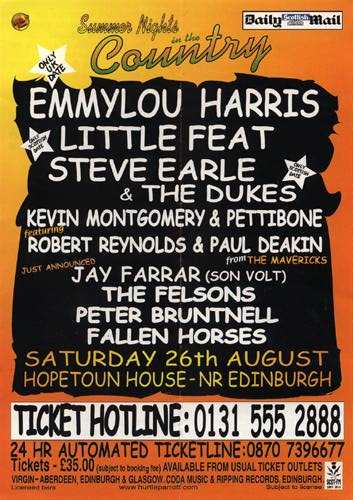
I won't talk about the weather which could have been better or the architecture which provided a stately backdrop, but get right into the music of Summer Nights In The Country at Hopetoun House near Edinburgh on August 26. This was one occasion far and away above anything I've heard in years and should be considered one of the all-time great music events. Firstly, I must nail my colours to the mast and admit that I was there because of Little Feat 'the best band in the world' (more about them later), but what went before was a demonstration of impressive programming, fast turnaround between sets and excellent sound via the PA. Congratulations to the organisers, Hurtle Parrott.
First off was an undampened Fallen Horses, despite a sudden downpour. Des Horsfall's four-piece country rockers from Yorkshire are a popular touring band in the UK with their honest acoustic/electric songs and warm harmonies. Their new album Breathing The Same Air is to be released shortly by Outback Records.
Second on was Peter Bruntnell with full band, including wunderkind guitarist James Walbourne who's equally at home on Telecaster, Stratocaster and acoustic guitars. That they've been asked to support hot new blues rockers North Mississippi All Starts for a month's tour of America, commencing end of September, tells much about how good they are and how well-respected by their peers. Peter's album, Normal For Bridgwater (Slow River), is a collection of alt.country gems. Titles such as By The Time My Head Gets To Phoenix and Jurassic Parking Lot demonstrate his wit as well as style.
The Felsons, a five-piece band based in Edinburgh, had a deservedly warm reception. Stage-filling and acoustically bright, they are a country band who also go out as a rock band. As the former, they toured as support for The Mavericks at the end of last year and will be playing with Jools Holland this Autumn. Impressive. Look out for them.
Son Volt and ex-Uncle Tupelo's Jay Farrar played as he did in London, acoustic guitar of the strum-along-song accompaniment variety with superb support from Mark Spencer's electric and lap steel guitar. The publicity notes sum it up 'Uncle Tupelo were a punk-garage band who took elements of traditional American folk and Country and single-handedly spawned an entire musical movement - namely alt.country, insurgent country and No Depression music (named after a Tupelo album). By blending the energy of Husker Du with Merle Haggard and The Carter Family, Uncle Tupelo captured the imagination of the growing US grunge movement and soon bands everywhere were rediscovering their American roots. REM were early fans and it's no coincidence that after Peter Buck produced Uncle Tupelo, REM themselves found a more Americana feel to their music. The Influence of Uncle Tupelo continues to grow to this day and history will place them in the league of the true orginators. Son Volt - After UT split in 1994 Bassist Jeff Tweedy formed Wilco and Jay Farrar went on to form SON VOLT. Over the course of three amazing albums with SON VOLT Jay Farrar showed what he was truly capable of as a songwriter, with his collision of straight-ahead rock with traditional American forms (country, folk, blues) harking back to visionary blends like Dylan's Highway 61 Revisited, The Band's Music from Big Pink or Neil Young's After the Gold Rush.'
Kevin Montgomery (looking like a smaller brother of Slaid Cleaves) with the Mavericks' rhythm section's Robert Reynolds, bass, and Paul Deakin, drums, plus very special addition of the outstanding Pat Buchanan on Gibson semi-solid, performed a set of sweet-voiced country fare. Kevin is the son of Buddy Holly's pre-Crickets musical partner Bob Montgomery. Kevin was joined by acoustic guitarist and edgy, storytelling singer-songwriter Jeff Finlin, who stole the set for me. He'll be supporting Kevin for the rest of his UK tour. New albums, Kevin Montgomery & Pettibone - Another Long Story (Road Trip Records) www.kevinmontgomery.com & Jeff Finlin - Original Fin (NBFNY Records) www.nbfny.com
The evening kicked off with the first programmed legend, Steve Earle & The Dukes, performing rootsy rockers from Steve's latest album Transcendental Blues, an album which has much to give on repeated listening. Every word is carefully crafted; from naming his own label E-Squared, production Twangthrust (that's a great description of the Earle sound) to, of course, the lyrics of his songs. A genius of narrative songwriting, he's lived the Devil's bargain and survived (it was touch and go there for a while). Emmylou Harris joined them for a number at the end of their set, before changing for her own performance. www.e2records.com
Emmylou Harris is an angel, a perfect musical being who stands alone in an imperfect world. Emmylou on acoustic guitar backed by a rocking 'wrecking ball' of a band, (Brady Blade on drums, Daryl Johnson on bass and djembe, the legendary Buddy Miller on electric guitars, 6 and 12), performed a set of such class and quality that they surpassed all expectation. And she rocks, how she rocks, with a grace and passion that has no equal. If you loved Wrecking Ball and Spyboy, you'll have to buy Red Dirt Girl, on Grapevine, released on 18th September. She'll be back in the UK with her band later this year. See her tour dates on our Listings page. www.emmylouharris.com
The great Little Feat took the music into the stratosphere - there is no way else to describe it. We were on a different planet. Thirty years of gigging has not diminished them. Lowell George's death has not made an iota of difference to the tightest, jamming band in the world. I saw the band four times in the 70s on different tours in London so I know about it. I can tell you they are so hot, so tight, that it's like group sex - band and audience together. Yup, it's hardly decent to talk about it. Opening with Spanish Moon segueing into Skin It Back, through to the encore Fat Man In The Bathtub, the energy was mammoth and the pace never let up. Shaun Murphy's version of Dylan's It Takes A Lot To Laugh, It Takes a Train To Cry was as passionate and dirty a blues as I've ever seen performed and I hope they can repeat it again at their Forum, London, gig on September 11th. Meantime they are now off doing wonders for US troops' libidos in Europe - what a selfless band they are. If you want the 'live' experience on CD, try the double album Live From Neon Park. Our magnificent seven's new album is the excellent Chinese Work Songs. Why Chinese Work Songs? Bill Payne, "I say why not!!! work ...work ...work") www.littlefeat.net
Sue Cavendish
This double album was first recorded 'live' for broadcasting in 1973 at Ebbetsfield, Colorado, and represents the best early Little Feat, and their brand of steaming hot, funky, Southern boogie/blues. The band, Lowell George, Paul Barrere, Bill Payne, Richie Haywood, Kenny Gradney and Sam Clayton perform 'classics' from their first recorded albums. Sixteen standards, including Two Trains, Fat Man ..., Dixie Chicken, Willin', Sailin' Shoes, are peformed with their special recipe of tight and classy musicianship, seemless tempo and key changes and segues. These days Little Feat on tour (remarkably) play a different set each night but the songs on Late Night Truck Stop still feature in their live repertoire and still pack the same punch. Look out for thier 1996 double album 'Live From Neon Park'.
The story goes that tapes of LNTS have been around since the early 80s as the bootleg 'Snakes On Everything' but were later transferred to dat by those who had access to the reel masters. In fact, it's a bootleg which is being sold 'legitimately'. There are moments on the album when small idiosyncrasies in the recording give you the feeling that the Feat might not have given permission for this to be released if they'd had any control over it. They hadn't, but then again, The Feat are largely complicit in being the most bootlegged band of all time. Thirty years of live performances, by arguably the best jamband around, have often been captured by fans plugging straight into the sound board! Although the many early bootlegs are still unofficially available via tape traders, 'Waiting For Columbus' (1978 and partly recorded at the Rainbow, London), has been the only legitimate 'live' album to date to include the great, late Lowell George. For this alone, lovers of Little Feat will want this album.
The moral of the story is, musicians, please don't sign away your broadcast rights, you won't see a penny later - but, thank the Lord, Little Feat (or their manager) on this occasion did.
Sue Cavendish
Last year, a full ten years on from their first appearance on the scene, the iconic folk-rock band released an anniversary double-CD that celebrated their longevity in fine style. It also heralded the return to recording of the latest LJE lineup (PJ Wright on guitars, Gareth Turner on melodeon, Guy Fletcher on fiddle and mandolin, with Hugh Bunker on bass and Mark Stevens at the drumkit). I'll own up to a certain amount of trepidation, and a distinct feeing of is this going to be as good as it should be? or am I going to be disappointed? Well I needn't have worried, so there's the good news out at the start!
The gang are back, with a vengeance, and the utterly unmistakable LJE sound is there in all its glory, but if anything tighter and more together than before and aided by a sensibly balanced production (by Mark himself) that harbours no grudges and bears no favours, everyone getting their fair share of the limelight. This record is clearly conceived in the spirit of the "dinner table" disc of the anniversary collection, in that it's a listening album that showcases the songs and songwriting as much as the playing, but that's an observation rather than a criticism and this is a sound-good set par excellence with a quite easygoing, relaxed feel (ie not too much in-yer-face). PJ's rocking guitar is perhaps reined back a touch in terms of number of solos (but he still comes into his own when the band plays live), but there's no complaint because he's still very much a presence in the mix notwithstanding.
As for the songs themselves, this comeback set opens with a pair of Pete Scrowther compositions (as it should!): the title track, a response to the timeless warmongering, and a quintessential quasi-trad folk-rock ballad Lily Of Barbary (one of the album's best tracks, albeit already pretty familiar from PJ's solo record). Pete's third offering, Steeltown Saturday Night, is a grittily truthful, if somewhat unflattering portrait of his schoolboy stamping-ground, Consett (though it could be any number of steeltowns I guess), complete with one of those catchily wordy-rhythmic Tanglefoot-style choruses.
Pete's song-tally is equalled by three Turner/Stevens compositions: Ginger Billy is the mildly embellished true story of a wartime farming man espousing his father's humanitarian values, whereas the jauntier Welcome To The Sparrow Club takes a slightly tongue-in-cheek fly-on-the-wall view of a bunch of "armchair worriers" down at the local (sort-of Show Of Hands meets Little Johnny), and The Falling Down Man kind-of speaks for himself.
LJE also turn in a rocking cover of Steve Knightley's venomously relevant diatribe Cutthroats, Crooks And Conmen, a sounds-familiar cover of Penny Sykes' fable Kenzie, and two reliable trad-arrs, the better of which is a lavishly spooky take on The Plains Of Waterloo. Elsewhere, PJ permits the band to revisit his Random Acts Of Kindness, but the band version doesn't really add anything.
One final point: in view of the weighted-towards-songs nature of the album, it might sound perverse when I comment that the customary medley of "instrumental malarkey", strategically placed just past midway through the album, turns out to be one of its highlights. No matter - you'll want to return to virtually every track to hear if it's as good as first impression gave. So it's a strong welcome-back for the Johnnies then!
David Kidman February 2010
Brief history: the band's iconic eponymous CD was followed by a better-than-decent live set, then the slightly disappointing Mercs And Cherokees, which seemed to indicate that treading water might be deemed more than acceptable. Some connoisseurs of folk-rock had by then assumed the mantle had passed to the mighty Duncan McFarlane Band, of course!
But accentuating the positive, quite honestly at times during the band's career it was a miracle that they survived the various (and continual) biz-related hassles that beset them. And this wondrous two-disc set from Talking Elephant reminds us forcibly of just how stonking brilliant LJE were prior to their temporary retirement from the scene. The two discs would score highly and make an essential purchase as a sampler-cum-best-of, but their glory is that they don't just recycle existing available material, and even the already-available cuts (which number less than half of the total19) have been vibrantly remastered by Gareth Turner and Mark Stevens (the band's new drummer).
Each of the discs has a defined "purpose": disc 1 (The Dinner Party) contains the less frenetic, "most dinner-party-friendly tracks" that you might play to friends to convert them to LJE, whereas disc 2 is the set to play out very very loud when driving home in the car from a folk festival finish on a Sunday! There's a myriad of sonic delights on both discs, but I'll just mention a few to whet your appetite. An absolutely blinding take on I Was A Young Man recorded in Rochester, NY in 2004, that morphs into an extravagant cornucopia of heavy-metal riffs; a fabulous live version of the band's self-styled theme song recorded at PJ's birthday celebrations and complete with extra updated verse; a great live post-rehearsal recording of the notorious Swine/UHT tune-set; a fierce and funky Dixie Chicken (for a while the band's regular encore showpiece); and of course a whole clutch of fine Pete Scrowther songs, which the band made their trademark - including a first-time appearance for Like The Moon At My Window.
Guest stars cropping up to lend more than a hand (or voice) include Miranda Sykes (notably on her arrangement of Blow The Candle Out, previously unreleased), Steve Knightley, aNNa rYDEr, While & Matthews, Christine Collister and Tom Leary… tokens of the high esteem in which LJE have been held over the years. Even if you've got all three LJE albums, you will definitely still need to buy this splendid set: one of the most useful (and musically notable) compilations of 2009, and an anniversary celebration to treasure. (Folk-) rock on!!!
David Kidman October 2009
For their third release, LJE continue “rocking the English tradition” in style, exploiting the strengths of their excellent line-up even further and building credibly on the runaway success generated by their full-of-promise début album of two years ago. The band may have moved onto a “name” label, with all the solid backing that implies, but they've retained all the trusty elements that made them such a success in their first two years on the road, while at the same time neatly avoiding predictability. So Mercs And Cherokees is more of the same, yet at the same time a step forward, though it's not clear how much further this direction can take them. The tried and tested features don't quite (yet) become a formula, thank goodness, though it sometimes feels that a small degree of recycling of material is in evidence (The Witherstone using the LJE signature dance-tune for instance). But enjoy this release for what it is, first sampling the instrumental cuts – Swine/UHT being a good example of the band's full-frontal attack, thrusting lead guitar lines, gutsy fiddle work, pumping squeezebox, enviably solid rhythm section more than capable of throwing itself round tricky corners without wrong-footing – in other words, everything in place, and generating a fair degree of excitement in the process.
The songs, as before, mix three fine original compositions by Pete Scrowther (The Moon At My Window being the standout here) with group compositions like My Heart's Where My Home Used To Be, whose similarly hard edge typifies their very real concerns about the modern world, passionately sung to memorable tunes, even if couched in the traditional idiom or utilising traditional tunes (40 Years On). Then there's a stirring version of Steve Knightley's haunting epic Widdecombe Fair, where Steve himself takes time out from Show of Hands to share vocal duties. Unfortunately, the album's brief closer is its weakest link – a somewhat misplaced anonymous punky thrash through Ralph McTell's Lost Boys. But for the majority of the time, LJE are to be heartily congratulated for giving the lumbering 70s/80s folk-rock beast a new lease of life and yes, a new identity. Where do they go from here, I wonder?
David Kidman
That'll be Jolene Higgins to her folks and guitarist partner Foy Taylor, residents of smalltown Saskatchewan and purveyors of country, blues, swing and ragtime that comes straight out of 20s and 30s Dixieland and Chicago. Influenced by such legends as Big Bill Broonzy, Bessie Smith and Memphis Minnie as well, I would suspect, as revivalists like Commander Cody, and singing in a jazzy warble that might well be caused by having her tongue in cheek on several numbers, it would only take a few crackles to make you think these were lifted from old 78s rather than recorded straight to tape on vintage microphones.
Her fifth release - though I think her first to make UK shores - it sets the mood with the playful lazy swing through Beautiful Sun, complete with (fake) bird calls and mid-section, and that's the vibe throughout, whether singing about a couple of good old boys getting liqueured up in the vaudeville jaunty Memphis on Glad Your Whiskey Fits Inside My Purse or the vagaries of the weather impacting on her garden on The Tornado Song.
Climatic conditions and agricultural produce are popular images. The New Orleans swing Wash These Blues Away invites the rain to help cleanse her romantic worries (though it seems she'd prefer moonshine) while a dreamily crooned My Love has the sun melting ice a drop at a time as the spring breeze of romance puts her at ease and the winkingly metaphorical percussive a capella work song Gather My Fruit has her inviting a lover to pluck and share a plum.
As per the title, these are songs from the prairie landscape, most notably the seven minute rumbling twang noir moaning blues of Slaughterhouse with its disturbing images of an abattoir on the outskirts of a small town and a killing floor where 'blood flow like a velvet evening gown'. While tuba and clarinet carry the song along on a 20s jazzy ambling trot and her vocal delivery is relaxed, she's in lyrical sober mood too for Snowing Today: A Lament For Luis Riel, a song, partly in French, about the 19th Century Canadian politician and leader of the Metis people of the prairies who led a resistance against the government and was hung for treason in 1885.
If, on the other hand, you prefer a little risque fun to musical history lessons, then how can you resist an album that features a rolling Chicago blues ode to cheap underwear called Bargain! Shop Panties. Definitely not to be sniffed at..
Mike Davies February 2011
Bennett recently upped sticks - her place taken by blues guitarist Abie Budgen - but not before recording this stunning debut album. Reflecting their various backgrounds and influences, the music ranges wide to embrace traditional Welsh and Jewish airs, klezmer, bluegrass, Celtic and English folk, and classical with the album setting up contrasts between the city and the country experience.
The harmonies sparkling, it's a heady affair with an open airy quality and freshness that captures the live feel, the band's playfulness evident on Bili Broga, a kiddie song fairytale about a love affair between a Welsh frog and a toad, and the Spanish and gospel folk swing Did You See Me?, apparently a song about someone who stepped over Fox when she fell and dropped her shopping.
Mattison's scraping fiddle sparks up proceedings with the Bennett-penned Rolling, a breezy blow your troubles away old school mountain music tune rich in counter harmonies with a rhythm perfectly described by the title and the squeezebox wheezing to great effect. Elsewhere, fiddle again setting the tone, there's the shanty like call and response trad folk styled Magpie, the plaintive ache of Coming Home, a virtual solo spotlight for Fox on vocals and guitar, and evergreen chestnut Gypsy Rover gets a lovely, harp plucked, almost madrigal style treatment.
Effortlessly proving they can take possession of non-original material and make it their own, Gillian Welch's One Monkey becomes a spooked folk blues everglades groove with moaning strings and intoxicating hand percussion while the Pomus/Shuman classic from which they derive their name becomes a Cajun shuffle with leg slapping percussion, handclaps, and Hot Club fiddle swing.
The interplay of their tremulous, pure voices is tremendous while, to underline their superb musicianship, there's two rousing instrumentals, Kevin with its gypsy and medieval flavours (and that touch of Bach) as harp, fiddle and accordion weave in and around the tune, and the brief but rousing throaty cello and fiddle driven No Job. They also have what I'm pretty sure is the only song ever to mention let alone be titled after Ashby de la Zouch, a percussion puttering, fiddle firing 60s shaded prog folk dance tune, the title of which comprises most of the lyric.
It'll be interesting to see how the arrival of Budgen tweaks the musical colours, but you can be sure you'll be hearing their praises sung wide and loud in the months ahead while, as a fitting swansong for the original line, the album is already a leading contender for those best of 2010 lists.
Mike Davies January 2010
The Living Sisters is a trio gathering together the talents of three LA-based female indie singer-songwriters. It's a heavenly extra-curricular teaming-up of Inara George (of jazz-pop duo The Bird And The Bee), who also happens to be Lowell's daughter, with Becky Stark (frontwoman of folk-pop band Lavender Diamond) and Eleni Mandell.
Right at the start, though, if you play this album blind, I'd swear you'd think this was a new (or hitherto undiscovered) Roches record, for those gorgeous but quirky, slightly off-kilter vocal harmonies on the opener How Are You Doing are an absolute dead ringer: it's truly uncanny. But at that point (and more so thereonafter) something equally uncannily tells you it couldn't actually be the Roches: most likely it's the album's generally retro musical backdrops, sometimes ever so slightly glutinous, that give it away, together with the way the girls conjure a dreamy, almost idealised vibe from a 50s-America that probably never quite existed, a vibe which incidentally permeates the songwriting as well as the purely musical aspect.
At times the Living Sisters sound to be almost completely steeped in that era, for they audibly take their inspiration from doowop, easy-jazz-cum-Andrews Sisters and early pop-standards as much as from close-harmony country ensembles and girl-groups. For the opening gambit is deceptive, and the more purely Roches-soundalike moments diminish from the third track in, with the girls reverting to a more conventional leader-with-support set-up for several of the songs, although the main thrust of their sound remains their skilled, precisely pitched vocal harmonising.
Love To Live's musical mode is in the main gently sweet, with an air of sugary confection that's not going to be to everyone's taste – and to be honest one or two of the tracks wear thin after a couple of plays. Also, since the album's ten tracks weigh in at a smidgen over half an hour in total, there's an unavoidable impression of frothy insubstantiality that's hard to escape. This is mirrored in the nature of the lyrics (cute small-town preoccupations of love, romance, babies) and in the way they're couched in a softly spoken, innocently sexy, often slightly cheeky musical setting.
Paradoxically, even though the majority of the disc's songs are clearly self-penned, album highlights are provided by two of the album's covers: (You Don't Know) How Glad I Am and Good Ole Wagon. Of the rest, the closer Don't Let The Sun Go Down, the knowing, breezy Double Knots and (especially) the achingly pretty country-waltzer This Mountain Has Skies are both charming and addictive in the right proportions, while the touching ballad Cradle would also be a front-runner if it weren't spoilt by a direly sickly spoken interlude midway.
At its best, this debut album by The Living Sisters is a delightful and quietly ecstatic experience that's so easy to forgive and so hard to push away.
www.myspace.com/thelivingsisters
David Kidman April 2010
The evening in question being that of 5th November 1972 at the Top Lock Folk Club in Runcorn, Cheshire, on which Bert, on near-top form, regaled his audience with a sequence of songs and stories that presented a veritable cross-section of his repertoire. Apart from three items (one song and two stories), the entire evening, complete with Bert's song introductions to the songs' provenance and background and the occasional bit of traffic or bar-till noise, has been lovingly transferred from the amateur tape onto this 73-minute CD.
Of course, by this time Bert's reputation preceded him, and if you've never before heard his singing you'll be a touch surprised at first by the actual sound of his voice (he speaks his introductions in a higher register than he sings) and its quite puckish timbre, which serves to mildly belie both his reputation as a bit of a heavyweight of traditional song and the understated gravitas of his readings.
But while many (Paul Adams and myself included) have found the appeal of Bert's singing voice hard to precisely define, one can never deny his stature as nothing short of a master storyteller. He naturally transmits the power and meaning of a song without artifice or undue theatricality, and one feels he has the entire measure of the drama at all times. He possesses the ability to move between serious ballad (Tamlyn) and rip-roaring shanty (Doodle Let Me Go), deep English song (Brigg Fair) to Australian song (Wallaby Stew and The Shearer's Dream), pithy parable (The Little Piece Of Wang) to equally economic ballad (The Lover's Ghost) with consummate ease. The disc also contains one example of a story, The Kush Maker: this exemplifies Bert's method, whereby creative embellishment takes the place of slavish retelling, and mirrors his reconstructive approach to traditional ballads (The Proud Girl and Prince Heathen being but two of the several fine examples scattered throughout this set).
It all adds up to a most involving evening of unaccompanied song, one which you feel privileged to now be able to attend.
David Kidman August 2011
Bert Lloyd was one of the archetypal architects of the UK folk revival of the 1950s. Not only was he a writer, broadcaster, folksong collector and folklorist, and mentor to many aspiring folk performers, but also a fine singer in his own right, whose directness of approach and delivery was appreciated as a kind of foil to the more theatrical style of his contemporary Ewan MacColl.
In the early 1950s, Bert embarked on a project to record English versions of some of the great folk ballads to be found in the five volumes of Child, and the resulting (1956) recordings were issued (in the US only) on a ten-LP set on the Riverside label which also included Ewan MacColl's contemporaneous recordings of Child ballads.
The majority of the MacColl contributions to that set were reissued on Topic the year before last (on the two-disc set Ballads), and now all of Bert's contributions have been assembled by Fellside under one very convenient two-discs-for-the-price-of-one roof, freshly and cleanly remastered and with a chunky booklet containing insightful and authoritative essays by Vic Gammon and excellent notes. These discs provide ample justification for the reassessment of Bert's talent as a singer and pretty much surefooted (even at that relatively early stage) storyteller-in-song, despite some tentative gestures here and there. But every single performance is characterised by Bert's obvious relish in the communication of the stories and his sense of true enjoyment in the activity of singing.
The discs' continuous programme of 33 tracks can be taken at face (ear) value as an entertaining collection of ballads in mightily definitive performances, either sampled individually or (effectively) as a sequence, or as an ongoing valuable reference source for future investigation, research or performance; either way, this set is a superbly well-presented release that will doubtless prove a cornerstone of Fellside's ongoing limited reissue programme.
David Kidman August 2011
This Fellside reissue, subtitled "A Selection From The Penguin Book Of English Folk Songs, collects together the contents of the historic LP and EP which Bert recorded with Alf Edwards (English concertina) for the Collector label in 1960. It was the first major recording devoted to English traditional songs, and thus a landmark release. Bert's approach to the songs he knew and loved is learned and scholarly, though not offputtingly so, and his no-fuss interpretations of the songs are described in the accompanying note as "virile, exciting - and extremely moving" - a description with which I wouldn't disagree, although his singing style may not be to everyone's taste (then again, equally, for some this record may be an un-alloyd pleasure!). I appreciated Bert's singing for its welcome combination of directness of expression and responsiveness to the text, alert and genuinely involved while equally keen to share the experience with the listener; a degree of ornamentation is used occasionally, but not as an attention-grabbing gimmick. Bert sings the versions of the songs that were collected at first hand from "the folk", whose music they are; these sources are detailed in the original liner notes, which are reproduced in the CD booklet. Bert's selection may include many songs that have become well known through sixties recordings and subsequent influences, but it also includes some more obscure and striking gems such as Gaol Song, a treadmill song from Dorset. As regards recording quality, since the original tapes have long since disappeared, modern technology has been brought to the transfer process, and the result is certainly well more than acceptable, in fact very impressive. As an aside, you may well be intrigued (as I was) to learn from the CD booklet that "in 1959 the composer Ralph Vaughan Williams and the folk song collector A. L. Lloyd compiled the Penguin Book Of English Folk Songs - quite an achievement for Mr. VW, who'd died the previous year! (OK, I know the date's that of the book's first edition)… Whatever, I for one am very glad to have this important release on CD format at last.
David Kidman
Northwest-based duo Chris Lock and Ian Tupling have been giving sterling service on the folk scene for the past few years, and more recently have teamed up with Steve Dawes and Helen Pitt to form the deservedly acclaimed maritime crew Four 'n' Aft. The duo's last recording as Loctup Together was five years ago: Further Down The Road was a splendid collection of songs which had been carefully chosen from predominantly contemporary writing, and it also included several of Ian's own fine compositions. That CD's highlights were the acappella items, which best demonstrated the duo's new-found confidence in the strength of their solo and combined voices, and Chris and Ian have wisely decided to concentrate on this aspect of their performance for this new collection, on which only two of the tracks have any instrumental accompaniment (and a third, well I'll come to that in a bit…!). Under The Sky's entire 17-track sequence they call "songs we love singing" - and that sure comes across all through the CD's well-filled 61 minutes.
A small proportion of the songs might be termed reasonably well-known (to existing devotees of the good song, that is - and other listeners encountering the songs for the first time in these sturdy and passionate renditions will be enraptured I'm sure); the duo's arrangement of the shanty Shallow Brown is thoughtful, with some unusual and well-coordinated harmony work, while another maritime favourite, One More Pull, receives a very fine reading and Ted Edwards' Lancashire chestnut Coalhole Cavalry is unlikely to be bettered by any other Yorkshire singers! Lucky Ol' Sun deserves to be sung more widely, and it's good to hear singers other than CB&S doing full justice to two Lester Simpson standards (Make It, Mend It and Falling Slowly).
Although the Yorkshire songwriting connection is strongly maintained with John Tams' Pull Down Lads and Brian Bedford's delicious cabaret number Talk To Me, it's Ian's own superbly moving "folk family" anthem Come The Day which must claim pride of place on this CD. Kent songwriter Ron Trueman-Border's Lead The Harvest Home, which closes proceedings, runs it close, and benefits from restrained guitar and keyboard backing and extra vocal from Alison Younger. For me, the only track that doesn't quite work is The Ostrich, a self-composed exercise in extrapolated "logistics" which stretches the basic joke out for a few verses too many I feel.
So there you have it - an extremely fine CD which against oft-received opinion ("who on earth wants a whole CD of acappella?") manages to retain interest through the sheer finesse and commitment of the performers, their constantly inventive and yes, interesting harmonies, and the high quality of the songs they've chosen. And by the way, that "third accompanied track" I mentioned is Chris's Travelling To A Gig, which might best be described as a fun "road movie" - or should I say a "vehicle" for her acting abilities, taking on the role of a damsel in distress?! - on which the CD's producer (Chris Harvey) decided to run quietly amok with his tapes of motorway sound-effects (and hurrah, it's all sensibly understated, not just gratuitously applied for "cheap laugh" value.) This new CD is a credit to Chris and Ian, and shows their excellent voices off to best advantage.
David Kidman, July 2006
Nils has a long history with Neil Young, having played with Neil during his formative years as a singer/songwriter. Most crucially, he worked closely with Neil on the sessions for his landmark After The Gold Rush album, near the close of which Neil gave Nils his Martin D-18 guitar as a gift for his contributions and commitment to the record. This now-historic instrument remains a treasured possession which Nils continues to play and cherish to this day. Inevitably, then, Nils chose to use it for this album in order to give the best chance of doing Neil's songs justice. The album sessions took place at Nils's home, and the intense conviction, intimacy and affection of these bare-bones performances, coupled with the sense of history and character ingrained in the two accompanying instruments, makes this a rather special set. Nils' considered yet natural-sounding intepretations of these songs are born of a true understanding, and contain some real insights. Some of Nils' approaches are not entirely expected: for instance, World On A String is reinvented as a delta blues, while four out of the 15 songs (Only Love Can Break Your Heart, Winterlong, Wonderin' and the epic Don't Be Denied) have an almost spiritual presence, being given further emotional gravitas by being accompanied on a baby grand piano which belonged to the father of Nils's wife Amy. Generally, the choice of songs takes no prisoners either, with both solo and Buffalo Springfield material all grist to the mill: it ranges from Long May You Run and Like A Hurricane to Harvest Moon, The Loner itself to Mr. Soul and Flying On The Ground. But all of these performances bring home, too, just how intuitive Nils is as both guitarist and interpreter. A magnificent and self-evidently heartfelt tribute.
David Kidman June 2008
Well, it's obvious that somebody over at Hypertension control had their marketing hat on straight when they decided when this album should be released. It surely can't be down to pure coincidence that this double-CD found its way into the shops just as Lofgren was grinding out the miles as part of The E Street Band on the European leg of Bruce Springsteen's latest and long-anticipated tour. And for any Brucefans looking for an introduction to what the diminutive guitarist can do when he's on leave from The Boss, "Live" is just the ticket.
The many hues of the Lofgren spectrum are on display here, from the hopeless romantic, through the lover unrequited, totally smitten and spurned, to the angry social observer. And across the collection's 23 tracks are moments of tender passion, picked out on acoustic guitar; plaintive cries from the heart, wrung out with a slippery bottleneck; and flashes of incendiary ferocity as his left hand takes flight across the fretboard of his trusty old Strat. For sheer goosebump-inducing beauty, look no further than the first two tracks of the second CD, where he dips deep into his back catalogue to his days with Grin and pulls out "I don't wanna talk about it" and "Like rain". His singing and playing on this pairing are nigh on breathtaking and, despite the fact he's performed them countless times over the years, he still conveys their emotion and how much they mean to him. Then, as if to show he can still turn out a song of such quality, he follows them with "I found you" from his last studio outing, "Breakaway Angel", which he dedicates to his wife Amy, singing: "I was clearly clueless, lost in the drift, wasted enough to welcome death as a gift" before going on to say: "I see colours since I found you, I found magic when I found you". Now, is that lovely, or what?
The album was recorded across three nights in June of last year (2002) with the band Lofgren toured the UK with at the tail end of the preceding year, just weeks after that fateful September 11. It's a really tight-knit unit, its members clearly enjoying their work, adding subtlety or strength and light or shade at exactly the right moment throughout. Listen to the awesome, near 12-minute seeing-to they give "Message", building and building to a magnificent crescendo. The rhythm section comprises Timm Biery's earthquake-proof drums and the lithe and sinuous bass of Wade Matthews. The quartet - don't forget Lofgren - is completed by Buck Brown, who concentrates on keyboards but, as he demonstrates on "Can't get closer", can turn his hand to some tasty guitarring when the occasion demands.
It's going to be several months yet before Lofgren's immediate E Street Band duties are complete, so this fine album will have to stand us in stead until we see this band touring again. That said, it's a damn good compromise.
Fred Hall
If the more tender, thought-provoking aspects of Nils Lofgren's canon are the elements that appeal most to you, rather than the cock-sure gunslinger of his early days, then Breakaway Angel could be fluttering its wings in your direction. The majority of the album's new songs - and one cover - highlight the gentler side of the Lofgren character with lyrics touching on the multi-faceted jewel of love and guitar-playing flitting effortlessly from electric to acoustic. I found you shows the best of Lofgren with a distinct edge to the song's message of a new love giving meaning to a life.
Some feisty lead guitar breaks are tempered with girlie backing vocals repeating the title's chorus. Over it, Lofgren sings: "I was crazy, nerves all distorted, guts like a brush fire gone unreported" - rhyming couplet of the album. I can't fly boasts one of the most haunting melody lines before tangentially drifting into a strangely effective faux-Hawaiian sub-theme, and Love you most is quite breathtaking with its gently loping bass, courtesy of ace session man Leland Sklar, and the gently plucked harp of Christine Vivona.
Two of Breakaway Angel's tracks are not all the work of Lofgren's own hand. A run-through of All I have to is dream stays fairly true to the Everly Brothers' original and that's followed by the acoustic guitar-dominated Driftin' man, co-written by Lofgren and Lou Reed, which benefits from some atmospheric tom-tom work from drummer Timm Biery.
The uptempo rhythm and perky guitar breaks belie the sadness of Cryin' tonight which sees the collapse of love's young dream when a chap's girl tells him they should see other people in order to test their feelings for each other. Lofgren sits down at the piano - it's easy to forget he's just as talented with a keyboard as a fretboard - for the slower-paced Heaven's answer to blue, a heart-breaking accounting of the emotional collateral of the reunion of an estranged father and his long-lost child. And he slips into classic singer/song-writer mode, with only his voice, acoustic and harmonica for company as he goes looking for love and answers along the Open road.
But it ain't all love and hearts 'n' flowers - Breakaway Angel kicks off the sort of punchy, intelligent rocker for which Lofgren is, probably, most revered. Puttin' out fires boogievates along on a demon bass line, from Lee Sklar, which gives more than a nod in the direction of Hall & Oates' Maneater and boasts a couple of Lofgren's delicious trademark, cascading notes solos on acoustic guitar. It's a fantastic album-opener. And his social conscience is given free rein on Tears ain't enough - a peek into the plight of America's homeless. How's this for angry? "Got my belly for a pillow, and the rain to wash her clothes, cement mattress, walls of cardboard. We ain't helpless, we're homeless and it shows." It's sung over a western swing backing enlivened by some cracking fiddle by Rickie Simpkins.
Breakaway Angel may not boast a Keith don't do, nor a Cry tough but it's a fine addition to body of work by a man whom too many people regard as no more than a member of Bruce Springsteen's E Street Band. He's much, much more that "just" that.
Fred Hall
Originally released in 1992 and out of print for some time, John "Juke"Logan's debut album, The Chill, has been re-mixed, re-mastered and has new tracks added. All 16 tracks were written, or co-written, by Logan and Fan The Flames is Texas blues with Rock 'n' Roll overtones, as heard in the Chuck Berry touches. A great opener and sets the scene for the rest of the album. She's Cool People is a strange one, a 60s style question and answer session with a few Latin twists. He virtually speaks the vocal on Play Tha Blues, as he does with many of the others, and I can hear Albert Collins influences in Junior Watson's guitar playing on this loose blues. Young & Wired underlines the fact that he is better at the rockers. Chuck Berry and Dave Edmunds come to mind on this and he shows that he is a good singer when he wants to be and the addition of David Hidalgo of Los Lobos is a masterstroke. This is a highlight. She Stone Me's Latin rhythms will grow on you and the fast-paced harmonica blues of Rumblin' Reeds introduces a little Zydeco to the proceedings. Logan on harp and Hidalgo on accordion both shine. He should concentrate more on these than on the spoken lyric tracks as he has produced another highlight. Dig Ta China is a strange one but he gets back online with the mid-paced swinging blues of Hustler. I can't understand why he includes novelty tracks when he can produce this standard. Collins style shines through on Watson's guitar again although the overall feel is that of Kansas, not Texas.
Long Low Ride has the addition of Brenda Burns on vocals and the result is a smooth, slinky blues and hey, we have another two good tracks in a row. There's a familiar Bo Diddley beat on Bayou Diamond Ring with a bit of The Who's Magic Bus thrown in for good measure. Mario Moreno's guitar is on full reverb for the funky blues of If The Money's All Right and you have to just wiggle your chromosomes to the manic guitar and harp of We Got Ta' Rock. The Chill is another of those that lean towards the novelty end of the market, at least as far as the lyric goes. Musically, it is fine but he can be so infuriating. Soul Stroll is the last of the regular tracks on offer and is a slow 12 bar blues with harmonica to the fore. The aforementioned harmonica is played with feeling but it is a bit strange to end the album with a slow instrumental. However, there are two, previously unreleased, bonus tracks in the form of Mello C and Tend To My Bid'ness. The former is 60s R&B with Logan's harp featuring more and more and played with such vitality and the latter is a laconic blues with the too often used almost spoken lyric. Otherwise, it is very good quality. John "Juke" Logan has been the harp player of choice for Ry Cooder, Los Lobos, Etta James and Bo Diddley to name but a few and they have excellent taste, as can be heard here.
David Blue October 2007
Eldest son of Grammy winning legend Kenny Loggins, Crosby Loggins and his band The Light release their debut album on Provogue Records. When your father's house guests include Jackson Browne, Graham Nash and Michael McDonald then there is bound to be a little magic that rubs off on you. Crosby has captured some of that magic during co-production with Jesse Siebenburg, a multi-instrumentalist with his own famous father, Supertramp drummer, Bob Siebenberg. Good Enough showcases a whispery voice fronting melodic acoustic rock. Always Catching Up, written with his sister Bella, is very familiar sounding, sometimes the sign of a good song, and the inclusion of Paul Cartwright's fiddle and Siebenberg on pedal steel gives a modern country feel. Rocks Into Sand is a country crossover and confirms his status as being very different to Provogue's other artists. There's a jazzy fiddle intro to Man In The Middle. This is very sophisticated and finally gives us a guitar break. Military drums from Jared Pope herald March On, America, political soft rock and very mechanical with a wicked electric violin solo from Paul Cartwright.
Written by Siebenberg, Here She Comes is a pleasant nu-country ballad that may remind you of Marshall Crenshaw and Wanna Be You is a very slick funky and soulful offering with vocals akin to those of Savage Garden. Radio Song is modern country and Angel Of Mercy is an impassioned country ballad that is surprisingly good for one from this genre. Loggins certainly has the type of voice for this. Couldn't Save Me is another from the higher echelons of the genre but it doesn't carry enough of an edge for me. The title track is one of the better songs on the album and this sultry, piano-led contribution builds up well and shows that he can construct a song brilliantly. It's even more impressive when you find out that he wrote it when he was 18. Same Old Song (La La La) is old style folk/country much akin to James Taylor. He throws in a Celtic influence with the fiddle but the whole effect is spoiled by the inclusion of the La La La excerpt. Apart from this, it is a top song. As I've already said, Crosby Loggins is very different to the rest of Provogue's roster. Then again, variety is the spice of life.
David Blue March 2008
The London Lasses are a well-established band on the London-Irish scene, with a recording history now spanning three albums. Though at one time ostensibly centred round the talents of founder member, fiddler Karen Ryan, the group interaction and togetherness has always been all-important in performance, with the contributions of all musicians carrying equal weight. Album number four takes in some personnel changes, with Brona McVittie (vocals, harp) and Elma McElligot (flute) joining the lineup in place of Kathleen O'Sullivan and Dee Haylin, alongside existing members Maureen Linane (accordion) and Elaine Conwell (fiddle) – with the redoubtable Pete Quinn still providing more than just a piano keyboard continuo. (I can't help thinking that the effect of the latest lineup change on the Lasses' sound is not unlike that on the Chieftains when harpist Derek Bell came into the band between albums 3 and 4, but that would be over-simplifying things!)
Although majoring on a no-nonsense approach to the music – yes, they still play with ample nimble musicality, inner fire and evident unpretentious joy and abandon – the Lasses can now also inhabit a quite refined sound-world at times, without leaving on display the rougher edges that you might get with yer typical Irish ceilidh outfit, pub session crew or showband; but equally you'll find no lack of genuine thrust or commitment in their playing. It can be quite like listening to a concert party that one minute is playing a concert and the next having a party!
Taking the instrumental tracks first, it's still hard to resist tapping your feet from the moment the Lasses "launch their boat" in the opening medley of reels – a delightful set and no messing, with typically agile interplay between fiddles, accordion and flute and some intelligent underpinning by Pete's gently pumping piano as ever. All the instrumental items are characterised by a tangible warmth and a real joy in musical collaboration, and they contain some imaginative performance decisions regarding tempo, choice of key and instrumental combinations, the majority of which pay off handsomely (though I wasn't entirely convinced by the amount of keyboard enhancement given to Elma's otherwise very persuasive, and measured, account of the Humours Of Ballyloughlin jig).
The proportion of songs to tunes on this new disc is probably about right: four out of the 13 selections, of which two are sung in Irish. Brona's harp is a key feature in the arrangements here, and gives the treatments a quite different, elegant and slightly ornate, flavour to the music; you might even think you're listening to a different band entirely from that which plays for the dances (and that's not necessarily a criticism). The Ballyronan Maid, learnt from the singing of Antrim's Len Graham (another undersung exponent of the song repertoire), is most charmingly done here, and the endearing lilt of Brona's voice is just right for this kind of material.
Interestingly, this song is followed by a lovely account of the Boys Of Belfast march, which combines stately elegance with forward momentum very appealingly, and the ensuing Charlie Lennon Camden Town polkas bring us back to the dance floor with gradually accelerating gusto. What of the other vocal tracks? Well, the song praising Johnny Seoighe has a gorgeous keening quality, whereas in contrast Brona also clearly relishes the cheeky nuances of Bean An Tí (Woman Of The House).
The more I listen to this latest incarnation of the lasses, the more I come to appreciate the inner subtleties and dynamics of their new lineup, so this CD is proving a grower.
David Kidman October 2011
The Lasses produced an album three years ago which encapsulated the very best of the current London Irish scene, a fifty-minute selection of melodious yet punchy instrumental sets (with a few songs thrown in for good measure), all played with real gusto yet at a civilised speed, losing nothing of the spirit of the dance or the welcome of the craic. Since then, they've appeared to great acclaim all over the place, including a celebrated storming appearance at Sidmouth festival. Track Across The Deep, their second recorded offering, retains the first's strengths but rings a few changes too. The Lasses themselves have had a couple of lineup alterations since that first CD - Dee Havlin has replaced Sharon Welton on flute and whistle, and accordionist Maureen Linane has replaced emigrating banjoist Bernie Conneely, while the mighty twin-fiddle front-line of Karen Ryan and Elaine Conwell is thankfully unchanged. In place of Sue Cullen, on this latest CD the Lasses now employ the fine singer Kathleen O'Sullivan (whose name I must admit was new to me) on three tracks here (Ball Of Yarn, There's A Path Across The Ocean, The Red-Haired Man's Wife - the last-named, learnt from Kevin Mitchell, being a particularly fine interpretation I thought). Casting a further glance at the new lineup might now begin to invoke superficial comparisons with Cherish The Ladies, but to be honest I find the Lasses' playing more invigorating. Look no further than the enchanting set of reels at track 5 for an illustration of the delicious way the players run rings round each other in superbly controlled musical banter. Thus far, I've not namechecked the masterly Mr. Quinn, whose keyboard work is a considerably more integral part of the group sound than the mere tacking-on after the "and" in the group name might suggest. Pete's contributions should not be underestimated; they're marked by a vital yet stylistically straightforward musicality that's firmly in tune with the playing of the lasses, and prove that strict-tempo metricality in the rhythms need not make them unattractively lumpy and four-square, they can be every bit as captivating as more experimental rhythmic input and to my mind infinitely more satisfying than tricky flashy syncopation-ridden fusion effects. Pete and the Lasses have produced another refreshingly unpretentious and very strong collection that the living tradition can be justifiably proud of.
www.londonlasses.net
www.copperplatedistribution.com
David Kidman
Recorded (primarily at Dingwalls) back in 2004 during their brief European tour reunion, this marked the first time they'd played together in 17 years. Heck, it was the first time Sid Griffin, Stephen McCarthy, Tom Stevens and Greg Sowders had been in the same room let alone on a stage since 1987. Drawing largely on the Native Sons and State Of Our Union albums, with a couple of nods to 10.5.60 and Two Fisted Tales, it's suitably raw and ragged, which is pretty much how I remember their gigs. You didn't go expecting smooth polish, but you did get boundless rock n roll energy and music played with conviction and passion, some blistering ringing guitar work, McCarthy's warbling twang and Sid's not always strictly in tune but compelling nasal vocals.
Disappointingly there was no room found for Good Times Today or Harriet Tubman and Looking For Lewis and Clark is a mite sluggish. But opening in influence acknowledging form with their belting version of So You Wanna Be A Rock n Roll Star, there should be few other fan complaints about a set list that includes Capturing The Flag, the choogling State of My Union, You Don't Know What's Right, You Don't Know What's Wrong, the Stonesy Prairie Fire, their live classic cover of Mel Tillis' (Sweet) Mental Revenge, the anthemic I Had A Dream and McCarthy's rousing rebel rocking Lights of Downtown. You had to be there, but this is a reasonable substitute.
Mike Davies November 2007
The Long Ryders - The Best Of 1982-1987 (Prima)
Given the cult reputation Sid Griffin's old outfit has garnered over the years since they split up it's surprising it's taken this long for a single (and the usual live cuts and rarities) compilation to emerge, especially given it's through his own label. But then, with the band reformed (with their most settled original line up of Griffin, Stephen McCarthy, Greg Sowders and Tom Stevens) for their first tours in 17 years, timing is clearly everything.
Inappropriately lumped in with the Paisley Underground movement when they were patently more a kick ass rebel country rock n roll band of the same ilk as Jason and the Scorchers, the Ryders hit the ground running with Looking For Lewis and Clarke, a blistering slice of punk influenced barroom rowdiness (produced like many here by Will Birch) that was really never quite as good as the reputation its accrued over the years. The band had far better material (largely down to the more countrified McCarthy) under their belt as is clearly evident from running the random button over a selection that includes the rousing Lights of Downtown, Chuck Berryish rock n chugger State of My Union, the jangling cover of I Want You Bad, I Had A Dream and Stevens' moody psychedelic folk Years Long Ago.
To be honest any real best of would have elbowed the cover of Masters of War (from the Metallic B.O album) and the Flaming Groovies I Can't Hide in favour of such glaringly absent numbers as Run Dusty Run, Harriet Tubman's Gonna Carry Me Home, The Light Gets In The Way and You Just Can't Ride The Boxcars Any More, and really the ragged live version of Capturing The Flag, easily one of their best songs, really isn't a patch on the blistering studio recording. Still, if devotees may be disappointed, it's an undeniably useful primer for newcomers and full marks for including Sid and Christine Collister's plaintively lovely folky B side If You Were A Bramble And I Were A Rose.
Mike Davies
Teesside-born Mark has been a familiar face on the Wharfedale (Yorkshire) folk scene for more than a dozen years, being involved in running local folk clubs and sessions and as a regular performer at the famous Otley Folk Club (and Festival), both solo and in a duo with Anne Jackson and with folk-bluegrass trio Northern Lights. His trademark rich, deep voice, together with his easygoing guitar style, makes him an ideal performer of country music, but with this release the clue lies more in its title, for Looking Back is exactly what Mark is doing here with a collection of ten of his own songs written over the past ten years. Around two-thirds of these can be placed firmly in the "tradition" of contemporary industrial/vocational balladry, the remainder being affecting songs of lost love. Mark's family made their living in the Staithes area of the North Yorkshire coast, from the sea and mining (and his father eventually got his own boat), so many of Mark's own songs are well steeped in the sea and the fishing, compassionately and intensely expressing, in simple and direct language, the contradictory emotions, the sense of resignation and inevitable tragedy set against the deep lure of the sea and the straightforward justification for the employment. Natural nostalgia for the work and its happier times is always tinged with infinite regret at the lives lost. There are some outstanding songs here that deserve a permanent place in the modern tradition - Waiting On The Shore, Gone To Sea, Mists Of Time and Lifeboat Song especially come to mind - and they stand the test of time well, being memorable both for their deeply-felt and thoughtful sentiments and their strong melodic content. The non-fishing songs provide a contrast, for they're couched in a different musical idiom, that of contemporary country singer/songwriter; 42 And Counting, Do You Think That I'm Crazy and Crimson Skies are attractive compositions evidently much inspired by the Hugh Moffatt/Kate Wolf repertoire which Mark performs live with Northern Lights, whereas Lost At Sea is more reflective, its catchy use of refrain reminiscent of Ewan Carruthers or vintage Allan Taylor. Finally a word of praise for Mark's decision to resist any temptation to over-arrange the songs, preferring instead to keep the accompaniment simple and unpretentious (just his own guitar, with well-judged contributions from John Savage (fiddle) and Steve Fairholme (melodeon) and fellow-Northern Lights members Anne Jackson and Chris Rawnsley; the production too is admirably unfussy, allowing the listener to concentrate on the songs. Congratulations to Mark on finally getting it together in the studio to set down these fine songs for posterity.
www.northernlightsweb.co.uk
www.myspace.com/markalongster
David Kidman July 2006
Mark has suffered with kidney failure over the last ten years and is once again on dialysis following the failure of a transplant last year. He has donated 100 CDs to the Kidney Research Fund (UK) to sell & raise money for the charity; contact www.kidneyresearchuk.org or freephone 0800- 7832973. Cost is £10.00 plus £1.50 p&p.
The three young musicians comprising The Long Notes come from different backgrounds, and their names will be familiar from different contexts. Piano accordionist Colette O'Leary was a founder member of the trio Bumblebees, who released their first acclaimed CD in 1997; fiddler Jamie Smith, from Glasgow, founded the band Beneche in 2001; whereas banjo/mandolin player Brian Kelly has been part of the established London-Irish scene for some years now (and he's even toured with Shane McGowan). The Long Notes' debut CD capitalises on their success at Celtic Connections and has all the feel of three justifiably confident musicians trying out a whole load of fresh musical ideas in company with a few friends. They prove they can handle a wide variety of styles on top of a predominantly trad-tune sensibility and framework. The special talents of the three individuals as musicians are both highlighted and well exploited on these eleven tracks. Colette's lyrical accordion is to the fore on Sean Cooney's majestic slow air Ag Fas Fos (which also features some delicate guitar counterpoint from guest Tim Edey), while she leads the ensemble superbly in the Taxi To Donegal set. The joyous, uncomplicated drive of Brian's banjo playing with its minimal but effective ornamentation, is a strong feature of the swinging Dancing In The Sky reel-set, while his brilliantly clear, precise mandolin work is called into the spotlight on the delectably light-textured opener, a tune from Lorient, and the gentler expressivity of Myra's Tune, written by one of Brian's key mentors Tom McManamon. Then Jamie's fiddle (and composition) skills really come into their own on the exhilarating Room With A View set, where he parades his mastery of more complex time-signatures and Balkan and middle-eastern inflections. Having said all that, there's also a fair amount of credit due, I'd say, for the contributions of the band's other guests too, who include Martin O'Neill (bodhrán), Ewan Robertson (guitar) and Julia Reid (bouzouki). The disc's nine purely instrumental tracks are additionally complemented by two songs: Jimmy McCarthy's enigmatic Bright Blue Rose (wrongly credited as traditional), which is sung appealingly by Julia, and Phil Ochs' When I'm Gone given an equally thoughtful treatment by Ewan. This is an appealingly vital release, full of feelgood playing and unassumingly impressive musicianship. I really enjoyed it, and have had it on replay several times since writing this review – always a good sign!
David Kidman July 2008
Some time ago Tom Pacheco told me about a fine Norwegian group he'd met; they were fans of his work and wanted to work with him. At the time Tom was outselling both Willie Nelson and Bon Jovi in the Norwegian album chart so the outfit's motivation may have looked beyond the artistic! However Pacheco enthused about having his opportunity to make his Blonde On Blonde and, finally, here it is.
Sounding nothing like the legendary Dylan double, it is, however, a triumph. You kinda know that from the moment Fredrik Viklund's slide guitar fires up the disc's opening cut, Norfolk, Little Rock, Memphis. The epic tale of a man destroyed by long term unemployment who, having been driven to uncharacteristic prayer, bundles his pregnant wife into the car to search for anything that'll leave him the vestige of his personal dignity. The detail unfolds to an soundtrack that would swell the heart of any Boss fan. That's not to say that The Long Walk - the trading name of this line-up, Pacheco is listed as no more than member tho' he supplies all of the material - are derivative; they offer the flavour of Crazy Horse at times with the passion and texture of Pearl Jam at others all marinated in a versatility that understands the need to serve the song at all times. It's certainly the first Pacheco album to warrant playing at stun level, that's for sure.
Long term Tom watchers will recognise The Last Rolling Stone, a song that celebrates the life force that is rock and roll, and Juan Romero, the tale of a Mexican waiter caught up in the assassination of Bobby Kennedy. The new material is as varied as you might expect; There Was Me (Before There Was You) examines loss of personal identity in relationships against an original, taut musical setting, Che is a muscular reading of the story of Fidel's friend and You Gotta Have Money berates materialism against a Hooker-ish boogie. And that's the first pass, there's far more substance here that'll reward continual playing for quite some time to come.
Rock and Roll with attitude is always welcome in these parts and even more so when it comes from one of Uncle Sam's finest songwriters even if it's a mite confusing that his co-architects hail from nil point Norway, hardly the first call for the hall of fame. Five stars all round.
www.angelfire.com/music5/roots2rockmusic/rootsalbums.html
Steve Morris
Aptly named, this Australian duo! Right from the opener, Heading For The Sun, you're taking off for that sunshine holiday experience, the archetypal long weekend, to a soundtrack of breezy, jangly summertime pop with just a tinge of upbeat country. Andrew Tragardh and Jackie Moffatt sure know how to pen a good song, and how to put it across. Andrew mostly sings lead, with Jackie backing, though when Jackie sings lead (as on Flowers) she comes on like a curiously wistful Debbie Harry. Andrew and Jackie accompany themselves with cool, fluid burnished guitar lines that owe stylistic debts to Hank Marvin, Roger McGuinn and even U2, but without a hint of pastiche. There's also a varying rhythm section, and other supporting musicians are used effectively to fill out the sound. Many of the songs are highly memorable, and certainly less disposable than the obvious pop tag might imply. They have a heady, choogling vibe that reeks of the open road, though having said that it's hard to generalise further, as there's also a more reflective aura to some tracks that's as attractive as it proves unexpected – instrumentally as well as lyrically. Holy Night, for example, with its brooding cello and harmonium backing setting the dark guitar riff in luminous relief. The album's one instrumental track, Gunnamatta, is kinda like the Allman Brothers meeting Echo & The Bunnymen and doing battle head on! Do track this CD down – if you respond to the pop sensibilities of acts like the Kennedys, for example, you'll not be disappointed with The Long Weekend.
David Kidman
The Long Winters - When I Pretend To Fall (Munich)
There are some albums you own just for one track (Deep Blue Something and Breakfast At Tiffanys to name one) or simply because you like the catch in the singer's voice. Such is the case with this latest offering from the Seattle four piece headed up by raspy John Roderick. It's not that there aren't a bunch of catchy ringing guitar-pop numbers among the dozen tracks. Blue Diamond and the beaty Cinammon could prompt you to turn up the radio, and Prom Night At Hater High's country-rock boogie woogie Bob Seger swagger is worth it just for the title, but it's New Girl, a bass twanging and piano boogieing strutter slab of indie guitar pop rock with its be kind to the new girl chorus hook to which the repeat mode keep returning. It's not a million miles away from The Posies and lo and behold their Ken Stringfellow pops up elsewhere on the album providing guest vocals along with contributions from other Roderick chums like REM's Peter Buck and Young Fresh Fellow's Scott McCaughey. Maybe the rest of the material will grow on me too, but for now, it's back to track 10 for the sixth time tonight.
Mike Davies
Far too often you come across an album of great songs, spoiled by a band unable or unwilling to rise to the challenge and make the most of them. No such problem here, not only are the members of Loomer up to the job of extracting every ounce Scott Loomer's gems superbly, they manage to bring an added lustre to them.
To fully appreciate the songs and, by extension, the band you have to look at Songs Of The Wild West Island in two ways.
Firstly come the songs of Scott Loomer. The promise of the band's first album Love Is A Dull Instrument is fulfilled here and Loomer shows himself to be one of music's true writing talents.
Only Lovers is one of the most tender, gently romantic songs you'll hear for a long time - mind you Sarah Harmer can do no wrong at the best of times, presented with Only Lovers her voice takes on a translucent quality - and Bang The Nails is the kind of intelligent rock n roll that comes along as often as Halley's Comet.
But the songs would be less than they are without Andrew Lindsay, Brian Duguay, Mike Taylor, Iain Thomson and John DeHaas. With Loomer they are fellow and sympathetic travellers, his songs are in good hands.
Loomer is all about substance, the foundations which will carry them on and up are solid. It means that tracks like Caramel Heart need no flashy, trashy decoration. The cracking voice of Scott Loomer is cushioned by the keyboards of Taylor and underpinned by an immovable rhythm. It's a simple formula but when it's done as well as this, it's also devastatingly effective.
Without losing its energy or sharp-edges Songs Of The Wild West Island is an album of rock 'n' roll for grown ups. The album engages the brain as much as it does the heart.
You could find traces of a myriad of bands in Songs Of The Wild West Island, right up to and including Tom Petty, Neil Young and Springsteen. But why bother, enjoy it for what it is an unforgettable experience.
www.loomeronline.com
www.myspace.com/loomermusic
Michael Mee November 2006
Loomer - Love Is A Dull Instrument (Newtone Records)
What a shame the phrase 'peaceful easy feeling' has been appropriated by some obscure west coat band because it would sum up perfectly the ethos behind Love Is A Dull Instrument. Nothing on the album is rushed before its time, the music just grows quite naturally until it blossoms into a wonderful explosion of country rock.
Loomer will not be the first band to spring from a drunken encounter but in the sober light of day few will have turned out to be such a good idea. This particular happy coincidence took place at the 1999 CMJ conference in New York, present were ex-Saddletramp Andrew Lindsay and former Heimlich Manouver drummer Iain Thomson, 'head of the table' was Scott Loomer. Lindsay then enlisted the help of John De Haas, Brian Duguay and keyboard player Mike Taylor and the five make up what is surely one of Americana's best bands outside of superstardom.
If there's any hidden agenda to Love Is A Dull Instrument then it's the music not the career that comes first. This is a band intent on play good old-fashioned, solid country rock for its own sake and not the glittering prizes it may offer, although I'm sure they wouldn't refuse them if offered.
Loomer are at heart a country band enthralled by the harder edges of the genre. Psychotic Killer and Imperial Parkette are pretty conclusive evidence that there is more to Loomer than three chords and heartbreak.
There is an almost malevolent undercurrent running through Love Is A Dull Instrument that eventually ignites into Bluebells and Roses, it's the prime example of an album and a band that's always on the edge.
www.loomeronline.com
www.myspace.com/loomermusic
Michael Mee
Jon Loomes - Fearful Symmetry (Fellside)
I first latched onto Jon as a man to watch when I saw him perform live sometime over the past year or two (though my memory's not detailed enough to recall exactly when and where!) in tandem with that tall young melodeon player Paul Scourfield, who joins Jon on many of the tracks on this his first album. Here, Jon himself is in a fearful symmetry, for not only does he sing, and darned well (of which more below), but he also plays guitar and fiddle, and sometimes hurdy-gurdy, with a spring in his step (and/or fingers!). There's a rhythmic import to his guitar playing that in its slapped style is sometimes distinctly suggestive of Nic Jones. His fiddle playing is informed by playing for dance teams such as Ryburn Longsword and Black Swan Rapper, and his hurdy-gurdy playing by his work on the Cambridge French dance scene. (I understand that Jon also plays English concertina, cittern and melodeon, but not on this record.) The vast majority of the material on this disc is English traditional in origin, however, and an enticing mix of familiar and unfamiliar. The opening track, a lively version of Jacky Tar, puts Jon firmly in the frame with some idiomatic singing that here and on some other tracks was (to me at any rate) reminiscent of Martin Carthy - bold and forthright, with deliberate enunciation (listen to Bridgewater Fair and you may hear what I mean), also an impressive command of fast pacing allied to an instant and enviable precision and clarity of diction. Similarly so with The Ride In The Creel, a pleasingly characterful rendition backed by melodeon, fiddle and guitar, while Jon also copes well on a rendition of Rolling In The Dew that Jon might say embodies a different kind of fizz to the well-known Pop of Mr Maynard's version! I also liked on one hand Jon's gently tender way with The Seeds Of Love and on the other his more pointed and at times slightly unusual phrasing, as on two of the unaccompanied tracks The Ploughman and especially All For Me Grog - where he seems to have an unlimited supply of brazen confidence at his command (and it's good to hear this intriguing, less-often-heard setting by the way). Perhaps there's an occasional feeling that Jon's engaging singing technique draws attention to itself at the expense of actually communicating the song, and there's a (slightly breathless?) waver on some of the longer-held notes, but in the end neither feature is a serious barrier to appreciating Jon's interpretations of the texts. The disc also contains three better-than-decent instrumental tracks, which veer between a richly-textured hurdy-gurdy-based pair of polkas and the curious sore-thumb of a solo guitar rendition of the main theme from Holst's Jupiter (competently played, sure, but I'm not sure about its inclusion on this predominantly traditional set). Jon's instrumental support crew (the aforementioned Paul Scourfield, together with Philip G. Martin on hurdy-gurdy and Michael Beeke on recorders and English pipes) and play with panache and evident sympathy, and Jon's booklet notes employ a delightful mixture of light erudition and abundantly witty fun – in that respect I can definitely feel in "fearless sympathy" with Jon! I reckon Paul Adams has backed another winner here, worthy of keeping Spiers & Boden company on his increasingly healthy roster of young revival artists.
David Kidman
Banishing sorrow is what these guys do alright! They gleefully blend roots, Cajun, old-time, polka, folk, country, ragtime and jugband, within the context of their own compositions. These are mostly deliberately in a fun style with witty lyrics on contemporary themes - with the difference that these don't tend to pale beyond first hearing in a way that those of some "fun" bands can. And along the way, they also pitch in a cover of Pinball Wizard done to the tune of Wabash Cannonball – with some delightful picking behind – that actually works! You can tell that the three guys in the band (Richie Lawrence, Ken Cooper and Steve O'Neill) are also having a great time making their music, and their infectious good humour beams through the defiantly unplugged, sparkling and "alive" arrangements, which combine accordion, guitjo (six-string banjo), bedpandolin (yes, your guess!) and upright bass with one-offs like jug and jew's harp. There's a nice little fast-waltz-time instrumental cut (Leaving Home) midway through, providing a pleasing beer-break. And the album draws to a more sober close with a Sally-Army-style We All Need More Kindness and a dreamy Flying (which pays cheeky homage to the Beatles instrumental, complete with soaring saw!). For the rest, well it's more fast and "loose", probably a bit like the Holy Modal Rounders meeting up with the Durbervilles – at times it's decidedly zany – but a grand time will be had by all. Pretty much irresistible, once you "get" what the LAT are about.
David Kidman June 2008
Not having heard of them since the release of sophomore album Takista five years back, I'd feared the Shropshire acoustic folk rock quartet had disappeared into the void. Good news then to find their third album dropping through the letterbox and, again produced by Ron Rogers, still seeding the lyrics with potent political themes and fruitfully mining the seam of jazz influenced prog-folk that fuelled classic albums by Traffic, Led Zep, and, more recently Paul Weller.
As the swirling dark rhythms of Come The Night and the didg drones of the bluesy Hey Man! respectively bear witness, there's also strong Eastern and Aboriginal colours in evidence. At times equally evocative of Asian textured 60s prog rock outfit Quintessence, the jam psychedelic folk of the Dead and, on the surging mantra rock Only Worlds Away, Midnight Oil, this is by far their most musically muscular album, core instrumentation augmented with the cello, melodeon, cornet, sax and Spanish guitar and the rhythms firmly focused on conjuring both groove and atmosphere.
Take a listen to What Ya Gonna Do For Love where, deep voiced vocalist Mark Haywood sounding like Johnny Cash, they weave all manner of musical textures and instrumental intrusions over the steady swampy march beat, dropping in a reference to The Beatles along the way. It's hard not to be impressed.
They get mellow for the bluesy Come On Over and, marrying Spanish and raga, Love Has Only Just Begun while roots country flavours lurk among the reflective gravel and accordion of Lonely and Train To Heaven runs fat sax and Celtic reel strains through a rowdy bluegrass stomp.
However, it's the urgent, heady, uptempo numbers that provide the album's driving wheel and keep bring you back time and time again to feel the rush of blood they stir. In a wry acknowledgement of the way music is often obscured and judged by image, the sleeve features them all headless with no clue to their look or age. Doubtless, many will still dismissively tag it as dad rock for New Age festivals and there is, perhaps, an element of truth to that. But, as they effortlessly demonstrate, father clearly knows best.
www.loosehounds.co.uk
www.myspace.com/loosehounds
Mike Davies February 2010
Formerly The Loosehound Drifters, the Shropshire/Welsh six piece return with an eagerly awaited sophomore album, once again produced by former T'Pau man Ronnie Rogers and once again mining their passion for heated rhythms and drivingly atmospheric acoustic folk rock that isn't ashamed of its roots in the heady days of late 60s progressive folk espoused by the likes of Traffic and Lindisfarne.
It's a lot tighter and more confident this time round too, Rogers gelling the instruments together in arrangements that create a surging wash of sound but also distinguish individual textures. Listen to the sultry colours of Outside The Pain with its Latin rhythms and rainforest moods, the slow stomping blues Someone I Believe In with its twanging Jaw harp and harmonica or the South African kwela cascades to Crazy When It gets Insane and the fusion of brass, mandolin and the steady percussive beat on the angry but naggingly catchy Lies.
Singer Mark Haywood is behind all the material, two tracks co-penned with mandolin player Richard Beasley, one with drummer (and band engine) Richard Jones and one as a band composition. They do the personal relationship bit, Turn Me On a grown up love song, but most are forged by social-political conscience, a commentary, that informs the observations of the Lonely World. Lies, Wheels To The World and the simple acoustic Good Morning that addresses eco issues, the Iraq war and the apathy towards Third World poverty. Taking its title from the Estonian/Greek for 'soon', the slow building title track serves as a warning of impending apocalypse, told through a view of Earth (aka Takista) from the perspective of colonists from space looking to find a planet with all the resources necessary for their survival, reporting back that the same eco madness is driving it to self-destruction.
Someone described the album as evocative of early Fleetwood Mac, but if you want a better comparison point, then Latin Quarter would be your best musical map reference, which strikes me as incentive enough.
Mike Davies
On the face of it they're six anonymous Shrewsbury based musicians with no band pedigree of any major note. Most will never have heard of them. Time to make up for that then and discover why NetRhythms very own Bob Paterson rates them and why Johnnie Walker was so impressed he broke Radio 2 format to play their studio demos on air.
There's no bluster or flash grandstanding here, just accomplished musicianship and strong songs played by artists whose heart and souls is in what they do. They've termed their music powerfolk, which is as reasonable as any name for their jazz-folk-global hybrid that variously summons thoughts of CS&N, Tull, Traffic, Dire Straits and Beck. A run through the tracks throws up several instant highlights. The folk-rock acid groove of Not Just Another Number, the moody Rain is Falling with its deforestation/eco-message, Dancing in A Dream's lazily sinuous melody with its guitars and flute tracing, the tumbling bluesy-folk of Games We Play and Fly, a number build around soaring harmonies and cascading guitar waterfalls that comes in radio edit form and a longer version with a cappela intro and twangy bass.
They keep the instrumentation acoustic and uncluttered with guitar, sax, mandolin, whistle and flute while the presence of hand drums imparts African colours and textures, on the spoken Keep On Falling, the tropical Get To Know Me and Pass My By with its veldt woodwinds in particular. Changing continents, Get To (Bastados) fires up with a Latin sway. The production is a bit harsh on the musky vocals at times, but otherwise the touch is light and hypnotic, an album that will sound as good to regulars at Cropredy, Glastonbury, and Cambridge as it will to anyone into Zion Train and the Ozrics.
Mike Davies
Those with longer memories of the Birmingham scene than they'd like to admit may well recall the name. Emerging from the Fighting Cocks in Moseley, the 70s bastion of acoustic progressive, with the core membership of Andy Morton, Phil Kirwan and Martin Berry augmented by an assortment of occasional sidemen, the Jack Russell Funtette, as they were, gave way to Slender Loris (named after an ex girlfriend rather than the animal) in early 1974, their move into jazzier fields coming a year later when they were joined by jazz/rock members Dave Bristowe and Micky Barker (currently with the Bushburys) on keyboards and drums. It was this line up that landed gigs on the college circuit with the likes of Procul Harum, The Pink Fairies, Curved Air, and Gong, building sufficient a following for Island to finance a couple of demos. For various reasons nothing came of these and resulted in the departure of Morton and his brief replacement by Paul Keatley before the arrival of soul man Curtis Little.
Despite building a loyal following at their two Birmingham residencies and getting the name further afield, nothing ever really materialised by way of a career progress and the band eventually broke up as the advent of punk firmly hammered the nails into the coffin of mid seventies jazz rock. Now, following response to some reformed acoustic gigs, the material recorded between 75-77 is finally seeing the light of day.
Vol 1 features 15 remastered reel to reel recordings and although there's no indication as to dates or the personnel on each it's the more soulful polished productions that see Little taking charge of the vocals. It's as muso as you'd expect from a 70s jazz fusion outfit, though interestingly the opening M'Aidez conjures thoughts of 10CC while Jobs For the Boys opens with a Queen style a cappela before going on to occupy similar territory to Steely Dan, a comparison that surfaces on several occasions, while A Better Way predates the sort of jazzy funk that would be later smoothed out by Simply Red. A Swarm of You also clearly owes a nod or two to Messrs Lennon and McCartney. Although some of the instrumental work outs get bogged down in prog rock indulgence (the keyboards of Piranah hinting at the riffing of a Lord or an Emerson) and quite frankly the lyrics of the stutteringly funked Bostin Weekend should never have seen light of day, the quality of the musicianship certainly holds up, giving the album more listening value than just nostalgic curiosity.
As a result of resurrecting the old tracks, Kirwan, Morton and Berry were persuaded to re-record some of the early acoustic material they used to play between 73-75. The result is a brand new album, 11 tracks of primarily vocals and intricately played acoustic guitars (with some added percussion for colour) that finds the trio still in good form, the Berry penned smooth Mulatto an especially fine groove that sounds like a Latin tinged CS&N while his Masquerade, Legionaire and Incognito all follow a hushed and brushed naive folksy filigreed pastoral pop that marries Clifford T Ward, and The Lilac Time. Kirwan's Spirit of the South and to some extent Twilight of the Idols harks to a bluesier side of the band though, just for the sake of throwing perversity into the comparisons, Blue Apron suggests early Bee Gees and Morton's minstrel plucking Three Quarter Time weds Bert Jansch to English baroque folk club days. Dated by way of its lyrical approaches, but otherwise this wouldn't sound too out of place among the latest breed of sensitive young poets with a guitar, a bedsit and a Nick Drake collection.
Mike Davies
Mary Lorson and Billy Cote - Piano Creeps (Cooking Vinyl)
Hang fire if you're expecting this to be a typical Madder Rose offering from its husband and wife founders. Drawing on their work with film music, this is a mainly instrumental 12 track collection that employs guitars (the album opens with the gorgeous cascading self-descriptive E-Guitar), percussion, horns, synths and, yes, piano to create a panorama of evocative atmospheric soundscapes. The global influences are apparent. Turtle Song hums with an Occidental ambience like melting waterfalls, Joe's House is a deep cellar jazz blues washed with mournful synth and a gloomy stabbing monochromic piano, Che a free range into beatnik electronica and spacey fragility that opens into a Latin sway, World's Fair a tumbling shoegazer that harks to both folk roots and calls to mind the brooding Asian pulse percussion intro to The Doors' The End while the title track is indeed as creepy as the image of moss hung Southern gothic swamps and ghostly musical boxes playing in abandoned nurseries and the closing Newfield Baptist Church is reminiscent of David Mansfield's work on Heaven's Gate in calling up the musical ghosts of the past when immigrant communities would gather in the halls to celebrate life or death.
There's three vocal numbers too. Americana a classic Madder Rose sample of brushed, er, Americana with Lorson's yearning voice drifting across the melody, Dig A Hole an hypnotic rumbling bassline blues etched with synth strings, icy piano and heavy echoing drums in a fuzz of darkness with Lorson's distorted vocals adding to the overall neurosis, a nervy quality that also informs See The Stars though here the duo chart their course on a more psychedelic folk path.
Unpolished, any 'accidents' of tuning and timing incorporated into the material's weft and warp, it might not sit comfortably with those who prefer Madder Rose's more hushed persona, but its dreamy textures have ample rewards for those prepared to immerse themselves in these dark waters.
Mike Davies
Mary Lorson and Saint Low - Tricks For Dawn (Cooking Vinyl)
The sophomore release from the Madder Rose singer's artrock side project, an outlet for the more liltingly mellow material that didn't fit within the band's context. Co-produced by Madder partner Billy Cote, while still exploring a sense of open space this is actually rather less lilting than its predecessor, opting for an edgier, more angular tone on several numbers, the slightly nervy feel of Oh Regret, the moody ominous percussive swirl of Strange Gift or Friends which sails close to the narcotic blues of The Cowboy Junkies. That said, Meaningless bizarrely brings to mind the melody of The Beautiful South's Rotterdam, Anything Can Happen is a pure pop shuffle celebration of surrendering to love and Your Lament waltzes around the heart on what sounds like treated piano. Playing around with experimental phrasings, Blast Off pares it back to a minimal guitar backing, brushed drums and watery gurgling samples, while the equally speed in motion titled Accelerate opens up on a nerve stretching murder mystery tone that reminds you of her Velvets influences before settling into a boulevard strolling slice of the sort of folksy pop that, shaded with violin, 10,000 Maniacs might have attempted under the influence of drugs to treat schizophrenia. And then, just to ring another change, Evan Dando pops in to share a ragtime amble through Long Way Down, another number that Lorson's talent for plucking offbeat arrangements from the air and bending unpredictable shapes from the melodies. No surprise to learn she and Cote are planning an instrumental album and have taken to writing film scores. The final number, the album's title track, is an eerie excursion into gothic (and I don't mean black mascara and sulks) territory, full of sombre dark piano, scraping violin, that perfectly modulated voice and splintered relationship, damaged psyche lyrics that suggest she's read more than a page or two of Sylvia Plath.
Mike Davies
Los De Abajo - LDA Versus The Lunatics (Real World)
Remember Fun Boy Three's perky platter The Lunatics Have Taken Over The Asylum? Well this new CD from the celebrated mestizo outfit LDA (their third, I gather) brings a vibrant punk salsa/tropipunk aggregation to 15 tracks including two different takes on that very 1982 Specials-offshoot curio. This highly contemporary Mexican sound, derived from a sub-culture of modern-day ska fans, also brings in a spicy wash of other musical styles from across the continent and beyond. That means cool hip-hop and brassy salsa, dub and twang as well as cumbia and polka, and even more traditional Mexican styles like banda, conjunto, norteño and mariachi. And one of the bonus tracks even features Natacha Atlas! To listeners unversed in Mexicana the CD will seem a bewildering, if at times breathtaking, headlong parade of rousing, if perhaps partly incomprehensible music. Even with more than a passing familiarity with some of them, I'll admit to being more than fazed on first acquaintance, and I had to learn to expect the unexpected (though this wasn't helped by the fact that my PC kept frustratingly insisting on engaging RealPlayer mode and either only playing the first track on repeat or skipping the very tracks I wanted to select, with error messages claiming a fault on the disc itself!) But once I'd gone past those hurdles, I found this a sturdy, spicy and invigorating experience, strong on Rude Boy charisma and upfront, fearless energy and excitement.
www.losdeabajo.com
www.realworldrecords.com
David Kidman
Los De Abajo - Cybertropic Chilango Power (Luaka Bop)
Let a musician with some taste run a record label David Byrne in this instance and you avoid the blandness of Pop Idol. Hallelujah! Having already taken Luaka Bop releases from Jim White and Shuggie Otis to my heart, it seems that I have to succumb to Los De Abajo. Coming out of Mexico, these folks take on all styles rather like Manu Chao does. Opening, literally, with some sounds of the street, Cybertropic Chilango Power launches into some hip-hop flavours with a punchy brass, burbling synth and the rap of Que Mala Suerte which compares the slums of Mexico City and Barcelona. I know this not because Im a dab hand at Spanish but because the sleeve notes are very comprehensive and have translations. Why doesnt everyone do this? The track that follows has a pop lilt that is reminiscent of Manu Chau which, I have to say, these ears dont take to for repeated listens. Fun in the sunshine stuff that Im happy listening to in bars on holiday but not sat at home on a cold February day. For Si Existe Ese Lugar, it sounds like the band have also been listening to Shuggie Otis with its funky sample. Funk and rap come together on Sr Judas which is a dig at a corrupt politician. Influences such as Salsa on Matame Amor emerge along with Columbian Cumbia rhythms on other tracks. Then, later, Vuelvo A Comenzar pulls in the Mexican folkloric style of their homeland.
So, this is a real soup of influences. There is already mumbling in the ranks about fusion reducing music from around the world to one approach. Certainly, sitting this record next to Manu Chaos, you might be building some evidence for this but, after all, a few CDs fusing similar styles doesnt really make for a disastrous trend. In fact, hasnt this been going on for years as musicians strive for a new sound? Whatever, theres a vibrancy with Los De Abajo which deserves attention from your ears.
Steve Henderson
Ewesi Para Hevioso is done in traditional Cuban style (Arara). There are African influences throughout and although it's short it has some brilliant choral work. Estan Tocando Part 1 is just the type of music that you would expect to hear in a Latin club and Part 2 is more upbeat and the tight band turn in some more music for the dancers. Indians (6 am Mardi Gras morning) is performed by Walter Harris & The Mardi Gras Indians, but it only lasts 0.36 and doesn't get the chance to get going. Their jazzy side comes out more on James Booker but it's soon back to the Latin rhythms on Rojo's Revenge. This is wonderfully played but is less passionate than some of the others.
Kermit Ruffins gets involved on The Mardi Gras Second Line and when he's there then things start to get crazy! This is New Orleans meets Cuba meets James Brown and The Rebirth Brass Band get things going along nicely. I can hear the Cuba and the carnival on Cubacajun Carnival but where's the Cajun? George Porter Jnr plays bass on George Porter which is a jazz/funk festival. Carnival Lullaby (Nite Nite Little Irvin) is a gentle interlude without the samba drums etc. There's another short song (0.33) to follow, Alakati Owo, and this is just far too short – please do a longer version sometime! Melena is big, brassy and bold and is Latin as only Latin can be. Carnival De Phunk is, as you would think, another jazz/funk offering and it is one of the highlights of the album.
There's a percussion fest on Mardi Gras Bayou and this is Louisiana at its best. The final two tracks are African influenced, Carnival Kongo (Congo) and Kendavshubi (West Africa). The former gives the African influence its chance this time and the band produces a wonderful song with Diblo Dibala on vocal and guitar. The latter is African with a Brazilian samba influence and again too short at 0.41. This is an album to get the heart going.
David Blue
This is a typical live album – suitably energised, musically adept and polished, conveying the essence of the band's stage presence and musicianship, but inevitably edited down and equally inevitably lacking in the final dimension of being-there sweat and excitement. Los Lobos could never disappoint a captive crowd though, and this cross-selection of material from throughout their career shows why they've retained their popularity and credibility over well over 30 years.
However, having already released a live DVD a few years back, I'm a bit puzzled at the rationale for releasing this new live set now, since it doesn't really add anything to our appreciation of the band's contribution to the roots scene. Sure thing, David Hidalgo and his chums were pioneers in the fusion of rock'n'roll with Mexican music, liberally stirred with flavourings from R&B, Spanish and Latin soul, and the uniquely spicy stew they served up from La Bamba outwards has always provided an antidote to the manufactured, sterile products of much of the past decades' music. Tasty is as tasty does, right through the 59 minutes' worth of music presented here.
Best representations on this well-paced set include Chico's Cumbia, Oh Yeah and the decidedly Band-influenced 12-bar Tin Can Trust, and the band also cranks up the tempo by revisiting Gotta Let You Know (dating from their 1984 success How Will The Wolf Survive?), but there's not a weak link even though a handful of the numbers may well by now feel a touch routine through over-familiarity. For the fans, this is a good album, but not a special one. For the rest, it's an impressively faithful live record – which is good enough, since I can't see how I could reasonably expect anything more. Even so, Los Lobos won't ever compromise on quality, and if you don't have the earlier live DVD this new release will deserve a place on your shelves nevertheless.
David Kidman, November 2013
Los Lobos crept out of the Latino districts of Los Angeles in 1977 just as punk was taking its grip on the live music scene. At that point, to establish a career in music needed a lot of character and these guys have it in bucket loads. Mixing southern US flavoured rhythm and blues with Mexican sauce from across the border gave an energy that has been hard to resist.
Previously, their career has been packaged as a double CD on the title with a tongue in its cheek, 'Just Another Band From East LA'. Here, we get the best of the best and it's better value for my mind. For, if truth is to be said, this is a band that needs to be seen live.
On this 20-track romp, the first 10 tracks come from their '….And A Time To Dance', 'How Will The Wolf Survive' and 'By The Light Of The Moon' records. In other words, the first three releases that got everyone leaping around. Next to the Mexican up-tempo of 'Anselma', you get the driving rock of 'Don't Worry Baby'. Stuff that is indispensable. But, later, they confused their pop inclining audience with the Spanish lyrics of the 'La Pistola y El Corazon' record before turning in a version of 'La Bamba' for a film soundtrack. The latter may have been a great commercial temptation but it also managed to throw their broader minded fans off the scent. You might ask who was left to support them at this point? A shame because they returned to form with 'Kiko', reflected here with two tracks, on a workout that showed they were happy to slide some soulful stuff a la New Orleans into their mix. You get the gist of their career though when you see only 3 tracks representing their last three records. Mind you, not really a worry with this ideal opportunity to pick up their very best.
Steve Henderson April 2006
David Kidman
An Atlanta-based singer-songwriter, Loebe's third album is a light and breezy affair that flits animatedly from Americana folk (Marguerita) to country (Redneck Karaoke Bar) to bluegrass (Meridian) to lazy New Orleans jazz (Her In That Dress), her pure voice soaring, caressing and generally sounding like she's having a good time.
Dory Previn and Randy Newman loom large over influences that also embrace Allison Krauss (Married Man) and Carol King (Trenches, Dear) on songs that are as well arranged (horns, strings, pedal steel) as they are literately penned. Indeed, the jaunty waltzing track title track is probably the only song to ever mention word game Boggle while Married Man wittily notes that "you can't knit socks for a married man".
The plaintive acoustic Siren and, caressed by warm brass, string and melancholic piano, five minute slow burn closer Avalanche with its celebration of the power of song, show her more melancholic, quieter side, but whichever mood you choose this a prize well worth pursuing.
www.rebeccaloebe.com
www.myspace.com/rebeccaloebe
Mike Davies September 2010
This film, which won the Best Long Documentary award at the Dutch Film Festival, travels far and wide within its 93-minute timespan in its efforts to retrace the steps of the celebrated folklorist and collector who has been responsible for documenting some of the world's great undiscovered music (much of it being housed within the musical archives of the US Library Of Congress).
The film takes the form of a kind of road-movie, except that it doesn't exactly quite go anywhere in particular in the strictly linear sense that a road-movie normally does - ie. it doesn't portray Lomax's musical journey as one with a beginning and an end as such. Its starting point is a visit made by Dutch film-maker Rogier Kappers to Lomax in 2001, just one year prior to his death. Lomax was suffering from a brain haemorrhage which had rendered him paralysed and unable to speak, yet he was clearly defiant about the ailment and still very passionate about the music. Inspired by this, Kappers made a pilgrimage in search of the musicians and people who had crossed paths with Lomax on his own music-collecting forays over the decades (mostly the 1950s in this case, so it's not surprising that many of the people he met then are now hard to trace).
He starts off in Scotland, first visiting Jack Mearns in Aberdeenshire and then island-hopping to end on Barra with Hugh Sinclair and Flora MacNeil, but then spends much of the film's second half in Galicia (Spain) and in isolated mountain villages of Italy. There are some wonderful performances of indigenous but still little-known music from Sardinia, Sicily and Calabria, in a few cases by the very performers originally recorded by Lomax (or their descendants), and the anecdotes and interview snatches are genuinely fascinating. It's so easy to be caught up in Lomax's passion, to feel the need to understand this unusual music, and the film encourages appreciation of Lomax's sheer energy and hard-driven determination in categorising it, in his all-consuming project to "record the whole world". It also stresses throughout Lomax's status as a key figure in our recognition that "poor folk" have a worthwhile culture and cultural heritage (as MacColl said, Lomax could get music out of a stone by telling it that it was special). To reinforce this assertion, Kappers punctuates the travelogue with extracts from conversations with colleagues and friends of Lomax: these include Shirley Collins, Pete Seeger, Henrietta Yurchenco, Peggy Seeger, Alan's daughter Anne and his fellow-collector, the late Peter Kennedy.
Representing Lomax's celebrated American journeys in this film, there's some archive footage of prison work-gangs and the like, and there are brief excerpts from Lomax's Blues And Ballads show and a priceless intro by Pete Seeger ("Hey, what's that funny-looking guitar you've got Pete? - That ain't no guitar, it's a banjo!"). However, given the tremendous importance of the legacy of Lomax's American collecting within the context of his amassed collection, and given the road-movie pretensions of this film, it's a real shame that its scope and budget couldn't have stretched to an American leg of the journey, which after all is the arena where most folks consider Lomax to have carried out the most seminal collecting work - but then I suppose we'd have been looking at a doubling of the film's length if true justice were to be done.
The constant interspersion of footage of a paralysed Lomax at his Florida home is a poignant device, but in the end it does mildly distract from the flow of the journey and the impact of the music. Those points notwithstanding, this is an important, absorbing and ultimately intriguing film, a valiant effort to communicate the spirit of this indomitable collector and at least the essence of the immense impact his life's work has had on our own appreciation of the value of indigenous folk culture/s.
David Kidman January 2008
Los Lonely Boys - Los Lonely Boys (Or Music)
If you, unlike me, watched this years Superbowl then you may well have seen these boys as part of the half-time entertainment. Los Lonely Boys are three brothers, Henry, JoJo and Ringo (their parents were Beatles fans then?) Garza and this, their eponymous debut album draws on such diverse influences as Stevie Ray Vaughan, Carlos Santana and Willie Nelson. In fact, they are described as Willie Nelson's favourite local band and the great man himself plays guitar on the closing track, La Contestacion.
As said, there are a number of influences on the album and there's something here for most tastes. If you are into the Latin tinged rock of Carlos Santana then Onda is for you. This has Henry's guitar playing at full speed and he's as good as anyone else in this genre or in any other at the moment. Jojo on bass and Ringo on drums (where else) are just as accomplished on their chosen instruments as their axe-wielding sibling is on his. Their vocals are tight and the harmonies are excellent.
There are more than a few nods to Stevie Ray Vaughan, including the guitar intro to Crazy Dream, in Henry's guitar style but don't get me wrong, Los Lonely Boys are not just a Santana and Stevie Ray tribute band. They have songwriting credits for each song on the album and they have shown their adaptability by not restricting themselves to one style. Songs like the melodic Heaven compliment the rockier tracks such as Dime Mi Amor and the aforementioned Onda. Hollywood has a more traditional acoustic feeling to it until they meld it very cleverly with North American influences to produce a summer song for this year. More Than Love tips its hat to another of their heroes, Richie Valens and completes their quartet of Tex-Mex influences.
This is a stunning debut album and the more you listen to it the more you will like it. I hope that the record stores don't try to pigeonhole them because they deserve to make their own mark.
www.loslonelyboys.org
www.ormusic.com
David Blue
The fiddle player in the Bluebells hit Young At Heart, occasional Clark Gable lookalike, brother of awards winning film music composer Ann Dudley, and former member of the Fabulous Poodles, Hank Wangford's band, and the Electric Bluebirds, Bobby Valentino is also the man who wrote Break For The Border, probably the best TexMex song not to be written in the Lone Star state, and Radio 2 turntable hit The Man Who Invented Jazz. These days, joined by veteran pedal steel player B.J. Cole, former Rumour guitarist Martin Belmont, bassist Kevin Foster and drummer Jim Foster, his deep crooning vocals and violin playing front the band who've been dubbed the UK's answer to The Mavericks.
Relaxed to the point of effortlessness that only comes with consummate musicianship, they are steeped in a love of old time American country, Western Swing and TexMex especially. Bob Wills and Asleep At The Wheel are obvious reference points, but then so would be George Jones, Johnny Cash, the Sons of the Pioneers and, er, Bing Crosby, all evident on their magnificent debut album Trigger Happy. Much of the material on that now resurfaces on this live album, recorded at Dingalls and featuring a ripping cover of the wonderfully named Slim Wallet's Don't Let the Stars Get In Your Eyes, Swingin' With The Chickens, Guaran-damn-tee, the excellent barroom country of Blood On The Honky-Tonk Floor and, naturally, the brilliant aforementioned Break For The Border. If you only have half as good a time as they obviously did then it'll be almost as much fun as actually being there.
Mike Davies
Steve Lott Band - If Licks Could Kill/West Texas Refugee (Fullmoon Records)
Ok, ignore the play on words in the first title – the songs will more than compensate you. I've already extolled Steve's virtues on Kay Kay and the Rays album and I'm about to do so again. If Licks Could Kill starts with a Cajun feel on Money Don't Care and I just love it, no need to say anything else. Too Hot To Handle is a blues influenced rock chugger with Paul Cheeseman's slide guitar prominent and, believe me, the licks are great. Lott's voice suits this type of song. Authentic blues arrive in the form of the shuffling Tambourine Walk. This instrumental benefits from Johnny Whyte's top class organ playing. The plain nightclub piano ballad Sunset To Sunrise is a slight disappointment but the Dobro on Ashes To Ashes wins me back again – this is the type of track that Steve Lott should be doing. Unfortunately, Steve decides to go back to the ballads again on Set Me Free With A Broken Heart before redeeming himself with the Texas blues of Bad Information. This is fun and Lott's guitar playing is quite sublime. The country influenced Better Angels shows that he can do a good slow one now and then and it's followed by a slow blues, I'll Survive. West Texas Refugee Part II doesn't work for me although it is well played. Lott finishes with the title track and there are licks aplenty as he burns up the fret board on this instrumental.
The earlier West Texas Refugee opens with Dance Thang, a funky, chunky R&B that has Lott's guitar sizzling. Pink Satin Sheets is country influenced and is another from Steve's pen but the first cover comes via Otis Rush's All The Love (I Miss Lovin'). This is given a fine treatment by Lott and it shows how seriously good he is. Back to the originals for Cut Down To Size, a Chicago style blues that is not too hard to think of Clapton playing. Steve shows his versatility on the acoustic country song, Everyone But You, which is pleasant enough. Echoes Of Dallas is a barnstorming blues with the customary high quality guitar and As The Years Go Passing By is a sultry blues that I'm sure that I've heard Gary Moore cover. This is not as in your face as Moore's but is a fine version anyway. Don't Lose Your Cool is an Albert Collins song and I'm sure that the Iceman would be happy with this high paced effort. The covers just keep coming and Sonny Warner's There Is Something On Your Mind is up next. Steve's country blues treatment of this hits the right spot. My Back Door is an average country rock song saved by Lott's guitar but T-Bone Walker's Strollin' With Bones is sheer class and should get your heart going. The final track is the title track which is an acoustic country rock song. Considering some of the other tracks available it seems strange to end on acoustic guitar and vocal but this is probably his best vocal and the guitar is just as you would expect, all the more puzzling why the aforementioned West Texas Refugee Part II didn't work.
Steve Lott is one of a bunch of top class guitar players plying his trade today and these albums give a little insight into what he can be if he sticks to what he does best.
David Blue
Piano accordionist Oliver and fiddler Damian both grew up in the Drumkeerin and Killargue area of North Leitrim, a locality famous for producing many prominent traditional musicians (Joe Liddy, John McKenna and Michael Carroll - to name but three). They've been performing together since age 12, warmly encouraged by Damian's button-accordion-playing father Michael and the late fiddler Seamus Horan, two acknowledged masters of their craft; they've also been members of the Inisfree Ceili Band for the past twelve years. What is most surprising, then, is that The Factory Turn is their first duet record. And what a brilliantly vibrant sound they make, the bright primary colours of their individual melody lines blending almost seamlessly in what I can only describe as sweet-toned aural splendour. They set out their stall on the disc's opening set of reels with a driving unison delivery that never lets up, impeccable in its togetherness and shot through with precisely the ebullient joie-de-vivre and spirit you find in all the best sessions. The approach doesn't vary much over the course of the album, but it doesn't need to, such is the wholly delightful nature of the guys' musicianship and the thoroughly infectious bonhomie of their brisk yet unhurried playing. The pair are buoyed along with some equally delightful and imaginative rhythmic accompaniment courtesy of master guitarist Arty McGlynn and/or pianist Kevin Brehony, with James Blennerhassett adding a subtle double bass part on the two slightly more measured selections (Tony Ellis's Cherry Blossom Waltz and – an interesting choice - The Princess Royal). These latter tunes aside, the menu mixes standard Irish session staples like Rakish Paddy and Paddy Fahey's with less-known compositions by the likes of Richie Dwyer, Sean Ryan and Paddy O'Brien (any relation? I wonder…). You may be interested to learn, too, that the title track, a Joe Liddy composition, is named after a crossroads around halfway between the places where our two musicians grew up. A suitably life-affirming three-quarters-of-an-hour.
www.copperplatedistribution.com
David Kidman July 2008
Four years after the last Jayhawks album, two since they called it a day, Louris finally emerges with his solo debut, sounding not a million miles away from what he was doing before. The songs still deal with lost, searching souls (though here asking questions is more important than finding answers), enfolded within familiar aching vocals and keening melodies, but, underscoring the album's overall themes of spiritual striving, they also now benefit from the country gospel backing of a choir of friends that include Susanna Hoffs, Rilo Kiley's Jenny Lewis, the Chapin sisters and Black Crowes singer Chris Robinson, who also handled production duties. mostly obviously so on Omaha Nights.
Going overboard on the Neil Young falsetto, a bluesy droning I Wanna Get High tempts the skip button and Black Grass sounds like the vocals were recorded underwater, but otherwise there's no false steps with the organ fuelled gospel country rock True Blue, the heart wearied acoustic country rock She Only Calls Me On Sundays with its weeping pedal steel and the harmonica led classic title track anthem all highlights.
The latter calls to mind a stadium swaying version of The Band and it's interesting to hear a couple of other unexpected influences in the closing moments with D.C. Blues harking to Tim Hardin's Lady Came From Baltimore and both it and Meandering suggesting a touch of the young Art Garfunkel to the soft, bruised angel voice. The inner sleeve photo shows a song list of some 40 tracks, from which those here were chosen. Hopefully it won't be too long before we get to hear the rest. I'm especially looking forward to something called Oh To Be Peter O'Toole.
Mike Davies February 2008
She doesn't sound like Chrissie Hynde, but there's a certain air of I Go To Sleep on Just Beneath The Chords, the slow fairground waltzing opening track to the solo debut by the former Devics singer. Dream pop that wears its Carpenters and Bright Building influences on its pillow, it's light and airy with songs that feel like reveries of youthful innocence and idealism refracted through years of experience. Love's upper register little girl lilt can be a little wearing over the course of a whole album, but taken in moderation you'll find yourself swooning to the Paris in the Spring vibe of Touched, lazing in the grass of New York and floating away on the chamber pop sprinkles of Fountain.
Singing about letting go and moving on, A Thousand Bees proves the album's self-penned highlight with its melancholic keyboard and strings and Lov's soaring voice. But, with the guitar lines of Animals calling to mind Paul Simon, it's perhaps not too ironic that the stand out track is her lovely cover of the achingly wearied Simon & Garfunkel classic, Old Friends, around which fallen leaves rustle like scuffs against the heart.
www.saralov.com
www.myspace.com/saralov
Mike Davies April 2009
A newish country duo (this is their second album, but the first for a major label), Stephen Barker and Eric Gunderson are both sons of Bible Belt pastors, reared on a diet of gospel bit with specials dispensations for the country music of Elvis, Orbison and the Nitty Gritty Dirt Band. As you might imagine, there's a fair few religious images and Jesus references scattered around, though when they sing 'I'd love to get you out of this bar' and about 'turning those blue jeans Inside Out', it's clear their interests are more in earthly than spiritual pleasures.
They have a track called Amen (which adopts a similar slow handclap style to The Lumineers' Hey Ho) but the answered prayer here comes in a sweet red dress they want to give the day off and, just there'd any doubt as to what occupies their waking thoughts, there's the uptempo rocking Girls Like To Shake It and the pedal steel streaked Girls Look Hot In Trucks.
Although Runnin' Out Of Air has a Doobies groove, the pair stick fairly close to the familiar Nashville country, though without the sterile slickness of those who've become entombed there, and wrong side of the tracks romance Town Drunk shows they can handle a storysong as well as a radio friendly verse and chorus.
They're not for those who like their Americana with an alt edge, but there's a freshness to them that might just blow a breeze through the often stale air of mainstream country.
Mike Davies February 2013
The Love Hall Tryst -Songs of Misfortune (Appleseed)
In 1987, Cambridge PhD candidate Wesley Stace began work on the lyrics of a song that, six years later, would finally come to fruition as Miss Fortune and finally find a home on his 1998 album Awake. Over the years since then Stace - now Harding - kept wondering what might have happened to the character in the song. To answer the question he did the obvious thing and wrote a mammoth 19th Century historical novel called Misfortune which, come April 2005, was greeted with delirious critical acclaim.
The novel chronicles the adventures of an abandoned baby boy adopted by wealthy Lord Loveall, named Rose in honour of his dead sister and raised as a girl at Love Hall, an upbringing that not surprisingly gives rise to confusions and questions of sexual identity as he grows older.
Aside from the extensive historical research that informs the narrative there's also frequent extracts from traditional British folk songs, 'in the style of' Harding compositions and even Cohen's Joan of Arc. It made sense then to produce a musical version.
Enter the Love Hall Tryst comprising Harding, country-jazz-folk girls Kelly Hogan and Nora O'Connor and, providing the deep bass voice, actor Brian Lohmann, banded together for largely unaccompanied readings of the songs inspired by soaking up recording by the likes of The Young Tradition, The Copper Family, and The Watersons and recorded in a cavernous former New York bank to get the natural reverb.
With 13 deaths over the course of 11 songs (Len's you'll recall ends in a barbecue), it's not much of a frolic in the hayfields. It's a mood Harding reckons dovetails nicely with the current political climate in America as the likes of Lord Bateman, The Sanguinary Butcher (ironically it sounds like a medieval carol), The Lady Dressed in Green, and Lord Lovel treat on greed, envy, broken love, betrayal and, just to top it off, double suicide.
Quite where the doo wop flavours of The Abandoned Baby fits in with the folk tradition I'm not too sure but it and the spirited Jack In The Green provide tasty contrast to the more sombre churchy arrangements of Do Not Fear The Dark and Lambkin while the melliflous beauty of Kelly and Nora's twinned voices on the gently guitar accompanied Shallow Brown provides one of the many beguiling highlights.
Doing a Steeleye, they also reprise Do Not Fear The Dark and Lord Bateman as bonus crunchy electric versions, but only serve to underline how much more effective the album is with the power shut off. A real page turner.
www.johnwesleyharding.com
www.appleseedrec.com
Mike Davies
Formed by London songwriter Norman Levene and Wolverhampton gospel singer Andrew Pearce, and joined by guitarist Mark McRae, I first heard this - then unnamed - outfit a few years ago on some early demos courtesy of manager John Mostyn, the same guy who first spotted the potential of Fine Young Cannibals. Even then it was obvious that magic was in the making. All praise then to Polydor for, unusually in these days of fast turnover, for letting them take the time to soak up experience and grow into the music. They'll reap the rewards because what you have here is nothing less than the sort of world class pop band that's not been around for a while.
Musically they take soul, shades of jazz, pop and a love of stage musicals and the glory days of the Brill Building, wrap it up in gorgeous arrangements and mellow vocals and then drench it in sunshine to evoke a cocktail of comparisons and influences that embrace Billy Joel, George Michael, Nilsson, Randy Newman, Queen, the Isleys, Barry Manilow and Elton John but emerge the other end with their very own distinctive sound and style.
Levene and Pearce share the vocal duties, giving you two stunning voices for the price of one, and while Trevor Horn handled production duties on three tracks (including debut single Vivid which begins on piano chord stabbing with the finger clicking feel of a Sharks and Jets stand-off in West Side Story before opening into a superb dreamy Hall & Oates style classic with Midnight Cowboy harmonica and Bacharach strings) the remaining nine are all the work of the obscenely talented Levene.
We're talking love songs, but there's also a dark vein to the lyrics that emerge on things like Beast (which could easily be about suicide), Scary Creatures, and King of The Universe while Mother Earth is fairly obviously an eco themed number about screwing up the planet and Come Unto Me one of several with obvious religious references. The emotional highs of Honesty are also balanced with the lows of Gone (which features the marvellous image of 'wolf bitten running shoes'), giving a sense of almost manic-depression were it not for the generally upbeat soulfulness of the music itself.
Whether the UK's ready for something quite this classy remains to be seen, but you can pretty much guarantee America's going to throw open their arms, give them the keys to their houses and let them have the run of their hearts.
Mike Davies
Her authenticity is without question, but just to underline the fact the album opens with her cover of Harlan Howard's Busted featuring the original mining lyrics. Trad gospel gets an airing with the back to back pairing of Working On A Building and Friends In Gloryland while the self-penned unaccompanied (We Are All) Children of Abraham could have come from the same hymn sheet.
Her contemporary choices are impeccable too and while nothing here falls below the bar she sets herself, highlights would have to include Susanna Clark and Rodney Crowell's Gram-like Fools Thin Air, Karen Stanley's honky tonk pedal steel and a heartache waltzer Half Over You, and, accompanied by pump organ drone, Diamond In The Crown where she's joined by writer Emmylou Harris on harmonies.
Harris isn't the only famous name lending a hand. Bluegrass family Del, Robbie and Ronnie McCoury bring mandolin and backing vocals to several tracks while Carl Jackson, Jon Randall and Vince Gill all provide baritone on various numbers, Gill also adding guitar to the Paul Kennerly and Karen Brooks fiddle blazing Blue Memories.
Again produced by husband and co-writer Emory Gordy Jr, Loveless says they had so much fun recording they didn't want it to end. Listening to it, you'll likely feel the same way.
Mike Davies November 2009
It now seems obligatory for every country star going to make an album covering classic songs. The results inevitably vary, but you're on solid ground with Loveless whose traditionalist blood is clearly mingled with the sawdust and tears and beers of America's honky tonks.
Produced by husband Emory Gordy Jr., the idea was to pay tribute to the songs and artists that provided the soundtrack to the Appalachian songstress' youth in eastern Kentucky. As such, any country fan worth their salt's probably already got countless different versions of the songs featured here, but Loveless imbues them with a freshness while staying true to their old school hearts.
Working with musicians that include Gordy, Al Perkins, Hargus Robbins and Harold Bradley with Vince Gill among those pitching in with backing vocals, Loveless opens in uptempo fiddling swing with George Jones' Why Baby Why and proceeds to stamp her voice firmly on a tree full of evergreen chestnuts.
There's Dolly and Porter's The Pain Of Loving You, Webb Pierce's There Stands The Glass, a tremendous acoustic take on Hank's Cold, Cold Heart, Conway Twitty hit Next In Line, He Thinks I Still Care (another Jones hit), Please Help Me I'm Falling, There Goes My Everything and, well, you get the idea. George Jones is also represented by Color Of The Blues while the spirit of Patsy firmly informs her cover of I Forgot More Than You'll Ever Know and on Boudleaux and Bryant's Sleepless Nights she brings together memories of both the Everlys and Gram and Emmylou versions. Arguably, the best country jukebox album this year.
www.pattyloveless.com
www.myspace.com/pattylovelessmusic
Mike Davies November 2008
Patty Loveless - Dreamin' My Dreams

Whatever possessed Patty Loveless to cover Steve Earle's classic My Old Friend The Blues? How can you get close to a song that has been ripped from the agonies of a man whose dark places are darker and deeper than most. Well, whatever instinct it was, she should trust it because, while it's impossible to improve on perfection, Loveless does find new emotions lurking in the song's shadows.
Then again nowhere on Dreamin' My Dreams does she descend into the frothy or shallow. This is a country album of some substance, When Being Who You Are Is Not Enough sums up the razor-sharp edges of the album.
Even when she does become a little 'light-hearted' and even whimsical on Never Ending Song Of Love along with Dwight Yoakam, there is still an undercurrent. The album is propelled by a voice that becomes an amazing instrument in the service of some wonderful songs.
While this was never designed to be a comfortable album, it is one of the most beautifully put together and performed. Patty Loveless has taken the songs straight from her soul and on to CD, the ballad Everything But The Words reflects and magnifies the ache that lives somewhere in all our hearts.
In a career spanning 20 years, Patty Loveless has built up a deserved reputation as a musician who delivers, Dreamin' My Dreams will surely reinforce and even enhance that reputation.
Michael Mee
The revival of interest in traditional American hillbilly music in the wake of O Brother Where Are Thou? Has prompted Kentucky born Loveless, cousin of Loretta Lynn and a coalminer's daughter herself, into a full on return to her roots. Although, aside from the uncredited trad Two Coats, the earliest number here, a duet with Jon Randall on Jack Clement's Someone I Used To Know, only dates back to 62, the air of tradiional authenticity is pure throughout on a collection of covers and originals mostly co penned with husband-producer Emory Gordy Jr. Rise Up Lazarus and Daniel Prayed take their cue from the old worksongs and it doesn't take too much to guess what inspired them to write Soul of Constant Sorrow, the hard times theme also running strong through Darrell Scott's You'll Never Leave Harlan Alive, a haunting account of mining's ability to keep you trapped, and the lost love numbers Sounds of Loneliness (a new version of the song from her debut album), Sorrowful Angels, The Richest Fool Alive and (a far cry the Martina McBride version) a desolate Cheap Whisky. There's even a cute Pretty Little Miss in which a youngster moans about how the guy she had a crush on took off with her grown up sister. Pile on the bluegrass banjo (Earl Scruggs guesting on one track), fiddles, mandolin, and a duet with Travis Tritt, cry a few rounds into the moonshine, praise the lord and gather round the family bible and this shapes up as one of the country albums of the year.
Mike Davies
Her ability to seamlessly blend musical cultures is evident from the opening Oh, India, a yearning for spiritual escape that finds tablas, sitar and mohan veena stirring a Bollywood rhythm while the melody line and Loveridge's crystal stream vocals conjure vintage folksy Joni.
Mitchell's a recurring comparison, indeed 30 Seconds To Save Your Life could have come from Ladies of the Canyon or Blue while Home Is Where The Heart Is, a song about a Palestinian woman, her mother and the futility of martrydom, harks to her later, jazzier tinged work. You might hear shades of Tracy Chapman too on Not Like Us, a rant against religious zealots and the blinkered war-mongers that mingles banjo and Tibetan chanting, the romantic Funky Funky Fingertips surely harks to a record collection featuring music by Carole King, Chi Coltrane and Rita Coolidge.
Covering the musical map You're The One welcomes Brian Hughes to bring rippling African guitar grooves, We Party On (written on a Saudi wildlife reserve) is a spoken club groove with Indian drone, and Imshee Ma'aia is an instrumental fusing the Arabic and Indian.
The lyrics strike too. You Live is a tribute to Saudi women (perversely featuring a flamenco mood Spanish guitar), Liberty Is A Bus observes how the Cuban revolution (and by inference others where politics became more important than the crusade) did little for the ordinary man, What You've Seen is a poignant response to the 2004 Tsunami in Malaysia (where she was staying at the time) and Is It Deep Enough moves from a fire that killed pilgrims in Mecca and a public beheading to images of the haves and have nots in an existential meditation on the world.
A tremendous combination of words, music and voice, this is an album to seep under the skin and become part of your musical blood stream. The title refers to a heady Arabian incense burned as a purification. Breathe her songs in deeply and you'll understand why it's so appropriate.
www.loreleiloveridge.com
www.myspace.com/loreleiloveridge
Mike Davies June 2009
He's not had a significant film role since The Opposite Of Sex and was last seen virtually cameoing in teen comedy The New Guy, but Lovett's Hollywood connection remains intact, at least musically speaking, with this collection of songs featured on the soundtracks of recent(ish) American cinema.
Working again with his Large Band many of the selections are straight off the standards shelf, among them jazzy, shoulder shrugging, loose suit, sit on a bar stool and snap fingers versions of Blue Skies, Gee Baby, Ain't I Good For You, Summer Wind, What'd I Say, Mack The Knife and, of course Chaplin's title track itself, rather better remembered from Modern Times than Hope Floats I suspect.
There's special guests too. Keb' Mo' shares vocals on shuffling rootsy cover of Bob Seger's Til It Shines from Mumford, Randy Newman reprises his Toy Story turn with his own You've Got A Friend and George Duke lends a soulful hand to the old school gospel ballad Pass Me Not from Leap Of Faith, the testifying mood rounding off the set in handclapping, piano pumping form of I'm A Soldier In The Army of the Lord from Robert Duvall's The Apostle.
It's not going to loom large on the list of essential Lovett, but relaxed, polished and easy on the ear it's still worth taking a box office hit for your home cinema CD collection.
www.timhinkle.com/lyle
www.lylelovett@mcarecords.com
Mike Davies
Lyle Lovett - Anthology Vol 1 Cowboy Man (Curb/MCA)
What it says, a 15 track look back at the lanky one's early career, drawing 13 tracks from his first three albums and topping up with a couple of newly recorded numbers, Texas shuffle The Truck Song and the western swing inspired San Antonio Girl. This is Lovett's more traditional countryfied era drawing on his Texas roots with two step fiddles and pedal steel, finding him riding the range Farther Down The Line, sitting on the Old Back Porch, shuffling round the honkytonk to If I Were The Man You Wanted and raising a glass to dance hall waltzing broken heartaches for Walk Through The Bottomland's duet with Emmylou Harris. Throughout his lyrical dry wit is clearly evident and the tracks taken from 1987's Pontiac begin to point towards the less conventional country areas of gospel and R&B that he would explore with subsequent albums such as Joshua Judges Ruth. 1998 saw him paying tribute to his early influences on Step Inside This House, so perhaps the circle's turning full and listening once more to the likes of Give Me Back My Heart and Cowboy Man are as much an indication of where's going as where he's been.
Mike Davies
For their breakthrough Oh My God, Charlie Darwin, the Rhode Island quartet largely split the music between melancholic acoustic folk that drew Fleet Foxes comparisons and rowdier, stomping blues-rock of the Tom Waits persuasion.
There's no such striking dichotomy this time. Yes, they turn up the pacing for Hey, All You Hippies, an acoustic swayer ironic salute to Ronnie Regan that harks to Dylan fronting The Band, and the superb ringing, poundings of 9/11 themed Boeing 737's anthemic folk-rock, but otherwise the mood is sombre, acoustic folk etched with the likes of saw and pump organ.
Recorded in a disused factory, the sound is suitably full of emptiness and distance (and creaking floors), the vocals often seeming to be coming from the far end of the building with the music at the other. Indeed, on the angelically minimalist Love And Altar they could be emanating from a cavern in a nearby hillside.
It's a haunted and haunting sound that often gives a hymnal tone to proceedings, underlining the emotional desolation that percolates around many of the lyrics. On the opening piano, guitar and clarinet lament Ghost Woman Blues, a cover of a 20s tune by George Carter, it also brings into relief the cracked with age sibilance and slight lisp of Ben Knox Miller's voice that makes the song so much more effective.
The Dylan comparisons prompted by the previous album resurface here as he takes the lead on Apothecary Love, a lovely country waltz that conjures memories of the young Bob's more tender moments filtered through a Louvins haze.
But if any influence stands out prominently, it's Leonard Cohen's. If his spirit hovered over Ticket Taker on the debut, he's almost a physical presence on Burn, Miller channelling both his melancholic timbre and his poetic lyricism while singing saw whippoorwills like a keening choir.
Each of the songwriters get to take their turn, fourth member, classical composer Jocie Adams stepping into her own spotlight for the stunning clarinet instrumental Wire which surely owes a nod to Grieg. She also wrote sparse, pensive and pulsing drone Matter Of Time with its lonely last post harmonica.
I'd suspect she had something to do with the album's stark arrangements too, especially the seven minute romantically morbid title track closer which opens on murmured vocals and spectral banjo, slowly gathering sonic substance with dulcimer, jaw harp and guitars rising to a crescendo before ebbing away again as Miller sings about the unknowing tumour "fixing its home in the damp bed of the catacombs".
If that makes them sound a lyrically dour proposition, don't be fooled by appearances. Yes, they sing about loss, regret, guilt and death, but they also have a wry deadpan smile playing on their lips. While some reviews have taken it on face value, I'll Take Out Your Ashes is actually a wickedly funny send up of maudlin country songs where, accompanied by plinking banjo, Miller sings about feeling guilty for not driving his lover's remains to Michigan which remain in the kitchen while he scrambles eggs and bacon, confessing " time just ain't no healer with your ashes sitting there". Now, when was the last time you heard Justin Vernon crack a gag like that!
Mike Davies February 2011
Having met at Brown University and played together in various ensembles since 2002, Ben Knox Miller and Jeff Prystowsky formed their latest project in 2006, releasing their self-titled debut that May. October 2002 saw brought award-winning EP What The Crow Brings and the following month they expanded to a three piece with the addition of fellow Brown alumni, classical composer and NASA technician Jocie Adams.
Which sort of brings us up to date. Recorded over 10 out of season days in a Providence beach resort cabin, the trio's debut was originally released last September as a limited hand painted edition on their own label and now re-emerges, updated and remixed, following their US deal with Nonesuch. In the UK they share a label with Fleet Foxes, a band to which they've been regularly likened, though, listening to Charlie Darwin's folk-hymnal vision of a drowned, cold and formless world and the dusty hushed devotional (Don't) Tremble, Miller's sublime falsetto is more likely to draw comparisons with Bon Iver who, of course, also recorded his album in a cabin.
Those who go weak at the knees when confronted with such whispered balladry had best have chairs to hand when also listening Ticket Taker's thick Cohenesque pledge of love in the face of the coming flood, To Ohio's elegy to a deceased lover, the clap and sway Appalachian spiritual sounding OMGCD and the pump organ drones of Cage The Songbird and To The Ghosts Who Write History Books.
However, this is just half of the Low Anthem picture. When not croaking bourbon fumes, Miller can be found gargling the same nicotine and gravel as Tom Waits and the throatier Dylan, the latter rising through the rocking guitar fire and blowing harmonica of Champion Angel with the former clanking away on Home I'll Never Be, which, you don't need me to remind you, is actually Waits' own setting of Jack Kerouac's lyrics.
Best of all though is the foot stomping belter The Horizon Is A Beltway which, with wailing harmonica, forcefully strummed guitar, singalong 'the skyline is on fire' chorus and a hollerin' vocal like Springsteen with laryngitis, sounds like something Pete Seeger might have whipped out to inspire the revolution as it marched on city hall.
At once stirring, evocative, melancholic, solemn and jubilant, it's such a terrific collection of songs and melodies, it could even have Creationists sneaking copies home in brown paper wrappers.
Mike Davies July 2009
The Low Countries turn out to be a new-wave indie-folk duo based in Lancaster, who base their act around the gently quirky songs of one of their number, Nigel Parrington. Nigel accompanies himself on guitar and harmonica, and shares the vocal duties with his "other half", Els D'hooge, whose plaintively tasty, sublimely innocent tones lead the way on around half of the album's songs and lend glorious harmonies to some of the rest. If I'm entirely honest, I find much of the music on this (the duo's third album release, it appears) captivating to a fault, and yet the remainder leaves me comparatively unmoved (the level of interest seems to wane towards the end of the disc); this despite a general consistency in Nigel's approach, songwriting and delivery.
Most of the songs are about friendship and simple romance: a good example of Nigel's no-nonsense yet genially imaginative writing is A Friend Worth A Name, couched in a lovely yearning melody with fairy glockenspiel sprinkling the softly burnished electric guitar arpeggios. The lazy brushed-snare meditation of Low Country opens the disc and sets both the tone and generally slightly melancholy theme, with Nigel's voice kinda echoing a tender, wistful Nick Drake-Kevin Ayers sensibility but without the same sense of cryptic depressiveness as the former. The former of those three comparisons is even more pronounced on songs like Ache, perhaps, whereas the latter is recalled more consciously in the wryly jaunty Heart Back.
The charming, catchy uke-/mando-tinted If Only (led by Els) feels much like an early ISB number but cheeky-romantic rather than spiritual (think Everything's Fine Right Now). Els also sings lead on the Nico-esque (but lighter) Disguise. There's also a hint of early John Martyn on a few of the songs, especially in Nigel's vocals, and yet Nigel also gives us a touching, affectionate tribute to Roy Orbison on the track of that name. Elsewhere, on the Syd Barrett-like A Journey, some curious interpolated production gimmicks intrude, and some intentionally-subliminal birdsong (well I think that's what it is) gets in the way on Ache, but for the most part the album's unpretentious production values embrace a welcome clarity of definition of inner parts, uncluttered though the arrangements are - although the percussion layers are occasionally slightly fuzzily defined. Instrumentation is sparse, with telling embellishments on melodica (?), bass, banjo and piano (which may or may not be attributable to guests Goldmundo and Ruby In The Dust who are namechecked, purely in passing it would appear, on the press release).
The whole album has a slightly cautious, tentative demeanour that belies the duo's evident experience; but maybe that's all part of its charm too, and it leaves me wondering what I've been missing hitherto. (Oh and by the way, I learn from the accompanying press sheet that this album has been nominated for the 2011 Grammys: a piece of information that has not influenced my assessment in any way!)
www.myspace.com/thelowcountries
David Kidman November 2010
This second album from the-low-country is certainly a more self-assured and confident release than the band's debut, welcome to the low country. What is 'lost' in naïve charm is more than made up for in listening to a band who have a clear idea of where they want their music to go and, what's more, have the ability to get there.
It's perhaps harsh to describe an album as beautiful as this as depending on one person but writer and singer Emily Barker is a real find and inescapably all things centre round her.
The contributions of Rob Jackson, Ian Pickering and Alex Machell are not to be dismissed too lightly, all provide the base that allows Barker's huge talent to take flight. Boo Hewerdine guitarist and Broken Family Band member Jackson in particular, is central to the band's sound but it is to the hypnotic voice of Australian Barker that all eyes are eventually drawn. She doesn't so much interpret her own lyrics as wear them like a second skin, performer and song become indivisible and indistinguishable, one could not survive without the other.
Described as an alt country/Americana band, the mix of those elements is only half the-low-country story in Moll Cutpurse the band reach back into the soul of traditional English folk and do it wonderfully well. But The Dark Road isn't some cherrypick of the genres, the band doesn't flit from style to style like some musical magpie, it embraces folk/country etc as old and welcome friends.
There's a strong yet gentle undercurrent beneath Emily Barker's voice, the rather macabrely titled I Want An Exit moves unstoppably towards its doom-laden conclusion. But it's the images and atmosphere the band conjures up that is the real joy of The Dark Road, Rain On A Tin Roof builds and builds to a crescendo, however it's not a crescendo of sound but one of feelings. This is an album that takes an almost unhealthy delight in turning the emotional screw tighter and tighter.
With nothing more than simple melody and Emily Barker's voice, Country Song For The Dumped becomes laden with misery. Like a Hitchcock film it's what they don't do that heightens the tension, they don't swamp the music simply because they can, this is a song that builds layer upon layer of hurt feelings, slowly deliberately and to devastating effect.
Having expelled the emotional turmoil, Down The Back Streets is almost the calm after the storm. These terms are relative however because by no stretch of the imagination could The Dark Road be described as a joyous album. The themes are even darker than their appearance suggests, Molly Craig is so lonely and desolate that it sounds like it could drop off the edge of the world at any moment. The-low-country will never be an easy listen, it's not a band that shares its secrets easily, but an album from them will always be an unmissable experience.
Michael Mee
The-Low-Country - The Dark Road (Low)
Based in Cambridge, formed by Boo Hewardine guitarist Rob Jackson and fronted by Australian singer-songwriter Emily Barker, the band's second album amply confirms them among the leading lights of the UK's Americana scene alongside the likes of Grand Drive. While you'll hear echoes of Lucinda Williams or perhaps the less gothic work of Gillian Welch on the tear stained Country Song For The Dumped and Song To Drive Away To the most obvious influence is the early, spare and spooked work of The Cowboy Junkies, coming through clearly on such tracks as Molly Craig, the near eight minute Love Was A Boat and the irresistibly wonderful heartache swayer that is Carmel.
But behind the country you can also hear the ghost of English folk. It haunts the verges of The Dark Road in Barker's phrasings and Jackson's hints of Richard Thompson guitar, it lurks in the shadows of Down The Backstreets but is most evident on the wonderfully mournful yet defiant Moll Cutpurse, a tale of a female thief in the dank underworld of old London, could easily be taken from traditional balladry as Barker sings "bury me face down so that I may be as difficult in death as I was throughout life".
And if the twangy chugging and ticking rhythm I Want An Exit, a tremendous, feverish song in which the singer begs for release from the drugs keeping them alive and from joining their departed wife, doesn't owe a small debt to The Watch by late 60s folk-country practitioners Matthews Southern Comfort's I'd be most surprised. Quite simply one of the best album's I've heard all year.
Mike Davies
the-low-country - Welcome To The Low Country (Nowrecordings)
Michael Mee
The Hawick News
Produced to coincide with the 20th anniversary of Jez's Bad Pennies band, Wotcheor! cordially greets us in the style of the 1940s BBC Newcastle radio show Wot Cheor Geordie. The cheery come-all-ye curtain-raiser Barnstorming in quintessential Jez fashion heralds a vaudeville-style parade of freshly-penned Jez Lowe compositions that tip their hat to the people, places, history and culture of his native north-east in his own distinctive way: astute observations where genial nostalgia is generously interlaced with piquantly wry humour and just enough of a dash of angry attitude and defiance.
Just as the original radio shows showcased storytellers and comedians alongside Geordie fiddlers and Northumbrian pipers, Jez's own songs, in embracing the diverse gamut of north-eastern life, cannily reference or paraphrase the idioms of its rich folk music tradition to draw us into their social commentaries and not-so-tall tales. This 13-song collection neatly mops up many of Jez's most recent songwriting activities: archetypal fun-with-a-serious-message slices-of-Lowe-life (It's A Champion Life, Watter's Coming Annie, Gramophone Dancing and The Ex-Pitman's Pot-holing Pub Quiz Team) are unashamedly set alongside the more hard-hitting Bare Knuckle and Hands Feet. Into this sequence are placed two songs from Kate Bramley's acclaimed Badapple Theatre production Back To The Land Girls and three songs adapted from, or taking their cue from, specific traditional sources: The Lost Piper, Darling's Other Daughter and The Judas Bus (the latter, originally composed for the BBC Radio Ballad Of The Miners' Strike, incorporates lines from Blackleg Miner).
During the course of the show, the perennially excellent musicianship of Jez's versatile Bad Pennies group (Kate Bramley, Andy May and David De La Haye) is supplemented by spirited (though mostly cameo) contributions from Benny Graham, Hinny Pawsey, Louisa Jo Killen and the Tyneside Maritime Chorus, while "concept continuity" is provided by four pithy "jingles", cheeky vocal interludes performed by that tireless Hartlepool threesome The Young 'Uns (who, however, prove only just audible beneath the to my mind rather unnecessary poor-wireless-reception gimmick that crops up from time to time during the course of the disc), and, on the leave-taking outro Why That's It Folks, the inimitable Bert Draycott waxes lively to a backing track that more than nods at the Calling All Workers theme.
For the diehard Jez Lowe fan, the chirpy cabaret of Wotcheor!, though beautifully gift-wrapped, may not quite be regarded as Jez's finest hour, but it contains many very fine songs nevertheless, and it still fulfils its purpose of highlighting the thriving continuity of the north-eastern cultural tradition while furnishing a worthily accessible introduction to Jez's own unique artistry.
David Kidman October 2010
This is a handsomely-presented release indeed. The first of its two discs presents a stunning 71-minute live set recorded at Gateshead's Caedmon Hall in February this year, on which Jez and his Bad Pennies (Kate Bramley, Andy May and David De La Haye) showed absolutely splendid form in performances of 17 songs from Jez's extensive back-catalogue.
The majority of these herald timely revisits of favourites which have been unavailable on CD for some time - and if nothing else they form a salutary reminder of just how many top-grade songs Jez has written during the past quarter-century-plus, a distinguished career by any standards. The programme consists almost entirely of excellent (and some temporarily - I hasten to add! - all-but-forgotten) songs from the venerable and extensive annals of the Jez Lowe Songbook, including songs all-too-rarely heard (like Too Up Too Down, Mary Martindale, The Boys Of Belly Row and The Honest Working Way), along with three rarities: A Dream Of Steam And Freedom (previously only available in a version sung by Bev Sanders on a commemorative CD) and two songs from Kate Bramley's theatre production Fighting The Tide. The whole set is a brilliant demonstration of the breadth and consistency of Jez's writing as reinterpreted by the master himself within the context of what must be his finest ever Bad Pennies lineup; it's a must-have in anyone's book.
The second disc is a DVD presenting footage from concerts during November 2007's landmark A Song For Geordie tour of village-halls and small venues, for which Jez and the Pennies were augmented by Benny Graham and fiddler Shona Mooney. The show attempted to put Jez's own songs into context with the long tradition of north-eastern "Geordie" songwriters from Joe Wilson and Tommy Armstrong through to Alex Glasgow, Ed Pickford, Alan Hull, Rod Clements and Mark Knopfler. The bright, vibrant performances both celebrate the ongoing tradition and look forward to the future with the revitalisation of the region and the increased awareness of the importance of its cultural and industrial heritage. The emphasis of the show, however, is on entertainment: its keynote is that infectious combination of universal appeal and local spirit, with outstanding musicianship allied to a keen and wholly inclusive sense of communication with the audience.
The DVD gives us some choice extracts from the show, interspersed with relevant archive stills and film footage and excerpts from interviews and informal conversations. There's a handful of complete performances of individual songs or sequences, highlights of which are the recent Radio Ballad song Taking On Men, an ensemble performance of Armstrong's Army and the canny medley reinterpretation of Dance To Your Daddy and Bobby Shaftoe; these are supplemented by some "tantoblising" compilations of mere snippets of songs. And that's where I come to the critical bit - for all that this DVD gives a flavour of the show and its purpose (and quite properly draws attention to ancillary issues such as the constant battle with nostalgia), the overall impression is at times unnecessarily bitty.
To be honest, I feel that so much more could have been accomplished by presenting the entire show (complete with integrated footage), then appending a bonus track devoted to the exposition and rationale and associated issues. Unfortunately, the present disc doesn't provide any kind of track breakdown or index, while navigation between "scenes" is confusingly managed too. But then again, the DVD is intended as a bonus disc to the audio CD, so no Jez Lowe fan will resent or regret what must still be termed an essential purchase.
David Kidman November 2008
David Kidman
As many of you will know, Jez is one of the country's very finest songwriters, with abilities both canny and uncanny that place him firmly in the solid north-eastern writing traditions. The mixture of lightness of touch and true perceptiveness in his lyrics is matched by an unerring ability to set these to traditional-style tunes of his own composition. Over the past couple of decades, he's produced an exceptionally consistent series of albums, both solo and with his band The Bad Pennies, and The Parish Notices has been long regarded as one of his finest. First issued on the Green Linnet label in 1998, it won plenty of awards at the time, and several of its songs have become known as Jez Lowe classics. Had Away, Gan On and Propping (Up Walls) contain some of the choicest couplets in his entire catalogue for instance. But the more obviously serious songs on this album deserve wider currency too - Tom Tom is a veritable masterpiece of economy of expression, and the poignancy of Sod All, the tragic title track, If I Had A Penny and Spares Or Repair runs very deep indeed - and even those which are set to a jaunty tempo (Glad Rags Again, The Limping Drinker's Polka prove double-edged. In fact, I welcomed the chance to re-evaluate this album, as I found that even as a Jez Lowe fan I'd underestimated some of the songs first time round. The other thing that struck me anew on hearing The Parish Notices again was the strength and inventiveness of the band arrangements and the incredibly high standard of the individual band members' contributions. The lineup of 1998 is now but a memory, with all three since departed for other ventures, so it's good to be reminded of just how good it was. This new edition of the album is subtitled "The Art Edition", since it uses cover and interior art by German Post-impressionist artist Wolfgang Wolff who died in 1994. Well reproduced though this may be, it has to be said that the principal enticement for purchase of this reissue has to be the three bonus tracks, all excellent examples of Jez's writing. Easy Town, a demo from the album sessions, has been a live favourite for some time, whereas the second demo, Slack Water Sea, has been all but forgotten since it was cut (shame); the final bonus track A Lass To Want Me finds Jez back in social conscience mode with a song that first appeared on an autistic awareness album. A very desirable reissue.
David Kidman
His last album, four years ago, was called At My Age. Here, on the chugging country twanged Checkout Time, he sings "I'm sixty-one years old now, Lord I never thought I'd see 30." It seems fair to assume that getting older has been playing on his mind for a while. No surprise then to find him in reflective lyrical mood.
On last dance swaying ballad House For Sale "the roof's giving in to the weather ...paint is peeling cracks in the ceiling"; it's a song about lost love and moving on, but it's hard not to hear metaphors in there too.
The music too harks back to earlier times. Indeed, several of the songs sound as if they might have been heard playing in some 40s or 50s ballroom, most notably the shimmering samba tinged Restless Feeling with its piano runs, bontempi organ, and crooning backing singers while Sensitive Man shuffles through Sam Cooke soul with a warm brass centre and, co-penned by keyboardist Geraint Watkins, Somebody Cares For Me might well be a cover of a forgotten Adam Faith 60s tune given a Doug Sahm rhythm.
It's a soothingly relaxed set, dominated by the early hours grooves and wistful lines of I Read A Lot (you can imagine the likes of Jack Jones doing this) and the melancholic lounge bar blues Stoplight Roses where, lamenting having wrecked another relationship, growing old once again underscores lines like "that little boy lost look that used to work so well doesn't anymore".
Although the Brill Building styled, On Broadway echoing closing track 'til The Real Thing Comes Along isn't an apostrophe shortened version of the Sammy Kahn classic, as ever he does mix his own numbers with choice - country flavoured - covers. Jeff West, from Big Sandy & His Fly Rite Boys, provides the Tex Mex flavoured You Don't Know Me At All, Shame On The Rain is an old 60s tune from Tom T Hall and long time compadre Elvis Costello gets the nod with a faithful bluesy late night barroom slow shuffle through The Poisoned Rose off King of America.
With his regular band joined by guests that include Paul Carrack, Jimmie Vaughan, Rory McLeod and Ron Sexsmith (though annoyingly the album doesn't note what they played on), the old magic still casts its spell.
Mike Davies September 2011
Nearly 50 songs from any artist is a lot to get through. In some cases it could be construed as 'cruel and inhumane treatment' but in the case of Nick Lowe, whether you take it all in one go or in 'easier to digest' segments, this new compilation is a pleasure from start to finish. And for good measure a DVD, featuring a live concert and videos of the better known songs, rounds things off nicely.
Nick Lowe is one of those artists who have well-earned the prefix respected. He has enjoyed the odd flirtation with chart success throughout his career, most notably Cruel To Be Kind but his is a career built on far more solid foundations that fleeting fame. Nick Lowe has a musician's bones.
It does help proceedings that kicks off this mammoth collection with What's So Funny About (Peace Love And Understanding) a song that was stunning in its Brinsley Schwarz hey day but one that is sadly just as telling and relevant today.
It cannot be by chance that that there are 331/3 years between the first and last song on Quiet Please. For those too young 331/3 is the rpm of a vinyl LP ah what memories. More importantly than mere nostalgia is the fact that Nick Lowe is an album musician to his core. Songs are developed and explored, they are given a life and depth that somehow belongs to the feel of vinyl, rather than the more soulless CD.
What Quiet Please also shows quite clearly, is that there is just no substitute for talent. Nick Lowe goes about his business of being a singer songwriter quietly and thoughtfully, when he has something to say then it's worth listening to. The constant thread of Quiet Please is the quality of the music, whether it's the haunting poetry of You Make Me or the lyrical intensity of I Love The Sound Of Breaking Glass, Nick Lowe never misses what he aims at.
By its very nature Quiet Please forces the focus on to Nick Lowe the songwriter and amongst the 49 offerings there just isn't a weak link, each song has its own identity and its own story, Heart, for one, places Nick Lowe alongside the sophisticated songwriters of the 30s and 40s.
There is an understated, almost accidental, intelligence about Nick Lowe's music. He doesn't have to constantly ram just how clever he is, down the listener's throat with lyrical dexterity or cheap tricks, he allows the songs to breathe and take on a life of their own. He is a gripping storyteller, the music becomes almost a bonus, you love the songs for what they say more than how they say it.
And because the gift is natural not taught, Nick Lowe is able to slip into styles as easily as donning a pair of favourite slippers. The funky Wish You Were Here, the slightly 'end of the pier' feel to Half A Boy And Half A Man, or the affectionate nod to the 50s that is Shting Shtang all come down to one simple truth, Nick Lowe is very, very good at what he does.
Eventually the sheer weight of songs takes over and the 'hits' become window dressing, points of recognition amongst the treasure trove of a 331/3-year career. Once you've passed through the magic that is All Men Are Liars, it's impossible to think of Nick Lowe as an ordinary musician. A song inspired by an audience member shouting out during an Oprah show (hard to believe I know) and containing the line 'Do you remember Rick Astley, he had a big fat hit it was ghastly', is a work of genius, even if only for its musical opinion.
The DVD that completes the 'holy trinity' of discs consists of a recent live performance, which illustrates the intimate joy a true singer songwriter can create. The way he manouvres Soulful Wind is an object lesson in the beauty of pared back performance.
The first part of the gig is solo, the second with a band but both segments are warm and relaxed and add flesh (literally) to the music. One thing is clear, both Nick Lowe and his music have matured well.
Through no particular fault of their own, the 'videos' are a little less satisfying. Understandably and unavoidably they have a dated feel and the 'staging' of Nick Lowe's music, even the 'hits' like Cruel To Be Kind looks contrived and uncomfortable when set alongside the man himself on stage. However, as a small part of a greater whole, they are interesting snapshots. In the final analysis, nothing can take away the feeling that listening to Quiet Please is to be in the presence of an unique talent.
Michael Mee March 2009
Now 58 and white-thatched, the one time Jesus of Cool is sounding a lot different from the days of I Love The Sound Of Breaking Glass and I Knew The Bride. His voice has thickened slightly, taken on a mellow nicotined stain burnished by whisky, so that the opening country waltzing A Better Man not only sounds like it could have been written by George Jones, it sounds like it might even be him singing.
The country feel ripples throughout the album, notably so with covers of Charlie Feathers' A Man In Love and the sax buttered Faron Young hit Feel Again, while Love's Got A Lot To Answer For suggests a lower key Roy Orbison ballad. But, especially as he sings Merle Kilgore's Not Too Long Ago, the 50s flavour of the album often puts you in mind of names like Marty Wilde, John Leyton and, bearing in mind Lowe once recorded Halfway to Paradise, Billy Fury. Indeed, if Fury had lived to the same age, it wouldn't be difficult to imagine him singing the self-reflective lounge bar piano noodling The Other Side of the Coin, which surely borrows from Little Things Mean A Lot.
Lyrically it offers an ambivalent attitude to love, sweetly reflective on Long Limbed Girl and bringing salvation on the Spanish Harlem sounding Hope For Us All, determined to break down romantic resistance on the soulful Rome Wasn't Built In A Day yet a chugging bluesy country The Club documents having your heart broken while the viciously misogynistic I Trained Her To Love Me sings of calculatingly making womankind pay for the damage by returning the favour. Yet on the vaguely Northern soul flavoured People Change, where Chrissie Hynde provides back ups, he accepts that, well, people and affections change.
A seasoned, lived in set custom made for rotation on Smooth Radio, it may be a long way from the days of Labour of Lust, but it goes down remarkably well with a crackling fire and a warmed glass.
Mike Davies June 2007
Singer with Cracker and Camper Van Beethoven, Lowery now strikes out under his own name with a collection that strikes a similarly eclectic note without straying too far from his roots.
While there's traces of psychedelia to the dreamy Deep Oblivion and the rhythmically fragmented title track and Baby, All Those Girls Meant Nothing To Me is rowdy riff indie rock, there' a country seam running through much of the material. Raise 'Em Up Honey's a front porch harmonica blowing country gospel stomp where you can almost hear legs being slapped, Ah, You Left Me rolls out the twangy guitar and Marigold's guitar tumbling, open road alt-country while the wheezing Big Life recalls Sparklehorse whose late frontman Mark Linkous plays keyboards.
I particularly like the waltzing whimsy of I Sold The Arabs The Moon with its weary vocal and its sea shanty folk music influences, but there's plenty of engaging quirks here to provide something for everyone.
Mike Davies May 2011
Here's some driving guitar-led alt-country, albeit with a harder edge than straight Americana usually has, from singer-songwriter Edward Abbiati and his seven-piece band. You'd be hard put to place this music in its native northern Italy, such is the authentic flatland-bar-band feel they conjure. Think a little Butch Hancock, Jimmie Dale Gilmore, Chuck Prophet, possibly Dave Alvin… Admittedly, there are also moments which more resemble the Pogues transplanted Stateside (the opener Ghosts In This Town for instance), and What Can I Do has some of the detachment of Buzzcocks, but elsewhere Edward and his troupe don't need to prove their loyalty to the alt-country cause. I tended to come back more often to the altogether more sparsely scored cuts like In Between, the desolate You Can Never Go Back and the tenderly rippling Like A Rose, while 38th & Lawton and Lately could be considered minor masterpieces in small-town atmospherics, but some of the rockier moments can be almost as satisfying too. Edward's emotionally-convincing vocal work counts for much in the Americana stakes, ably conveying the haunting nature of his visions and stories, while his musicians are fully in tune with the idiom. I mentioned The Boss earlier, and you'll find from one ramble through Leaving NYC that the man is very probably another of Edward's heroes, for this song goes as far as to quote a handful of Springsteen titles in its lyric. If it seems as though I've pointed up Lowlands' inspirations as soundalikes, then that shouldn't be taken as a negative comment, for Edward has clearly learnt from, rather than merely slavishly drawn from, his influences. As a debut offering, The Last Call has a lot to commend it, even if it hasn't always quite got the individuality of artistic statement you might expect from a singer-songwriter - but given time...
David Kidman September 2008
Drone alt-country pop in the narcotic manner of Galaxie 500 and the early Velvets, the Athens trio unfurl walls of fuzzed guitar dissonance, tremolo cranked up and feedback turned on in the manner of the classic Jesus and Mary Chain albums.
Much written following Noon's break-up with longtime girlfriend and former musical partner Lily Wolfe (their last album title providing the new band's name), on Dear Flies, Love Spider singer Parker Noon sounds like an otherwordly Michael Stipe while Velvet suggests what the VU might have been had they been fronted by a young Johnny Cash.
They do a nice line in druggy slow burns, blissfully parcelled here with the keening St Neil the spare, empty desert spaces of Wolves Eat Dogs, and the ghostly bare boned barroom waltz Poor Georgia while White Lines is all hauntingly spooked.
But, to keep the balance right, the shoe-gazing No Such Thing As Sarah Jane is all echoey, cavernous reverb and the closing The Russian Ending drenches its spoken word delivery with the ebb and flow of organ storms, its mood encapsulating the shroud of sadness and heartbreak that inform the album.
A follow up, Little Tigers, is scheduled for January 2007, with Noon saying he's in a happier frame of mind now. Hopefully, for the sake of the music, not too happy.
www.thelowlows.net
www.myspace.com/thelowlows
Mike Davies, Sept 2006
If you like your Americana with plenty of ringing guitars and nasal drawl, then Lucas would like to be your man. Opening with the driving urgency of the alt-country rocking Let Me In he calls to mind both early REM and Miracle Legion. He delivers equally scorching moments with the title track and So Much More Than Lonely and the guitar still flares frequently on less driving buts till rock centred numbers such as Different Shade Of Red and Small Town Heart, but it's more ruminative moods that dominate.
The melancholic mid-tempo Alone In Memphis delivers a road weary chorus and circling guitar before the violin and pedal steel-stained Four Wheels snags another hook in the heart and the emptiness of loss hangs heavy over the barely there, beaten to the ground Rings. He closes up with the mandolin-backed Splinters, a meditation on faith and love that recalls his earlier bluegrass offerings before building to a tightly coiled climax. There's nothing new here, but he's certainly on the right side of the familiarity fence.
Mike Davies, October 2013
Austin's critically acclaimed 2009 album Somebody Loves You impressed me with its raw, rugged and timeless country character that formed the entirely believable backdrop for Austin's decidedly personal songwriting. The distinctive quirks and rolls I noted in his vocal performance on that album have perhaps been slightly tamed or played down on his latest offering, but this doesn't mean that his singing is any less intense or immediate in its impact on the listener; if anything, there's possibly a gain in immediacy and accessibility, but never at the cost of putting the songs across effectively.
There's a muscular, almost Springsteenesque gait to Thunder Rail, whereas The Grain hangs heavy with the gestures of classic Crazy Horse-era Neil Young, and Austin brings a beautifully tender touch to Nevada County Line and the sparsely-scored Keys. The driving electric bluegrass of the opener Run Around gives way to a yearning barroom waltzer Sit Down, whereas the closer Somewhere A Light Shines is a soulful power-ballad, a new departure for Austin, but hey it works… Austin's solid studio backing crew, which derives from a rotating cast of friends and family, again includes father Bob and sister Chloë Manor and members of alt-country outfits Lucero and Magnolia Electric Co.; it rocks out from the standard country template with fiddle, banjo, electric guitar and rhythm section riding high above Austin's acoustic, then adding pedal steel, Hammond organ and occasionally trumpet to the palette.
The songs themselves find Austin moving on a stage and pushing the envelope out a further notch in terms of self-realisation and personal retribution, for learning to learn from past mistakes rather than dwelling on them is a lesson hard-won. A very classy set – and not to be ignored.
David Kidman July 2011
His vocal delivery is something extraordinary to behold too, for he sings fervently and intensely, as if his life depended on communicating, and literally every bit as if he's living every moment as it happens. The pained, entirely genuine expression Austin naturally conjures is most compelling, while its effect is tremendously moving, captivating and quite individual (although I might at times call to mind a less histrionic version of David Thomas).
Although it's unquestionably Austin's voice and guitar that actually drives the songs and defines their basic character, his small but perfectly formed backing band also plays a key part in defining the sound of his songs when performed. The crew comprises his father Bob (on banjo, fiddle and snare), Chris Westhoff (contra bass) and Todd Beene (pedal steel), and his sister Chloë Manor joins him for some sublime vocal duet work on several of the tracks.
The album was recorded by Bob at the family home in Ohio, and lovingly too judging by the feel of the session that's conveyed. This is one of those very special records that's actually so blindingly knockout-good it's real hard to write much about - so direct in its expression and impact, and so universally resonant in their meaning - and thus you just have to experience it for yourself.
www.myspace.com/austinlucas1
www.austinlucasmusic.com
David Kidman August 2009
Mark's a Sydney-based singer-songwriter who migrated from England around 20 years ago. He spins stories of ordinary people and the world we inhabit, expressed with a realism tempered by an often dry wit. The Ghost Of Lost Creek Road, his second album (Jukebox Jury came out in 1999), carves Mark's connection with his adopted home even deeper, through honest observations of the people and the land itself. Although many of his songs have the overt trappings of traditional-style country (fiddle, mandolin, steel, dobro), Mark mostly manages to escape any potential charge of merely peddling antipodean Americana. Aside from the "barking didgeridoo" on one track (Walk In Beauty), there's no shoutingly obvious Australian sound to this album, and certainly no sense of alienation for the listener. Rather, the sense of place is rooted in the lyrics, as on the mesmerising "official" closer The Place We Call Forever for instance. The wonderful uncredited bonus track (All On The Borderline?) is a sparse philosophical treat, and Bring Me Whiskey is a great Burrito-style slice of what you could probably term the nearest thing to authentic Australian honky-tonk - though on other tracks Mark's perceptive portrayal of real life situations is every bit as much in the mould of Townes van Zandt or Tom Russell, you might say (just sample Between The Ditches and you'll hear what I mean). Mark gets charismatic support from a pool of classy musicians too (James Gillard, Mark Marriott, Mark Oats, Andrew Claremont, Michel Rose and Robbie Souter), and a finely-toned production courtesy of Glenn Skarratt that copes equally well with acoustic or electric textures.
David Kidman
Born Lucinda Kladovsky in South London, she discovered her musical passion when her mother would drag her along to classical recitals at the Royal Festival Hall. It was here she began a love affair with the harp, going on to join the National Children's Orchestra and become a winning contestant on Opportunity Knocks (not, I assure you, the original Hughie Green version!) before, now grown up, touring and recording with the likes of Rufus Wainwright, Annie Lennox and Missy Elliot while still managing the family laundrette in Balham.
Assembling her 'orchestra', she was spotted by Fearne Cotton, appeared on her radio show and landed a five album deal with Universal. Recording variously in London, Nashville, LA, Paris and Stockholm, her debut album, a cocktail of gypsy jazz, kletzmer, ragtime, blues and pop.
Veined with lyrics about love's up and downs and female empowerment, it opens with the jaunty title track (imagine Duffy doing Jewish polka soul) where she declares her mind's made up as she ditches her lover for her voice and harp, although she's clearly having an affair with piano, brass and drums on the side.
The lazy jazzy trot along kittenish Dodo Blues provides the first single, a 30s flavoured walking with my baby number (she isn't he left her for a slender blonde) arm in arm with clarinet and tuba before proceeding through the likes of the purringly seductive Valentine, Keep On Looking's tangoing duet with Roachford, loping handclapping bank robbing newlyweds tale of Rose Marie & Bobby McGee, dreamy chansons Jimmy Choo's (sic) and the Parisian waltzing These Broken Things, and, staking her Radio 2 pop soul claim, Right Here and Unlucky In Love.
For a harpist's album the instrument tends to rather get lost amid the orchestral polish, but it does have its moment to shine with Northern Lights, a shimmering torch song that might have been written for the soundtrack of some 40s English romance. Probably not for Joanna Newsome stringalongs, but it'll sit nicely along the Norah Jones, Madeleine Peyroux and Nouvelle Vague albums in the collection. PS, she's selling the laundrette if you're interested. www.thelbo.com
www.myspace.com/lucindabelleorchestra
Mike Davies July 2010

During the course of his life as a jobbing troubadour, in 2010 Dublin singer-songwriter Eamonn O'Connor found himself swapping musical influences with producer Stephen Ceresia while touring through Kansas City. A year later they met up again at a studio some forty miles outside Austin spending five weeks with a bunch of session players laying down tracks that would come together as this debut album. Back home, O'Connor put together musicians for the promotional tour, eventually leading to the formation of the band under which name he now operates.
A combination of Irish roots and influences that include Van Zandt, Dylan, Guy Clark, and Springsteen yields pretty much what you might expect, brewing together an acoustic concoction of Americana, country and Celtic folk with plenty of shuffling rhythms, fiddle, mandolin and banjo to which O'Connor lends one of those catch in the throat twangy warbles that have well served the likes of David Gray, Damien Rice, Glen Hansard and Michael McDermott.
The busking jaunty title track sets the prevalent theme of alienation and the emotional distances that can bring people together or push them apart. The slow tempo Frank Sinatra tells of a couple's break ups and reconciliations set to the backdrop of 'the master' delivered in a breathy voice with melodically cascading falsetto chorus. Hung on upright bass, the bluesy Summer Night's Eruption unfolds a Hey Joe like story of a besotted man who, betrayed by his lover, shoots her down. Melodically evocative of Hotel California, Stand So Tall is a portrait of woman staring defiantly in the face of her car crash life while Alice is a stripped down trad-folk styled acoustic lament for a lost love.
As you'll gather, he's a bit of a storyteller, his narratives populated by the lost and lonely, scarred lovers and wistful hopeless dreamers. Only once does he really stumble, Commercial Presentation an acoustic strummed diatribe about the mind-numbing, brainwashing nature of television that falls victim to tired cliches and, with lines about 'umbilical situations' and 'mass media masturbation', overwriting.
That aside, whether he's going for the ringing guitar country rock of Longshot, waltzing with the fiddle on Magnificent Mistake's anthemic sadness or, conjuring a slower military beat The Times They Are A Changing, with the stand out Unbelieving Eyes, a (possibly true) account of a young man kicked to death and a legal system where 'money buys freedom and big safety nets', these lucky bones have charms a plenty.
Mike Davies February 2011
Hailing from Melbourne and mining a theme about the distance (physical and metaphorical) between city and country, this often sounds like Australia's answer to The Lilac Time. So much so that singer Tali White sounds uncannily like Stephen Duffy on California In Popular Song. I don't know about the preceding ten albums, but this is very English flavoured pastoral folk-rock and, when not evoking thoughts of Duffy then something like Up With Sun may well conjure Pete Atkin or early Al Stewart while Never & Always bears a Wedding Present pop clatter and that's surely shades of Morrisey wrapped around Up With The Sun.
On the other hand, if you want to draw antipodean reference points, then South-East Coastal Rendezvous perhaps lead to you the chiming glories of The Triffids.
There's a lovely playfulness here. The light jogalong innocence of Song Of The Undersea borrows its title and story from Steinbeck's novella The Pearl, while A Sobering Thought (Just When One Was Needed) recalls a drunken escapade at a swimming pool. Best of all though, featuring warm Salvation Army style brass and a swaying choir that includes Kellie Sutherland from Architecture in Helsinki, The National Mitten Registry is told from the perspective of a lost glove. How can you possibly resist.
Mike Davies December 2008
The sister of Texas songwriters Bruce and Charlie Robison tracks her own Lone Star state country blues with a set of songs which, produced by and featuring Gurf Morlix alongside contributions from Ian MacLagan and Trish Murphy and Slaid Cleaves on harmonies, sound like they were born to be heard in a booze fumed Austin saloon, Ludwick slouched over the microphone stand, guitar slung round her hips, as she sleepily warbles tales of love, leaving and losing while the drummer keeps a steady beat and the organ swirls around her.
With fiddle backed Can't Go Back and the bluesy licks of For You Baby the only numbers that comes close to even breaking a sweat, the album's dominated by things like the honky tonk slow waltzing Out Of These Blues, Hillbilly's dirty country drawl, the steel keening Woman Now (one of several broken romance numbers where she sings from the male perspective) and the broken blue collar dreams of I Am.
It's not a particularly ambitious album in musical terms, but it does bear sterling testament to her writing prowess, perhaps no better than on the country soul Fight Song where, turning a decades long history of women complaining about abusive husbands and lovers on its head, she invites her caring man to spice up a 20 year marriage up by giving her some hurt and tears. Now, what are the feminists going to make of that!.
Mike Davies February 2011
A slurred Texan warble opens the album with All right, immediately suggesting what Fleetwood Mac might have sounded like had they come from the Lone Star state and been fonder of the rye than the powder. Married to producer John Ludwick who plays bass, she's comes from a fairly illustrious Texan pedigree with brothers Bruce and Charlie Robison both acclaimed Nashville songwriters and the other halfs of, respectively, Kelly Willis and Dixie Chick Emily Robison.
Ludwick's every bit the equal of her sisters-in-law, her sophomore album of character driven songs populated by hard drinking and hard living bad boys and determined girls struggling with love, life and loneliness.
Ludwick's voice occasionally hinting at gravelly Joplin depths, it's a heady a mix of from the hip boogie rockers like Desire, barroom heartache waltzers such as 72 Texas and the banjo on the backporch mountain folk of Lolita or even the meld of Texan slow dance nights and Eastern European fiddle that she brings to the melancholic Julie Odessa, a character inspired by her infant daughter.
Her brothers and Warren Hood and Eliza Gilkyson help out on harmonies and son Thomas duets with Eleanor Whitmore on the fiddle instrumental Lullaby, but as the likes of No Way Out, the Band influenced Sweet Marie and a harmonica driven Boulevard ably demonstrate, when it comes to both writing and putting across a song, this is Ludwick's show and she's more than capable of conquering the world on her own.
Mike Davies July 2008
After winning many new admirers with his last album Proof Of Love only last year, and fired by its reception among devotees of roots music, Chris Luedecke went straight into the studio armed with a whole bunch of new songs and with producer Steve Dawson again in tow. The result, laid down in just three days, is My Hands Are On Fire…, a collection of eleven jewel-like creations inhabiting that indigenous world of well-craftedness that connects Chris's music to that of his key inspirations and ostensible mentors Dock Boggs, Ralph Stanley and Pete Seeger. Chris and his trusty banjo are augmented throughout this new collection by a neatly configured small pool of musicians which comprises Tim O'Brien, Steve Dawson and the rhythm section of Keith Lowe and John Raham, imparting a deftly accomplished degree of unity to the proceedings and at the same time brilliantly reinforcing the timeless quality of the songwriting. Particularly memorable examples come with the idiomatic Mountain Plain and Woe Betide The Doer Of The Deed, while Machu Picchu, Lass Vicious and Foreign Tongue probably aren't all that far behind. Yet even though My Hands Are On Fire… is a strong and consistent set of original compositions that represents a significant advance in Chris's own songwriting, his evocative and well-paced cover of Caney Fork River (from the pen of Canadian roots legend Willie P. Bennett) is also a disc highlight.
David Kidman June 2010
David Kidman December 2007
Lumière is a well-named female duo, Éilis Kennedy and Pauline Scanlon, two singers hailing from the Co. Kerry town of Dingle, who in their own right have previously released solo records of quiet character, and their second joint release could well be said to continue that strategy.
It's a collection of free-spirited yet sensitive, limpid and gently breathing, gently harmonised takes on songs which clearly resonate with the ladies, whether traditional or contemporary in origin. All but three are pretty widely-travelled, which isn't necessarily a drawback, although I think it was a mistake to yield the lead vocal duties for their version of Sandy Denny's Who Knows Where The Time Goes? over to special guest Sinéad O'Connor; not that she does a bad job, but the treatment as a whole is a touch sugary, especially at first, and seems at odds with, or even detracts from, the intimate, more distinctively Lumière character of the rest of the disc.
Indeed, initially the listener might be lulled into a false sense of security due to the lilting, drifting string-soaked backdrop, the title track coming across almost too soft-focus and even slightly poppy, but the girls' assured reimaginations of The Wind That Shakes The Barley and The Streets Of Derry are rather more plausible and their characterful take on Suzanne Vega's The Queen And The Soldier is in the end probably less understated than a cursory listen would suggest. Interestingly, the three least-familiar songs, all (coincidentally) sung in the singers' native tongue, seem to come off particularly well too, although it would have been nice to have the texts to hand.
The light, airy "produced" textures brought to the ladies' singing by producer John Reynolds generally suit their approach, although Ye Jacobites could have done with more bite and there's quite often a feeling that the drama is subsumed by the settings. Some listeners will doubtless find the Lumière sound a touch too cosy for some of the material, a charge with which I have some sympathy on occasion, but there can be no denying the ready accessibility of this disc.
David Kidman May 2013
There's probably nothing you haven't heard before on this offering from Irish duo Éilis Kennedy and Pauline Scanlon. That's not a put down, it's a statement of fact since the 11 numbers here are all well turned folk classics that include Fair And Tender Ladies, The Poor Wayfaring Stranger, and Martin Wyndham Reed's tale of notorious New South Wales bushranger Ben Hall, The Streets of Forbes.
Admittedly, Fíll, Fíll A Rún Ó, Ca Rabhais Ar Feadh An lae Uaim and Edward On Loch Erne's Shore(also known as Edward On Lough Erin's Shore) from the Irish tradition may not be quite as familiar as Spencer The Rover, but they all underline the setting of the girls' musical compass.
Both hailing from the Kerry town of Dingle, each has earned popular and critical notice as individuals but together they seem to set to reach a much wider audience with their pure harmonious voices and the vibrant and organic Gaelic mood of the music and arrangements. They also have a couple of guests on board. The second verse of their glorious hymnal setting of Thomas Davis' poem The West's Awake sees them joined by Damien Dempsey with James O'Grady providing pipes and whistles and high acoustic guitar by John McLoughlin while Seamus Begley sings harmonies and the third verse of wistful lullaby Óró Mo Bháidín.
The booklet is superbly presented and the photography is high class and the design a joy, and admirably the words of the songs and some personal background about each of them are included. With a full colour booklet that includes both lyrics and song notes, this is an auspicious debut and one likely to illuminate the best of lists of traditionalists and contemporary folk fans alike.
www.lumieremusic.net
www.myspace.com/lumieremusicofficial
Mike Davies October 2010
Their seventh and sadly final album sees Dean Wareham and co go out in vintage form, the album dripping with beautifully hushed strung out melodies and chiming Velvetish pop (Malibu Love Nest even sounds like Lou Reed!), this time recorded live without any added guests and a toning down of effects to produce a more organic sound.
On the uptempo front, Speedbumps and Astronaut bubble along in nervy agitated fashion, Star-Spangled Man (which embraces both New York artist Stephen Sprouse and Black Panther leader Geronimo Pratt). takes an alt-country key and Buffalo Boots takes off into psychedelic skies. But it's the druggier slow rolls that strike most; the shimmering Broken Chair (one of two on which Sean Eden takes over vocals), a narcotic Rainbow Babe and the wonderfully titled Cindy Tastes of Barbecue all reasons to mourn their passing and celebrate their legacy. And did I mention they even adapt Edward Lear's The Owl and the Pussycat to their own whispery late night soft shoe shuffle. Look like those bong trees still bear ripe fruit.
Mike Davies
Lúnasa have for the past 11 years been one of the hottest of the Irish bands taking traditional music forward, their splendid musicianship allied to driving, energetic and innovative arrangements which as often as not are built around thrusting, jazz-tinged bass lines and impeccable (though not soulless) musicianship. To celebrate the consistency of Lúnasa's achievements over that time, founder member and double-bassist Trevor Hutchison spent much of 2007 casting a detailed backward glance over the band's recorded output with the aim of putting together this retrospective. Over the course of around an hour, it presents key moments from each of Lúnasa's six previous albums while showcasing the individual sound and special strengths of the current lineup. The 16 items chosen also give a persuasive illustration of the distinctive Lúnasa style of arrangement and the band's wholly organic approach to composition within the tradition. All selections have been freshly re-mixed from the original tapes, while two tracks (Aibreann - now renamed The Last Pint - and Morning Nightcap) are brand new recordings of established Lúnasa classics. This scintillating and well-paced collection also contains within its deluxe package expansive liner-notes on the band's history (and a photo-journal). Although it's (albeit necessarily) only "a mile-marker on a longer voyage", the disc will readily enable you to catch up on what you've been missing before embarking on the next stage of the journey.
David Kidman April 2008
Although this is ostensibly a specialist release, on which you'd think was aimed at a specific niche market, it's one whose appeal I suspect will range far wider, not least because its artistic quality and presentation are of the very highest standard. It forms the final release in a series of (six) collaborations between Frank, one of Ireland's finest singers, and Dónal, one of Ireland's finest musicians and a key mover/shaker/producer figure in its traditional music scene. I say final, because the recordings for it were completed barely a couple of weeks before Frank's untimely death in June 2005.
Everything about this release is totally masterful. First and foremost, there's Frank's peerless, tremendously assured singing, with its entirely natural command of phrasing and timing, perfect diction and an equally natural expressiveness that's always wholly in keeping with the tenor of the texts, be they gently humorous or ironic or wistful or deeply tragic and emotionally poignant. Over the years, Frank's inexhaustible interest in Irish song had enabled him to amass a significantly large archive of material, and his extensive research furnished him with the degree of authority necessary to produce a definitive set of admirably copious, scholarly but eminently readable notes for the exceptionally fine accompanying booklet (48 pages) - notes which illuminate immeasurably both the origins of the songs themselves and the actual sources from which Frank obtained them (or the versions he sings).
The disc's theme invites the discussion or portrayal in song of a broad selection of occupations, from the plight of the standard farm labourer (the light-hearted Galbally Farmer and the more nostalgic Reap And Mow The Hay) to the versatility and resilience of the industrial navvy (Mickey Dam, Paddy On The Canal) and the hardships they suffered (John O'Halloran), as well as examining the effects of ridicule and prejudice on the migrant labour force (Do Me Justice). Frank's choice of songs for this project is second to none and commendably wide-ranging: entirely befitting the subject-matter, it imaginatively encompasses both songs from the tradition and songs written much more recently. In the latter category, we find Frank's benchmark, refreshingly passionate renditions of songs by Ewan MacColl and Dominic Behan alongside Kieran Halpin's Aran Exile, Séamus Duffy's McAlpine's Crew and, to end the disc, Mick Curry's heartbreaking Murphy Can Never Go Home.
The final element in the unbridled success of this disc, and one emphatically not to be underplayed, is Dónal's spare, restrained yet unstintingly tasteful and sensitive instrumental accompaniment on just over half of the 19 songs on the disc - ten on guitar and one, the brilliantly impassioned account of The Blantyre Explosion, on keyboard. Truly, nothing on this wonderful 77-minute disc could have been done better; this is one of the most outstanding releases of Irish song repertoire that I have come across in a very long time, and it will be a treasured item in my collection.
David Kidman June 2008

'La Lush' and her band, Blues Shouter, return with their first studio album since 1998. Unfaithfully Yours shows why she has been voted Best British Female Blues Singer by Blues in Britain Magazine for the fifth time this year.
Self-written, on the whole, with band members Terry Harris, John Lewis and Carl Woodward providing telling contributions, the album is a tight set of songs. There are only two covers, Randy Newman's Guilty and the classic Chicken Shack piece I'd Rather Go Blind.
The album drifts from blues to jazz and into country without any effort. Songs like the more uptempo Standin, Get It Right, Dedicated To You and the jump-blues Shoppin are the highlights whilst the best of the slower songs is the six-minute epic Can We Love Again. This track, probably more than any other, uses her voice to best effect. She has a wonderful blues voice, in fact, BB King once said "That woman's voice makes my heart sing!". I can think of no higher compliment.
www.connielush.com
www.bluerhythm.co.uk
David Blue
Rob's another of those quality Canadian singer-songwriters who's been steadily gaining a healthy following in his native country over the course of eight years and three CD releases, but who's hitherto not registered on UK radar as far as I can tell. All of which should be set to change with Truth And Fiction, his fourth CD, which is a pretty stunning collection of songs (all but one self-penned). Here, the landscapes of America (and Americana) provide a metaphor for the landscapes of the soul, portrayed with a telling combination of simply expressed literacy and raw honesty. Rob's deftly impassioned musings are delivered in an earthily confidential, gently rasping vocal style that more than anything calls to mind Chris Smither, but has also been likened to Dave Van Ronk or John Hiatt - whereas I also hear Van Morrison in the more intense outpourings of Down To You. The lynchpin of the songs' accompaniment is generally Rob's eloquent, understated and truly economic guitar playing (and a nice touch of banjo on Autumn Light). Additionally, there's a soupcon of further, beautifully restrained instrumentation on most cuts courtesy of producer David Goodrich, along with Rob MacDonald (resophonic and electric guitars), Olivier Demers (violin), Morgan Moore (bass) and Geoff Arsenault (drums), all ideally suited to the atmospheric nature of Rob's writing, also some neat backing vocals from former Wailin' Jenny Annabelle Chvostek. For the characters in Rob's songs, "the blues is the only soul that they know", the whisky-soaked barroom shuffle the only dance they can manage, but there's an underlying universal hope both in their experiences and their world-view that's tempered by realism. The end result is a whole bunch of genuinely moving songs that manage also to be both likeable and memorable - and within which the lone cover (Warren Zevon's Mutineer) fits extraordinarily well too.
David Kidman May 2009
David Kidman
David Kidman
Jerry Lynch - The Dimming Of The Day (JL Records)
Jerry hails from Kilfenora, Co. Clare, from a musical family (his brother John leads the Kilfenora Ceili Band), and over the past few years has cemented his reputation as a fine singer with a lyrical tenor voice. The Dimming Of The Day, Jerry's debut album, was first released in 1998 on the Dolphin label, as a response to a great deal of pressure following the enormous success of his single A Silent Night (Christmas 1915), which achieved a high position in the Irish charts and almost saturation airplay on Irish radio stations. The album presents a collection of ballads and story songs, drawn from the tradition and the drawing room alike, a variety to highlight the versatility of Jerry's voice and his interpretative powers. The selection of material carefully reflects Jerry's background and development too (he'd starred in light operatic productions as well as featuring in singing competitions). So this is obviously not an album for the strict folk enthusiast, or the more traditionally-minded listener who appreciates sean-nós, say; it's far more likely to appeal to the lover of crossover easy-listening. Think a kind of low-key Josef Locke without the over-cloying rubato, perhaps. The instrumental accompaniments are for the most part anchored firmly at the tasteful end of the folky colouristic spectrum (accordion, fiddle, concertina, guitar, bass and occasional piano, all played by choice Clare musicians), with not a glutinous synth in earshot (hurrah!), and the playing is plain and unadorned – no intrusive vibrato or needless emotional pointing, but just enough expressiveness to provide an attractive foil for Jerry's voice. As for the choice of material, well much of it is distinctly middle-of-the-road albeit tasteful and refined in execution if you like that kind of thing; myself, I can only listen to the likes of Mona Lisa, I Hear You Calling Me and Mary Of Argyle for so long, although I can appreciate Jerry's superb artistry and innate way with this repertoire for what it is. Jerry's performances of Hard Times and the celebrated Richard Thompson opus that gives the CD its title are, I find, marginally too florid, due to his wholesale adoption of the parlour ballad style on material that it doesn't quite suit; Jerry's gentle crooning does, however, perfectly suit Dreaming My Dreams (waltzing is for dreamers, after all!), and I also liked his rendition of My Lagan Love, while earlier in the album there's a nicely responsive take on Mark Knopfler's Done With Bonaparte. So the verdict is that if you enjoy the smoothness of Irish singers such as Sean Keane and Christy Moore, and can cope with Jerry's choice of material, then you're likely to find this well-recorded CD well worth trying.
www.cloghermusic.com
www.copperplatedistribution.com
David Kidman
Barbara Lynn - Blues & Soul Situation (Dialtone Records)
Barbara Lynn has been away from the recording studio for a while but she's returned with an absolute cracker. In the past she has had songs recorded by The Rolling Stones (We've Got A Good Thing Going) and Aretha Franklin (You'll Lose A Good Thing) so the pedigree is there. This is an album full of soul and R&B sung from the heart, backed by a band of superb musicians.
You Make Me So Hot has Barbara and the band laying down a groove that sets the scene for the rest of the album and You Don't Sleep At Night is classic R&B with full horn backing. There's scorching sax from Kaz Kazanoff and Barbara is in good voice. Crank up the volume and get moving. You Better Quit It is a slow grinder that Stax would have been proud of and there's a wonderful piece of guitar from Clarence Pierce.
Barbara gives her best vocal performance on the funky R&B offering, Movin' On A Groove and the rocking band makes this a favourite. The pace is slowed down for He Ain't Gonna Do Right and this brings us soul to match the best with Kazanoff at his wailing best as he is on I'm Not Doing Nothing Wrong. This soulful song could, and should, easily get Barbara into the charts.
I'm A Good Woman is more soulful R&B and offers some more excellent guitar work from Pierce. The introduction of harmonica from Hash Brown on I Got Love If You Want It really sets up this shuffling rhythm and blues and Long Gone is R&B played the way that it should be. Matt's Hat sees the band get into a groove as they settle into a slow, shuffler whereas the old standard, Money, is given a funky treatment. Everyone from The Beatles to The Flying Lizards has covered this song but no one plays it this way.
The album closes with two songs of differing styles that show Barbara's versatility. (Until Then) I'll Suffer leans towards 50s doo-wop before going off into soul and Sugar Coated Love is the bluesiest song on offer with Hash Brown again on harp.
David Blue
Having released three albums (Frisky and Fair, The Weary Wake Up, Haven) of self-penned material that have seen her compared to Bonnie Raitt and Peggy Lee alike, for her fourth release the Nashville born red haired singer-songwriter has opted for an acoustic collection of covers that takes her back to her folk and Americana roots.
They're not, however, songs she herself has selected. As a Community Produced project the nine tracks has been individually chosen and funded by 11 members of her fan base, her Circle of Support, who are all credited as co-producers.
Her fans certainly have eclectic taste. Opening track We're All In This Together comes from Old Crow Medicine Show, Lynn's open, honest and life-worn vocals as pure as Appalachian streams. I doubt anyone who doesn't scan song credits will be aware of Tia Sellers but, in partnership with husband Mark Selby, she's been responsible for countless country hits, including Dixie Chicks Grammy winner There's Your Trouble. Here, though, she's represented by the song she co-wrote with Mark D Sanders, the Grammy winning I Hope You Dance, recently a hit for Ronan Keating. Lynn makes it her own.
Equally little known to the wider world, the visionary late gospel preacher and composer James Cleveland provides Sit Down Servant, rendered a capella with Alia Clary on harmony vocals, while elsewhere she turns in a lovely mandolin-accompanied version of Kim Richey's Red Dress, Doc Watson's bluesy Life Is Like A River, a tenderly melancholic readings of Dougie MacLean's This Love Will Carry and Van Morrison's When The Leaves Come Falling Down.
The album closes with a heart-touchingly world weary cover of the traditional Shenandoah, but the most poignant inclusion has to be the fiddle and dobro backed version of Ellen's Tune, a country blues love song by little known but well respected New Hampshire folk singer Bill Morrissey who passed away on July 23.
An album to sit back and let wash through your soul, it's currently only available in the UK or from her website with a US release due in the Autumn, A second volume, to include songs by, among others, John Prine and Mississippi John Hurt, will be released next year. I'd bookmark her site now.
Mike Davies July 2011
Another year, another tribute album to a country legend. There are, however, a few artisti curve balls flying around this one. There's nothing to scare the horses with the opening straightforward country covers as Gretchen Wilson's yee haw honky tonk stomping Don't Come Home A Drinkin' (With Lovin' On Your mind) and Lee Ann Womack's mountain music fiddle run I'm A Honky Tonk Girl, but then comes a pared back Rated X with acoustic strummed guitar, minimal percussion and husky blues twang vocals by White Stripes. It's not too surprising to find Jack White doing country, but it's a little more unexpected to find You Ain't Woman Enough (To Take My Man) in the hands of emo rock outfit Paramore. However, with what sounds like just Hayley Williams on acoustic guitar, this is firmly in the original Loretta mode rather than some reinvention. Which isn't something you can say about Kid Rock's take on I Know How, an organ and funky guitar backed throaty Southern rocker that sounds like he's imagining what Rod Stewart might have done with it. It's ok, but unlikely to appeal to the same ears as Carrie Underwood's old school You're Looking At Country, Faith Hill's Nashville balladeering Love Is The Foundation or Reba and the Time Jumpers string band romp through If You're Not Gone Too Long.
There's two duets, Alan Jackson and Martina Mcbride taking on Louisiana Man, Mississippi Man as you might expect and, rather more in Gram & Emmylou style, Steve Earle and Allison Moorer with a great After The Fire Is Gone.
Perhaps inevitably the strongest contribution comes from Lucinda Williams with a weary, ache-streaking Somebody Somewhere (Don't Know What He's Missin' Tonight) with sympathetic weeping pedal steel. Naturally, as is regulation when possible, the subject of the tribute puts in her own appearance on, what else but, her signature Coal Miner's Daughter. Unfortunately, joined by Sheryl Crow and Miranda Lambert, it's something of a throwaway version that does nothing to reflect the life that was poured into the original. It's all pleasant listening and an affectionate tribute, but perhaps a little less reverence wouldn't have gone amiss.
Mike Davies January 2011
Loretta Lynn - Van Lear Rose (Interscope)
Why have we canonised Johnny Cash and forgotten Loretta Lynn? Lynn's brand of country music practically defined the word 'feisty'. Whether threatening her love rivals with a good kicking or celebrating the benefits of the Pill, her hits made the conservative Nashville establishment choke on their cornbread. Her remarkable life story, which saw her married at 13 and a grandmother at 29, was filmed in 1980 as Coal Miner's Daughter, with Sissy Spacek starring. Like Cash and Dolly Parton, Loretta Lynn faded from view during the 1980s, but unlike them, she never found a way back into the limelight. Until now.
Lynn has found her Rick Rubin in the shape of the White Stripes' Jack White, a long-time fan, who has arranged and produced this new album. Lynn's most memorable songs were always self-penned, but her old albums tended to be bulked out with second-rate covers. Van Lear Rose is thus the first to feature only Lynn compositions; and it's all the better for that, since her gifts as a songwriter have diminished not at all. 'Mrs. Leroy Brown' and 'Family Tree' are typically ballsy, whilst the title track and the closing 'Story Of My Life' are joyfully autobiographical. Perhaps the highlight is 'Miss Being Mrs.', a lament for Lynn's late husband that's all the more moving for its dignity and restraint.
The album has the warts-and-all production you'd expect from White, with plenty of tape hiss and amp hum, and playing that's muscular where appropriate and delicate where it needs to be. He's also drawn Lynn into fresh musical territory, from the stomping electric blues of 'Have Mercy' to the bluegrass hoedown of 'High On A Mountain Top'. Lynn even talks her way hesitatingly but affectingly through a short story, 'Little Red Shoes', and though her voice may not quite have the power it once did, it's still more than a match for White's on the smouldering duet 'Portland Oregon'.
Too often, the label 'alt country' is used to mean 'rock music with a pedal steel guitar on it', but Van Lear Rose is an album that really deserves the tag. This is music that's at once old and new; there's a joyous freshness and abandon to the performance, yet the depth of Loretta Lynn's honky-tonk roots is obvious. Welcome back, Loretta.
Sam Inglis
Sam used to run the excellent Wednesday evening Singer-songwriters' evening at the late Boat Race, Cambridge. To find out what he's organising in Cambridge these days, go to his website.
www.themorningpeople.com
An unashamedly gimmicky package and presentation for an unashamedly fun collection that (and this comes straight from the press release!) "makes the accordion sexy, fun and hip for a whole new generation"… Well, LynnMarie's been dubbed "the Dixie Chick of the accordion", so that's a start I suppose. And just to get it straight, we're talkin' about the button accordion here, not the piano accordion. LynnMarie's playing, very much rooted in the polka style, sure has plenty of spark and brio, so no complaints there - but the catch is that accordion aficionados of the instrumental persuasion are likely to find this offering less satisfying due to its concentration almost exclusively on vocal numbers, where the squeezebox is admittedly the principal melodic interest within the accompanying band but there are times when it's reduced to being an almost incidental element in the overall texture. The only instrumental cuts are a nice Tennessee Waltz and a slightly over-keyboarded Rainy Day Waltz, which at least compensates by displaying LynnMarie's technique (particularly the rubato element) to perfection. The songs given the sprightly LynnMarie treatment on this set include novelty numbers (Happy Feet, Polka Till The Cows Come Home - a duet with guest Ray Benson), standards (Blue Moon – here given a ska-style setting that doesn't quite gel), and pop repertoire (Stuck In The Middle With You and Is Anybody Goin' To San Antone?). Oh and of course the Who's Squeezebox, which LynnMarie's recorded before, but here it's given a lively discofied-knobs-on treatment complete with Won't Get Fooled Again riff and partly sung in Slovenian to boot! But my favourite track turns out to be a straightforward and emotionally genuine rendition of LynnMarie's own composition - Still Cry. There are good things elsewhere too (LynnMarie really rocks out on the title cut for instance), and LynnMarie's singing is full of presence and pizzazz throughout, while there's no underselling the dynamic contribution of LynnMarie's collaborator, Boxhound guitarist and producer Charlie Kelley, in the musical impact of the album. What does grate a bit after a couple of plays, tho', is the rather cheesy, clap-happy beat on several of the tracks: although I do appreciate that synth-driven percussion is currently popular on the Euro-polka scene in Slovenia, this may not qualify as "hip" to our home audiences! But hey, back to where I started - this is a fun album, I just lurve that box playing and LynnMarie's voice, and if you're in the mood to polka-party then it's all highly enjoyable in the "guilty pleasure" sense (and I bet you'll think Abba when you hear the chart-friendly Zivio!).
David Kidman June 2008
Shelby's last album, 2008's Just A Little Lovin', turned out against expectations as a cool collection of covers of Dusty Springfield songs on which Shelby revealed hitherto unrealised insights into the soulful pop expression necessary to do that kind of material justice. On Tears, Lies And Alibis, Shelby returns to her own compositions, but her covers album has clearly informed her progress in the interim, for the musical idiom is markedly more pop-oriented, at least for the first few tracks, and this development is not necessarily for the better.
The first couple of songs breeze by in little around two minutes or less, and are nothing if not insubstantial both in setting and content. After these disappointments, however, the album improves considerably in stature. Like A Fool is a slowburner that reveals so much more of the creative and emotional depths that Shelby's writing can achieve, whereby she draws her inspiration from the everyday and uses the familiar to render a more complex emotional landscape. Personal determination against the odds is a key thread running through Lynne's songs here, and the most persuasive of them (like Alibi) tend to share this preoccupation. Here, as also on Something To Be Said About Airstreams and the driving rant of Family Tree, the stripped-down nature of the setting - and Shelby's restless but subtly controlled vocal delivery - enables a greater concentration on the power of her lyrics. Old Dog scores highly with its Gillian Welch-like evocation of the Appalachian ballad, while there's a delicious Cline/honkytonk-angel vibe about Old #7 and the steel-soaked Loser Dreamer that prompts immediate replay.
Sadly, the supporting information doesn't reveal much about exactly who's playing on the album, but there's some nicely subtle dobro, pedal steel and acoustic guitar playing in the mix, only the barest smidgen of backing drumming, and Mark Jordan is apparently responsible for the haunting piano solo on the aforementioned Like A Fool. I guess I might seem cruel if I say that on initial acquaintance with at least the first half of the disc the actual playing can feel more memorable than Shelby's songwriting (in that the playing is somehow more "tangible", and her writing sometimes more elusive than it should perhaps be revealing)? Yet this impression is almost completely dispelled by the delights on offer during its second half. Puzzling, that.
David Kidman October 2010
As many have found to their cost, tribute covers albums can prove a nice idea when you're talking about it over dinner and rather less so when the finished product emerges from the studio. Sighs of relief all round then that Lynne's collection from the Dusty Springfield songbook emerges smelling of black mascara roses. Prompted by a suggestion from Barry Manilow, Lynne began work on the project some three years back only find Capitol Records cutting her adrift just as it was coming together. Fortunately, the ears at Lost Highway were far more receptive and so, with Phil Ramone at the helm, Lynne set about laying down the tracks, recording live on 2" tape with stripped down backing and simple arrangements devoid of any distracting clutter.
Thus the melodramatic orchestra swamped bombast of the original You Don't Have To Say You Love Me becomes late night soulful melancholy with just a guitar, piano and spare brushed percussion complementing Lynne's mellowed, life-seasoned voice. Likewise Anyone Who Had A Heart swaps the surging chorus arrangement for more plaintive, desperate emotion while I Only Want To Be With You mutates from bright sparkling r&b pop to a quieter, more pensive jazz lounge celebration of newfound love. Jazz and blues notes inform much of the work here, notably so on the hushed, bare bones title track, the gorgeous brushed snare arrangement of The Look Of Love and Randy Newman's I Don't Want To Hear It Anymore. But that's not to say she doesn't break loose and raise the tempo temperature too, her version of Tony Joe White's Willie And Laura Mae Jones clearly giving the nod to the swampy r&b of Dusty In Memphis while Dean Parks' guitar gets decidedly throaty on the smouldering Breakfast In Bed and bonus cut Wishin' And Hopin' is decidedly grained with hot buttered southern funk to go with the bottleneck guitar.
She departs from the Springfield template only once with the self-penned wearied hurt of Pretend. It says much that, were you unaware, you might find yourself scouring the internet to unearth from just which obscure Dusty album it was plucked. Now, how about Vol 2 because Son Of A Preacher Man, Going Back and I Just Don't Know What To Do With Myself are just crying out for the Shelby touch.
www.shelbylynne.com
www.myspace.com/shelbylynne
Mike Davies February 2008
Lynwood Slim (aka Richard Duran) followed the well-trodden path of many bluesmen of his generation before being knocked out by the sounds of the Chicago blues legends in his teens: an inspiration which carried on right through his own musical adventures. His mastery of the blues harmonica (both standard and chromatic), initially under the tutelage of Big Walter Horton, has been second to none, and he's no mean vocalist either! As Last Call, his latest offering, particularly proves. On this album, Slim also makes a conscious effort to tap into the jazz sounds that moved his father, so his thesis that "jazz and blues are just different fleas on the same dog" is given plenty of chance to work its magic; his cool, soft-brushed rendition of Wee Baby Blues is a case in point. Here, as on most of the tracks on this album, Slim's given some tasty and strong support from Kid Ramos or Kirk Fletcher (guitars), John Bazz (bass), Richard Innes (drums) and Ron Dziubla (horns), with the "Chicago Blues Angels" providing a massed kick on Say It. I specially liked the swinging acoustic-stride of Me, Myself And I, and the slightly country-rockabilly touch of All Night Long (some really juicy guest mandolin from Rich Delgrosso on this cut, by the way). Overall, it's fair to warn prospective buyers that Slim does definitely concentrate on his singing here as opposed to the playing, which may be a disappointing feature for harmonica buffs (he only takes the harp out of its case for three of the album's 12 cuts including the opener and the steamy Across The Sea, and he moves over to flute for the relaxed groove of the closer, You Never Cried For Me), but he certainly handles the vocal duties pretty persuasively, that can't be denied, and Last Call proves a sophisticated addition to the bluesman's catalogue.
www.deltagrooveproductions.com
David Kidman 2007
Angus Lyon & Ruaridh Campbell - Simple Tricks (Lochshore)
This is a polished CD, from the playing to the arrangements to the engineering. Let not that description put you off, though, for this is also a very satisfying one that has plenty of joie de vivre - Angus and Ruaridh know what they're doing, make no mistake. They're described as a Scottish traditional duo, who share a passion and pride for traditional music yet are accomplished composers in their own right. The blend of Angus's accordion or piano with Ruaridh's fiddle is something worth hearing, and they both prefer to demonstrate their considerable instrumental skills without recourse to bloodless note-spinning (and good for them I say!). The very opening track's build from stately repose to bouncing jig is a case in point, and further facets of their talent for arranging come into the fore on the jaunty rhythms of Sue's Celebration and the devil-may-care release that energises Freewheelin'. Quite a number of the compositions here are Ruaridh's own, and a further three or four are by Angus, while the remaining tracks use tunes by James Scott Skinner, James Hill, Chris Armstrong and of course our good old friend Trad (the duo's strutting-out version of the popular Hens' March O'er The Midden is one of the CD's many highlights). And with support on a handful of tracks by a small complement of excellent musicians including Fraser Speirs (some great harmonica playing) and Stevie Lawrence (guitar, bouzouki, percussion), well you need no further recommendation I'm sure. This gem of a CD should not be missed.
David Kidman
Though its great to hear a fine album from one of your favourites, there's nothing quite like stumbling across a great record from a relative unknown. I'd merrily been listening to Oh Susanna when Shannon Lyons "Summer Blonde" landed on the door mat. The two acts share the same Canadian management though their styles are quite a contrast. While Oh Susanna treads the dark side of country, Shannon walks a more sunlit path. Digging back into history finds that he's been involved with four albums but that this is his rootsiest effort yet. Stylistically, he falls somewhere between country rock and a folk tendency.
'The Hobo Song' opens the record and recalls his days on the road in a caravan. A place where, apparently, a number of these songs had their beginnings. Lisa Winn comes in with a delightful harmony on 'Right Time Of The Year' as some pedal steel creates an atmosphere that reminds you of those long interstate highways with nothing to be seen. That's great driving music in other words. The laughter that kicks off the title track suggests that this was as much fun to record as it is to listen to. Later, Richard Buckner adds a harmony vocal to 'Lake Huron' which sounds like another travelling song with its reminiscence of being hand in hand with a 'pritty little gurl' down by the lake. Fiddle, dobro, harmonica, lap steel, it's instrumentation that recalls that cosy back porch image with a bunch of friends just hanging around. Certainly, Summer Blonde turns out to be a mini-masterpiece of relaxed intimacy.
Steve Henderson
Scottish singer-songwriter Yvonne is among the brightest stars to recently emerge from that country of late. She is blessed with an engaging performance style that at its best rather recalls Karine Polwart, notably in the winning combination of strongly melodic writing and a fragile yet expressively intense singing voice.
Ashes And Gold, which would appear to be Yvonne's fourth full-length album (although it's listed as number three on the press release!), consists of ten new songs, the majority of which captivate the innocent ear fairly immediately, and any losses incurred by the very occasional imparting of a slightly cloying, pop edge to the production (on some songs only) are amply offset by the genuine charm of Yvonne's vocal delivery. The Karine connection surfaces most on aspects like the thoroughly appealing melodic contours of songs like the gorgeous All Is Not Lost and the country-tinged Tiny Things, and the overall delicacy of phrasing with which Yvonne moulds those melodic lines (as on Someday).
And I really like the life-affirming spirit with which Yvonne imbues both her writing and performance: this quality gets the album going nicely with the uptempo bounce and hopeful lyric thrust of Feel The Light. That track, it turns out, forms a deliberate counterpart to the disc's standout track The Reckoning, an impassioned plea for justice for the victims of Cambodia's Tuol Sleng prison. The melancholy warmth of the ensuing song Undone provides great comfort thereafter. But earlier on, there are moments when Yvonne doesn't always convince quite as readily: Hollow Sound feels more like a forgotten show-tune, an idiom which doesn't altogether suit her vocal expertise, while The Coffee Song is pleasant enough as a catchy single-fodder confection but whose appeal reduces on repeat play.
Instrumentally, Yvonne's well supported by a fine collection of musicians that includes multi-instrumentalist co-producers Graeme Duffin and Sandy Jones, as well as David Lyon, Gareth Davies-Jones and Pete Harvey, with a special mention for Alistair Savage's genially expert fiddle playing. With Ashes And Gold, Yvonne has given us a very pleasing record, and yet I can't help feeling that she's holding something back and that she has even more to offer in the future.
David Kidman April 2010
Dana Lyons - I'd Go Anywhere To Fight For Oil To Lubricate The Red White & Blue

This has to be in with a chance of the 'longest title of the year' award! Dana Lyons is a self-proclaimed 'enviro-mental-ist' with definite leanings toward mental (but that's a good thing, of course).
A follow-up to his relatively successful 'Cows With Guns' single, this is a satirical track in the style of an army marching/recruiting song. Although it is originally from 1991 and presumably written about the Gulf War it is obviously relevant today. Lyons is against the war with Iraq but this review is not the place to agree or disagree with him. What he has produced is, quite simply, a funny song with a hard-hitting message. The not so subtle suggestion is that the Americans would pick a fight with anyone if it guaranteed their oil supply - "If you drive a big V-8, it's time to celebrate. They're gonna fight a war for you, to keep prices cheap so when you drive or when you sleep, you can do it in an air-conditioned room. For driving is your right, so let's get out there and fight, you can read it in the constitution, oh I'd go anywhere to fight for oil, to lubricate the red, white and blue!"
There are three other songs on the single - two, more traditional Americana tracks and another satirical offering. The first of the Americana style songs is a strange choice to follow the title track but My Country, in which Lyons says he'll fight for his country, is nonetheless an excellent example of his songwriting talent. Prayer For This Land is more run of the mill and would be classed as an album filler. The final track is WTO Disco and he's back to the satire. This time it's the World Trade Organisation that gets the edge of his tongue. Set to the music of YMCA, it is good for a chuckle or two if you are one of those people who like a dig at the large conglomerates.
Dana Lyons has his heart in the right place and I'm sure that he'll continue his crusade whether or not this single is a success.
www.cowswithguns.com
www.danalyons.com
David Blue